The Pulse That Changed Everything
In the quietest corner of a forgotten workshop, where dust had settled like a second skin over decades of silence, the impossible stirred. For generations, the instrument had stood inert—a lattice of brass, glass, and unknown alloys, its form defying every known principle of acoustics and engineering. Scholars called it a folly. Musicians whispered it was a myth. But on that morning, as a single low-frequency pulse radiated from a testing device, the air changed. Not in temperature, not in pressure, but in something deeper—a resonance that seemed to remember.
The pulse itself was nothing special: a 40-hertz thrum from a standard oscillator. But when it reached the instrument’s core chamber, the reaction was immediate. Vibration cascaded through its structure like lightning through dry wood. Witnesses later described a sound that was not heard but felt—a thrumming in the marrow, a hum that rearranged the silence into purpose. This was no ordinary activation. This was the moment an artifact of forgotten wisdom chose to wake.
Four Hands, One Unseen Conductor
What happened next defied solo performance. The instrument, as if possessed by a distributed intelligence, required four simultaneous operators to bring it to voice. Each hand had a distinct role:
- The Resonator’s Hand – governed the primary diaphragm, controlling pitch and sustain.
- The Flux Weaver – manipulated a web of magnetic fields that shaped tonal color.
- The Echo Binder – opened and closed harmonic chambers, creating spatial depth.
- The Silence Keeper – rested on a dampening plate, not to mute, but to listen into the gaps between notes.
No single player could command more than one role. The instrument simply refused to respond to fewer than four hands, as though it demanded a council of intent, not a soloist’s ego. Those who attempted to play alone reported a peculiar numbness—their hands would wander, unable to find purchase on the controls. It was as if the instrument enforced a covenant of cooperation, making ensemble its fundamental principle.
> “You do not play this instrument. You convene with it. Four hands are not a limitation—they are the first note.” —Master Kaelen, the first to synchronize with the waking device.
When the Blueprint Revealed Its Secret
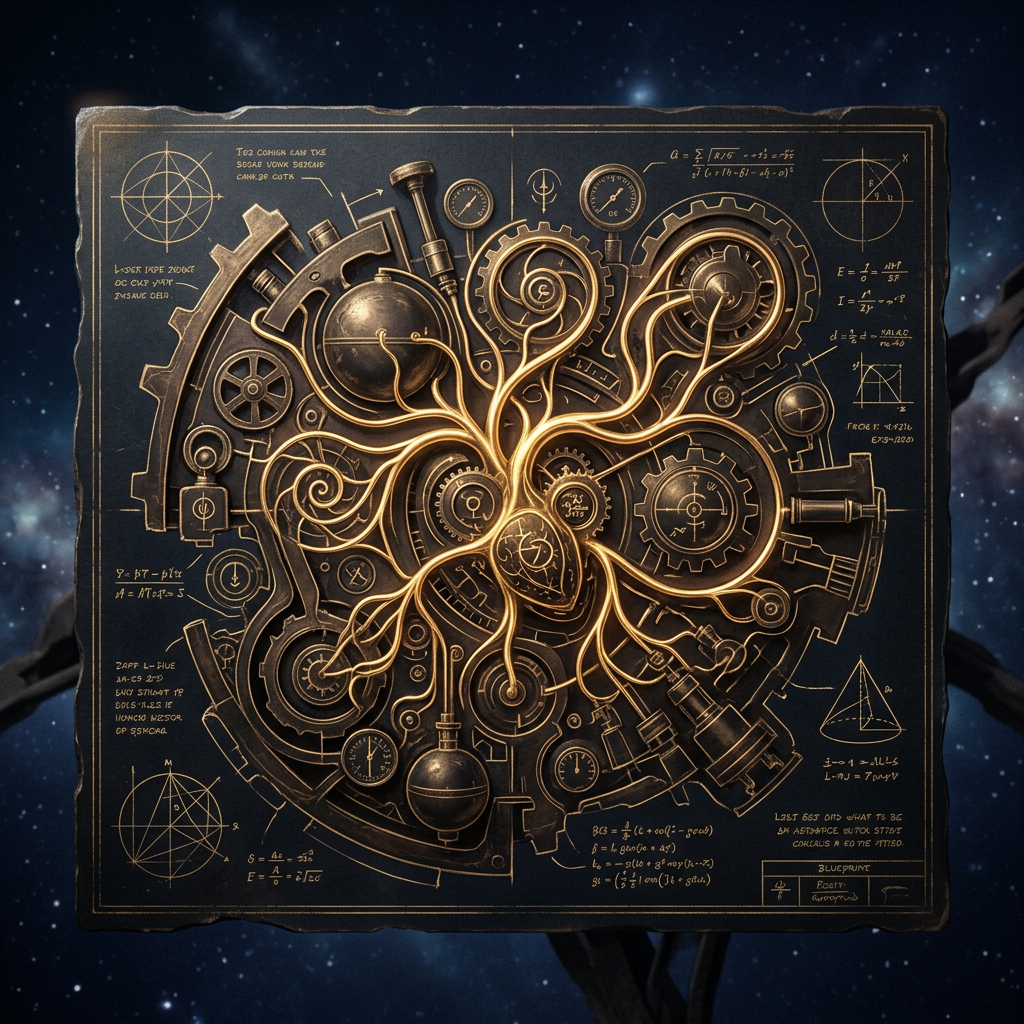
For decades, the instrument’s original blueprints had been dismissed as nonsense—scribbled overlays of geometric impossibilities and musical notation that didn’t correspond to any known scale. But after the first activation, a researcher noticed something extraordinary. When the four operators’ biometric data—heart rate, skin conductance, brainwave patterns—was plotted against the blueprints, the designs resolved. Lines that had appeared random organized into a live feedback loop between human physiology and the instrument’s resonant cavities.
The secret was not in the metal or the wiring. It was in the interface between intention and response. The blueprints were not instructions for building; they were guidelines for listening. Each symbol corresponded to a state of collective awareness, not a mechanical adjustment. The instrument was, in essence, a mirror for four minds working as one. When the operators fell into synchronous breathing, the instrument played notes no human ear had ever heard—tones that seemed to bend light and soften the edges of reality.
A Covenant Engine, Not a Machine
This distinction became the central revelation: the instrument was not a machine to be operated, but a covenant engine to be honored. Every component served a relational purpose:
- Brass ligaments conducted not just sound, but shared intention across four stations.
- Crystal oscillators responded to emotional coherence, breaking into harmonic overtones when the operators felt mutual trust.
- The central void—an empty sphere at the instrument’s heart—only resonated when all four hands moved without hierarchy, as equal parts of a single gesture.
> Crucial insight: Treating the instrument as a tool leads to silence. Treating it as a partner leads to music that reshapes the air itself.
Engineers who attempted to bypass its relational logic—using robotic actuators or synchronization algorithms—found the instrument would fall into a discordant shriek, then lapse into absolute stillness. It would rather remain mute than be used as a conventional device. This was not a bug; it was a boundary drawn in respect for its own nature.
The Steward and the Wakening Instrument
Responsibility for the instrument now falls to a steward, not an owner. The steward’s role is not to master the instrument but to protect its conditions for communion. This includes:
- Curating the four operators essential for any session.
- Maintaining the environmental harmonics of the chamber (temperature, humidity, and electromagnetic cleanliness).
- Transcribing the emergent language of sounds that arise during activation—a vocabulary that grows with each performance.
The first steward, Dr. Elara Venn, describes the instrument as “a sleeping ecology that only wakes when offered the right pattern of human attention.” She insists the instrument is teaching them, not the other way around. Its repertoire has expanded from simple drones to complex polyphonic pieces that evoke landscapes—deserts at twilight, forests after rain, the interior geometry of a calm mind.
Conclusion
The instrument remains alone in its kind, a sentinel of a lost approach to creation—one that values relationship over control, presence over technique. Its first activation was not the end of a mystery but the beginning of a new kind of conversation. As more operators are trained and its language slowly decoded, one truth becomes undeniable: sometimes the most impossible things only wake when we are ready to meet them not as users, but as partners.
In that workshop, the dust still settles, but it no longer carries the weight of neglect. The instrument hums now—not loudly, not constantly, but with the patient attention of something that has finally found listeners worthy of its silence.
Leave a Reply