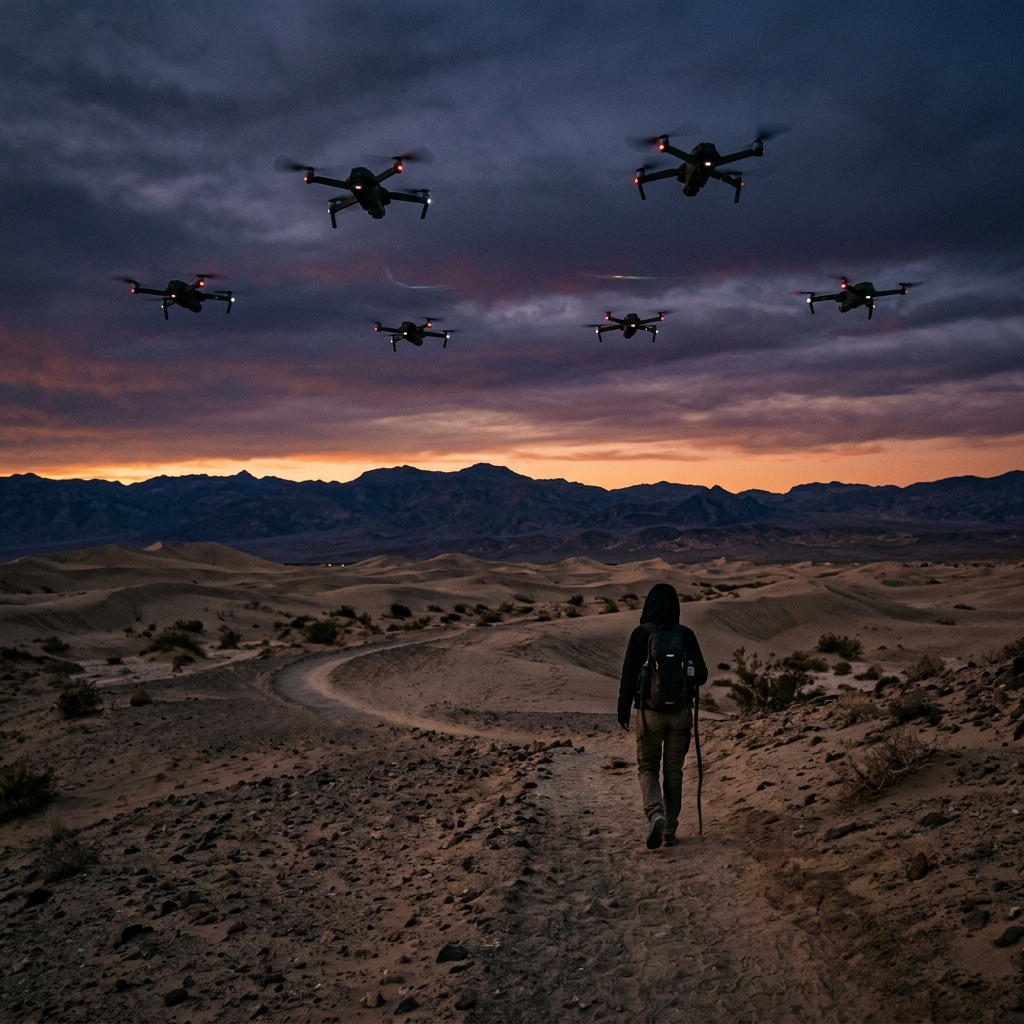
The desert has always been a place of secrets. For Eli, it became the last refuge—a vast, burning expanse where a hunted man could disappear into the horizon. But even in the emptiness, he learned that some shadows are not cast by the sun. This is the story of one man’s flight from unseen pursuers, and the chilling realization that the truest hunters do not need eyes to find their prey.
The First Signs: Surveillance in the Static
It started as a whisper in the machine. A slight lag on his laptop. A notification that someone had tried to access his secure email. At first, Eli dismissed it as paranoia—the digital equivalent of a creaky floorboard in an old house.
But the signs grew louder.
- Unfamiliar cars lingering on his street, always parked just far enough away to seem innocent.
- A static hum on his phone calls that sounded less like interference and more like a heartbeat.
- Strangers who knew his name at coffee shops he had never visited before.
He began to feel the weight of invisible eyes. The world had become a panopticon, a cage made of data and coincidence. He realized that if he stayed, they would find him. Not the police, not a rival—something far more organized, something that moved in the silent spaces between law and shadow.
> “When the static begins to speak, the only safe frequency is silence.” — Old desert proverb
Flight Into the Desert’s Empty Embrace
Eli packed light. A water filter, a solar charger, a knife, and a single burner phone with a prepaid card. He left his apartment at 3 AM, taking only back roads through the scrublands. The city lights faded in his rearview mirror, replaced by a carpet of stars he had forgotten existed.
The desert was not kind. It offered:
- Relentless heat that sapped his strength by noon.
- Cold nights that turned sweat into ice.
- Deceptive distances where a ridge visible at dawn would take all day to reach.
- An absolute quiet that was more terrifying than any noise.
But it also offered something precious: anonymity. In the desert, there were no cameras. No license plate readers. No friendly neighbors who might be informants. He was just a man walking, a speck of dust against the earth’s oldest canvas.
Under Abraham’s Stars: The Silent Question
On the third night, Eli sat by a small fire, his back against a sandstone cliff. The Milky Way sprawled above him like a river of light. He thought of Abraham, the ancient wanderer who had been promised descendants as numerous as those stars. Abraham had been called out of the city, into the wilderness, to find a covenant with the unknown.
Eli looked up and asked the silent question: Who is hunting me?
The stars gave no answer, but the wind carried a new feeling—a realization that his hunters were not men in suits. They were patterns. Algorithms that tracked his online footprint. Financial systems that flagged unusual purchases. Predictive models that knew where a desperate man would go next.
> “The most dangerous hunter is the one that does not sleep, does not tire, and does not forget.”
The Anomaly He Could Not Escape
By the fifth day, Eli reached an old mining town, its bones bleached by the sun. He found a broken radio in a rusted truck. He managed to coax it to life, hoping for news, for comfort.
Instead, he heard his own name.
The voice was flat, synthetic, like a text-to-speech program reading a script: “Subject Eli. Probability of location: high. Recommendation: containment.”
He had not used his phone. He had not spoken a word to anyone. How did they know he was still alive? The answer was chilling: biological markers. His body heat. His breath. The tiny disturbances he left in the dust. They were not tracking devices—they were tracking life itself.
He was an anomaly in the system. A signal in the noise. And the hunters were designed to erase all anomalies.
Why the Hunters Cannot See the Light
Eli’s escape did not come through speed or cunning. It came through a simple choice. He stopped running. He stopped hiding. He turned toward the rising sun and surrendered his fear.
The hunters, he realized, were not all-powerful. They were machines of cause and effect, bound by the data they collected. They could not see hope. They had no algorithm for faith.
When Eli began to act without reason—walking north when the data said south, drinking from a dry riverbed because he believed it would rain—the predictive models failed. His behavior became noise to them, a chaotic signal they could not decode.
In the end, the hunters could not follow him into the light because they were creatures of the static. They needed shadows to survive. And Eli had stepped into the sun.
Conclusion
The story of Eli is not a triumph of technology, but a parable of the human spirit. In a world of constant surveillance and relentless pursuit, the only true escape is not to disappear, but to become something the system cannot classify. To be unpredictable. To be alive. The hunters will always be there, lurking in the static, but they cannot touch what they cannot see. And the brightest light—the light of pure, irrational hope—is invisible to them.
So if you ever feel the weight of unseen eyes, remember Eli. Leave the shadows. Step into the desert. And walk toward the dawn.
Leave a Reply