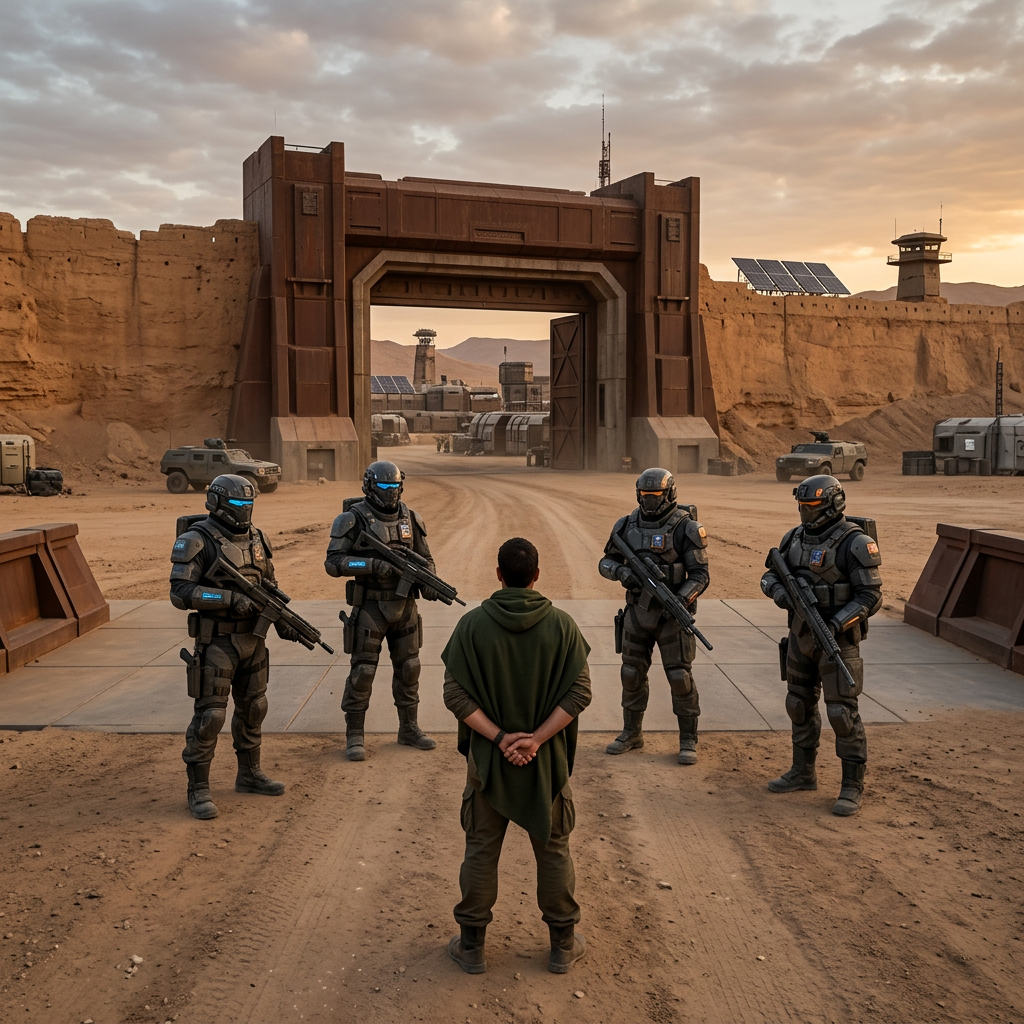
The Desert Haven’s Last Stand Begins
The sun bled across the dunes like a wound healing over, painting the adobe walls of Desert Haven in shades of amber and rust. To the few hundred souls who called this place home, it was just another evening in a remote sanctuary carved from the unforgiving sands. But the quiet was a lie. For weeks, the Controllers—a shadowy consortium that governed the “civilized” regions beyond the Great Erg—had been tightening their grip on the settlement. They claimed it was for “resource reclamation,” but everyone knew the truth: Desert Haven sat atop a vast, untapped reservoir of a rare mineral known as Sylvex, essential for the energy grids of the northern cities.
The people of the Haven were desert dwellers, engineers of the harsh landscape. They practiced baraka, a form of cooperative resilience where every structure, every well, every solar still was shared. The Controllers saw only a resource-rich outpost populated by stubborn squatters. Diplomacy had failed. Ultimatums had been ignored. Now, the siege was set to begin.
At Dusk, the Controllers Closed In
It began not with a roar, but with a sigh. At exactly 6:13 PM, a caravan of armored ground-runners crested the eastern ridge, their engines so silent they seemed to glide on the sand. Each vehicle bore the Controllers’ sigil—a broken gear entwined with a laurel—painted in sterile white. The settlers gathered at the central square, their faces a mixture of fear and defiance.
The Controllers deployed in a perfect semicircle, a half-moon of cold steel around the ramshackle gates of the settlement. From the lead vehicle emerged a woman in a jet-black uniform, her name tag reading Commander Rael. She raised a loudspeaker and spoke in a voice that cut through the wind:
> “By decree of the High Council, Desert Haven is hereby under enforced administration. You have one hour to evacuate nonviolent personnel. Resistance will be met with measured force.”
There was no bluster, no threat of annihilation. Just a cold, bureaucratic promise of controlled destruction. The settlers looked to one another. Their water stores were low. Their weapons were scavenged and ancient. But their spirit was forged in the crucible of the desert.
Eli’s Unarmed Defiance at the Gate
Eli was not a warrior. He was the settlement’s waterkeeper, a man of fifty-three years with gnarled hands and eyes the color of dry earth. He wore a simple white thobe and carried a wooden staff that had once been a tent pole. As Commander Rael’s ultimatum echoed, Eli walked to the gate—slowly, deliberately—and stood before it.
He did not speak. He did not raise his fists. He simply planted his staff in the sand and stood there, a solitary figure against the line of armored vehicles. Someone in the crowd gasped. A child began to cry. But Eli remained still, his face a mask of quiet resolve.
This was the moment the Controllers had not prepared for. They had tactics for barricades, for drones, for negotiations. But how do you counter an unarmed man who refuses to be intimidated? A junior officer whispered to Rael, but she waved him off. She had seen this before—a grand gesture that would crumble the moment the sun dipped below the horizon.
The Instrument’s Pulse That Changed Everything
But Eli was not done. From beneath his thobe, he withdrew a small device—no larger than a pocket watch—crafted from brass and crystal. It was an ancient Sylvex harmonizer, a relic from the time before the Controllers, when the desert tribes used the mineral’s resonant frequencies to heal and communicate. He held it aloft, and with a twist of its outer ring, it began to hum.
The sound was not loud, but it was pervasive. It vibrated through the sand, through the walls, through the very bones of every person present. The Controllers’ vehicles flickered. Their communication arrays sputtered. The harmonizer wasn’t a weapon of destruction; it was a weapon of interference.
In moments, the Controllers’ advanced systems were rendered useless. Their targeting lasers went dark. Their encrypted networks dissolved into static. Commander Rael shouted orders, but her men could only stare at their dead consoles. The instrument’s pulse was a song of the old world, a frequency that the sleek machinery of the new world could not comprehend.
Eli spoke for the first time, his voice calm and clear:
> “You came for our resources, but you cannot take what you cannot find. This device disrupts your mapping of our settlement, your ability to coordinate, your visibility. You see a shantytown. We see a sanctuary that works with the land, not against it. You cannot siege what you cannot see.”
A Siege Won Without a Single Shot
The standoff lasted four hours. The Controllers attempted to manually override their systems, to re-establish communication with their command center. Nothing worked. Every time a signal was attempted, the harmonizer’s pulse warped it into gibberish. Meanwhile, the settlers began to emerge from their homes, not with weapons, but with lanterns and food. They set up a communal meal just inside the gate, the aroma of spiced lentils and flatbread drifting toward the stranded Controllers.
Commander Rael faced an impossible choice: remain in the dark, with dwindling supplies and no tactical advantage, or retreat and face the humiliation of an unfought defeat. She chose the latter. At 10:07 PM, she gave the order to withdraw. The ground-runners turned and disappeared into the night, their headlights small and pathetic against the vast desert.
The Desert Haven had not won a battle. They had won a demonstration—a proof that sometimes the strongest weapon is not the one that destroys, but the one that refuses to play the adversary’s game.
Conclusion
The Siege of Desert Haven was a small affair in the grand history of the Controllers’ expansion, but it became a legend whispered through the dunes. It taught a simple truth: that power does not always come from guns or numbers, but from a deep understanding of the land, the people, and the subtle energies that bind them together. Eli’s harmonizer was eventually replicated, and other outposts adopted the technology. The Controllers never returned to Desert Haven, and by the time they did, ten years later, it was as a trade partner, not a conqueror. The siege that began a war ended it before the first shot was even fired.
Leave a Reply