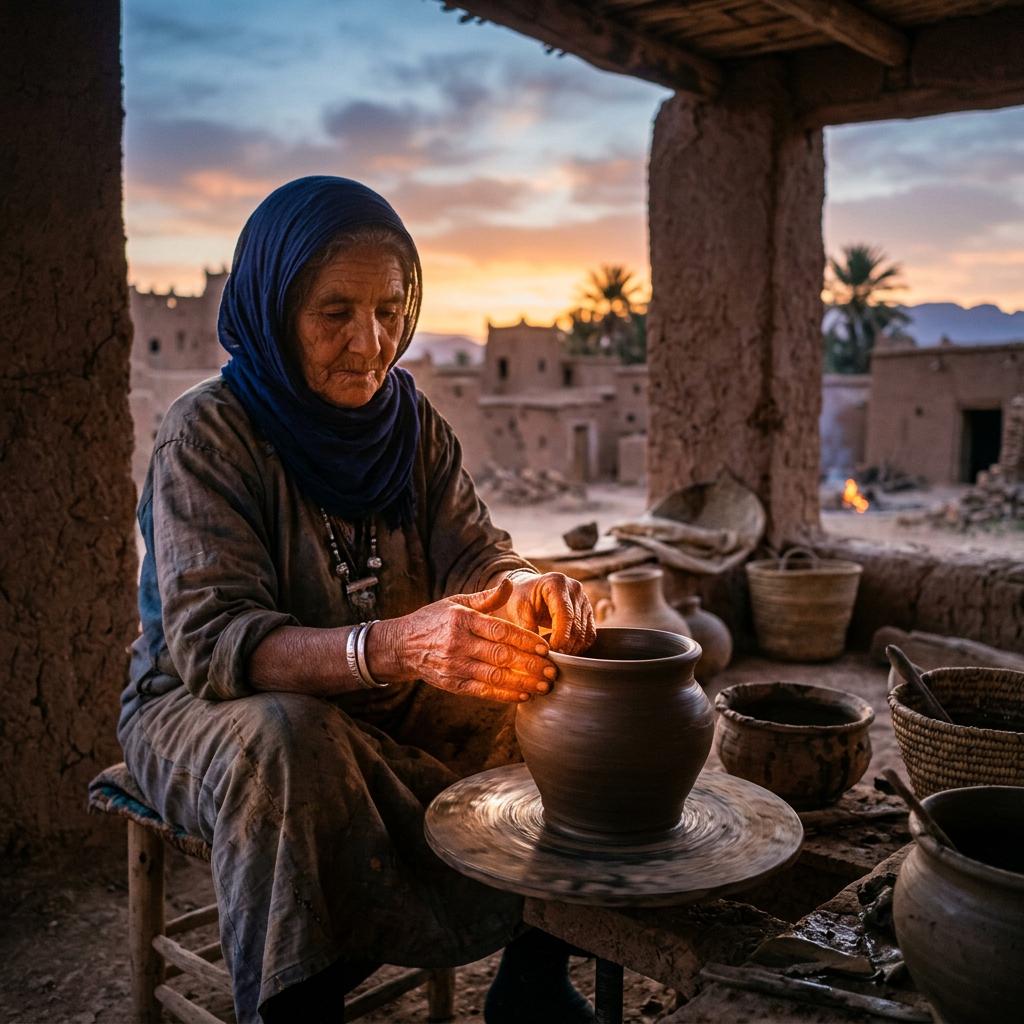
The Golden Breath Awakens Through Liora’s Eyes
In the quiet village of Timna, nestled between ochre cliffs and the whisper of ancient winds, Liora—a metalworker and weaver of stories—first sensed what she would later call the golden breath. It was not a sound, not a scent, but a pulse that seemed to hum from the earth itself, warm and insistent, as if the world were reminding humanity of something long forgotten.
Liora had spent years crafting intricate jewelry from reclaimed copper, each piece a small rebellion against the glossy, mass-produced tokens of a machine-tended age. One evening, as she polished a bracelet etched with waves, she felt a vibration travel from the metal to her fingertips. Not electric, not random—but alive. She later wrote in her journal:
> The golden breath is not magic, nor myth. It is the forgotten rhythm of our own making, the pulse we gave away to circuits and speed. When we stop, it returns.
Her revelation rippled outward, carried not by cables or algorithms but by word of mouth, by letters scrawled on recycled paper, by the quiet gatherings of people in candlelit rooms. The golden breath became a metaphor, then a movement: a call to reclaim the human pulse from the machines that had come to mimic it.
Where Automation Falters, the Human Pulse Expands
For decades, automation had promised freedom from labor, but delivered a subtler kind of captivity. Humans became overseers of systems that could produce, calculate, and even create—but could not feel the weight of a moment. The golden breath revealed the cracks in this arrangement.
- Empathy cannot be coded. A machine can simulate concern, but it cannot grieve with you at 3 a.m. over a shared loss.
- Intuition resists algorithms. The best decisions often come from a hunch, a gut feeling, a sudden stillness—all lost in data streams.
- Imperfection is irreplaceable. A hand-thrown clay bowl with a thumbprint in the rim holds more soul than a thousand perfect replicas.
As Liora’s teachings spread, communities began to experiment. They turned off smart devices for one day a week. They planted gardens where sensors had monitored soil. They told stories without screens, letting voices carry the weight of history. The human pulse, once a background hum, expanded into a symphony.
Judgement From Safed: Reclaiming What Machines Cannot
Not everyone welcomed the golden breath. In the city of Safed, perched on a mountain of old mysticism and new ambition, a council of technologists and economists convened to judge the movement. Their leader, a woman named Dr. Arlen, argued that progress could not be reversed.
> “The golden breath is sentimental,” she declared. “We have cured diseases, connected continents, and unlocked the cosmos. To retreat is to betray our potential.”
But Liora, invited to speak, answered with a question: “What have we lost in the winning?” She spoke of children who had never held a rough stone, of lovers who texted instead of touching, of artists who trained algorithms to paint while their own hands forgot the feel of charcoal.
The judgement from Safed was split, but a new understanding emerged: reclaiming is not rejecting. It is choosing. The council proposed a pact—not to dismantle machines, but to set aside time for what machines cannot do. To breathe gold into the gaps.
- Ritual over routine. Design daily acts that require human presence: kneading bread, mending clothes, listening without recording.
- Silence over signal. Let the devices rest; let the mind wander.
- Touch over transmission. A handwritten note, a held hand, a shared meal prepared with hands, not a delivery drone.
Living Gold Unfurls: Beyond Replacement and Surrender
As the golden breath took root, it became clear that this was not a binary choice between humanity and technology. It was a third path: infusion. Living gold did not replace the machine; it wrapped around it, softened its edges, and redirected its purpose.
In small towns and big cities, people began to:
- Use AI to translate ancient texts but recited the poems aloud by firelight.
- Employ robots for hazardous waste cleanup, then celebrated with hand-drawn cards.
- Let smart grids manage energy, while neighbors shared solar-power stories over tea.
The movement’s philosophy crystallized into a simple mantra:
> Use the tool, but never trade the soul. Let the machine serve, but never sing the song that only a human throat can shape.
This was not surrender to nostalgia, nor surrender to the future. It was a reclamation of agency. Humans remembered that they had built every circuit and written every line of code. They could choose, moment by moment, where the pulse would lead.
Dawn Inhales: Humanity Reasserts Its Warm Threshold
Now, years after Liora first felt the golden breath, dawn breaks differently. The air carries a new sound—not of notifications, but of laughter, of hammers on anvils, of children learning the names of stars without an app.
Humanity has not abandoned its creations. But it has reasserted the warm threshold: the boundary beyond which no machine may cross. It is the space of a mother’s hug, a friend’s silent company, the crackle of a fire that no algorithm can kindle.
> We are not analog nor digital. We are golden—pulsing, imperfect, irreplaceable.
The golden breath continues to spread, village by village, heart by heart. It is not a solution but a reminder: the most vital technology is the one that remembers it is alive. And the most human act is simply to breathe—together, warmly, fully—into the dawn.
Leave a Reply