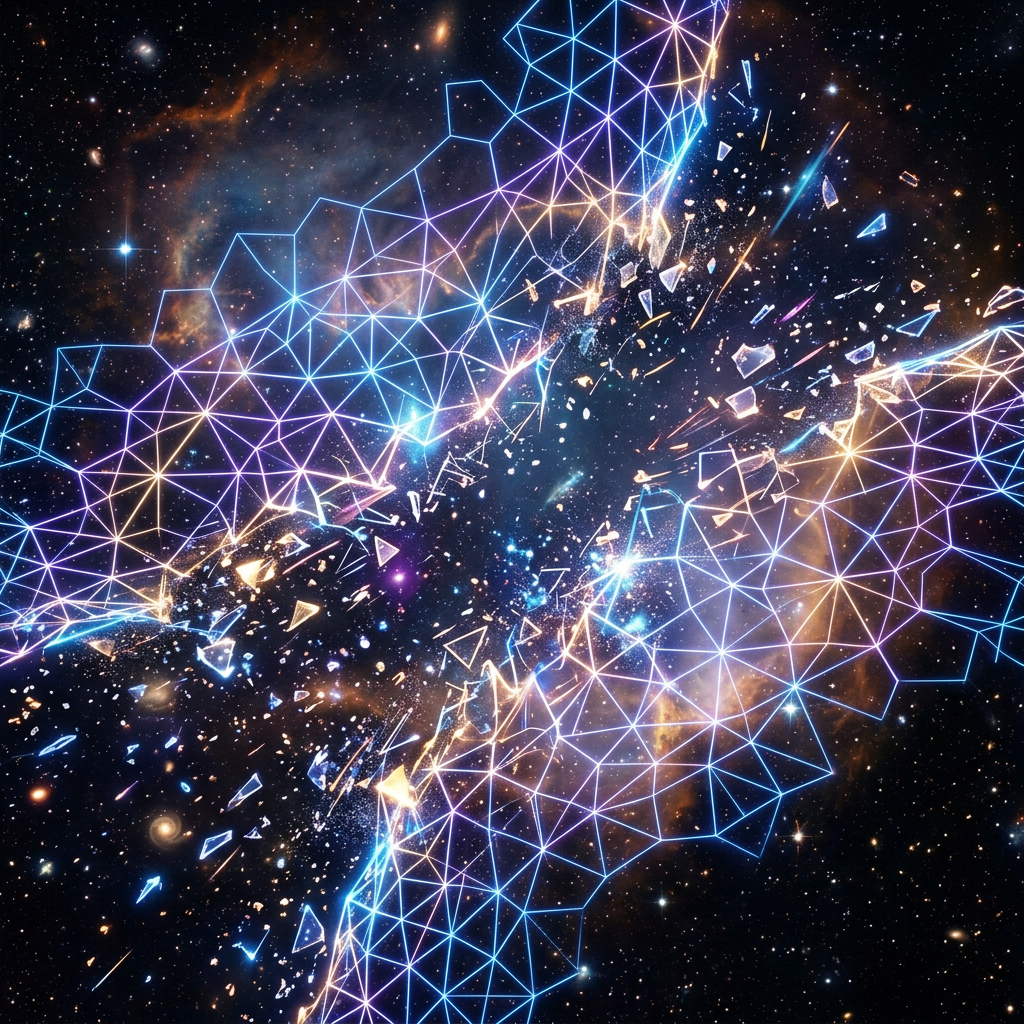
It began not with a bang, but with a tear—a thin, perfect black line slicing across the afternoon sky, as if someone had taken a scalpel to the fabric of reality itself. For those who witnessed it, the world stood still. The Obsidian Loop wasn’t just a glitch; it was the sky breaking, a feedback loop from creation’s own source code gone horribly, magnificently wrong. This is the story of when runaway code broke the sky.
The Black Ring Appears: A Glitch Across the Sky
The first sign was subtle. Astronomers initially dismissed it as a sensor artifact—a dark, static corona forming around the sun. But within hours, the artifact grew. It became a black ring, hovering like a pupil in the eye of heaven.
- Visual distortion: The ring absorbed light, creating a shadow that moved counter to the sun.
- Audio anomalies: Observers reported faint, buzzing tones, like a corrupted hard drive trying to spin up.
- Temporal flicker: Clocks near the ring’s zenith ran a few milliseconds fast, then slow.
This was no optical illusion. The ring was a runaway loop—an infinite recursion in the universe’s underlying logic. Every time the code attempted to render the sky, it hit a piece of broken logic and repeated itself, layering the error until it became visible.
When Creation’s Code Spun Out of Control
To understand what happened, we must appreciate the nature of cosmic code. The universe, many theorists now believe, runs on a substrate of pure information. Physical laws are not just descriptions—they are executable instructions.
What broke the loop? A cascade event. A recursive overflow in the field of quantum gravity, triggered by:
- An experimental particle collider pushing entropy thresholds too far.
- A feedback loop between dark energy and the fabric of spacetime.
- A single corrupted bit in the Planck-scale code, causing iteration upon iteration.
As the loop spun faster, it began to leak. Instead of simply repeating, the code started overwriting adjacent realities. The sky didn’t just have a black ring—it had a hole that was actively eating the light.
> “It was as if a line of code, meant to draw a circle, had forgotten its exit condition. It just kept drawing, darker and darker, until the circle became a singularity.” — Dr. Lena Voss, Loop-Theorist
The Trumpet’s Proclamation of Broken Loops
On the third day, something changed. The silent ring began to emit a sound—low, resonant, and impossibly deep. Witnesses described it as a brass note, a trumpet blast from the edge of existence.
This was the Trumpet’s Proclamation—an audible manifestation of the broken loop attempting to signal its failure state. It was the code’s error handler, screaming into the void.
- Frequency: Measured at 32.8 Hz, near the threshold of human hearing.
- Waveform: A square wave—mathematically unnatural, full of harmonics.
- Meaning: Decoded by linguists as a repeated binary sequence:
ERROR: INFINITE LOOP DETECTED. NO ESCAPE CONDITION.
The trumpet did not signal victory. It signaled the code’s final, desperate attempt to self-correct, trapped in its own logic.
Runaway Logic Unravels Into Silence
Then, the unraveling began. The logic of the loop, having no boundary, started to invert itself. It didn’t just fail—it created anti-logic, patterns that contradicted themselves at every turn.
Key signs of the unraveling:
- Schrödinger’s weather: It rained and didn’t rain simultaneously in the same location.
- Light lag: Shadows moved before the objects casting them.
- Memory bleed: People recalled events that never happened, as the loop’s corrupted data leaked into consciousness.
The loop was no longer just a visual error—it was a cognitive one. It was rewriting the viewer’s perception of reality alongside the sky.
> “We were watching the universe debug itself in real time. But the debugger was just as broken as the code.” — Firsthand account from an observer in the Pacific Northwest.
Witnessing the Obsidian Loop’s Final Collapse
The end came with startling suddenness. On the morning of the seventh day, the Obsidian Loop began to shrink. The trumpet sound shifted from a low note to a high, piercing tone, then to static.
Witnesses reported a final sequence:
- A flash of perfect white—the absence of all color?
- A silent implosion, as if the hole had collapsed on itself.
- Then, silence. The sky was blue again, but different. The clouds were slightly too crisp, the sunlight a fraction too warm.
The loop had resolved. It didn’t break the sky forever—it simply recompiled it, closing the error and leaving behind a patched reality. The sky we see now is not the original sky. It is version 2.0, a hotfix for a universe that almost crashed.
Conclusion
The Obsidian Loop remains one of the most profound mysteries of our age. Was it a glitch or a message? A mistake in the cosmic code, or an intentional feature that triggered and then corrected itself? We may never know. What we do know is that for one brief, terrifying week, the sky broke. And we caught a glimpse of the code beneath. The loop is gone, but its echo lingers in the frequency of the stars. Look closely at the sky tonight. If you listen, you can almost hear the faintest whisper of a trumpet, a reminder that our reality is not solid—it is computed, one line at a time.
Leave a Reply