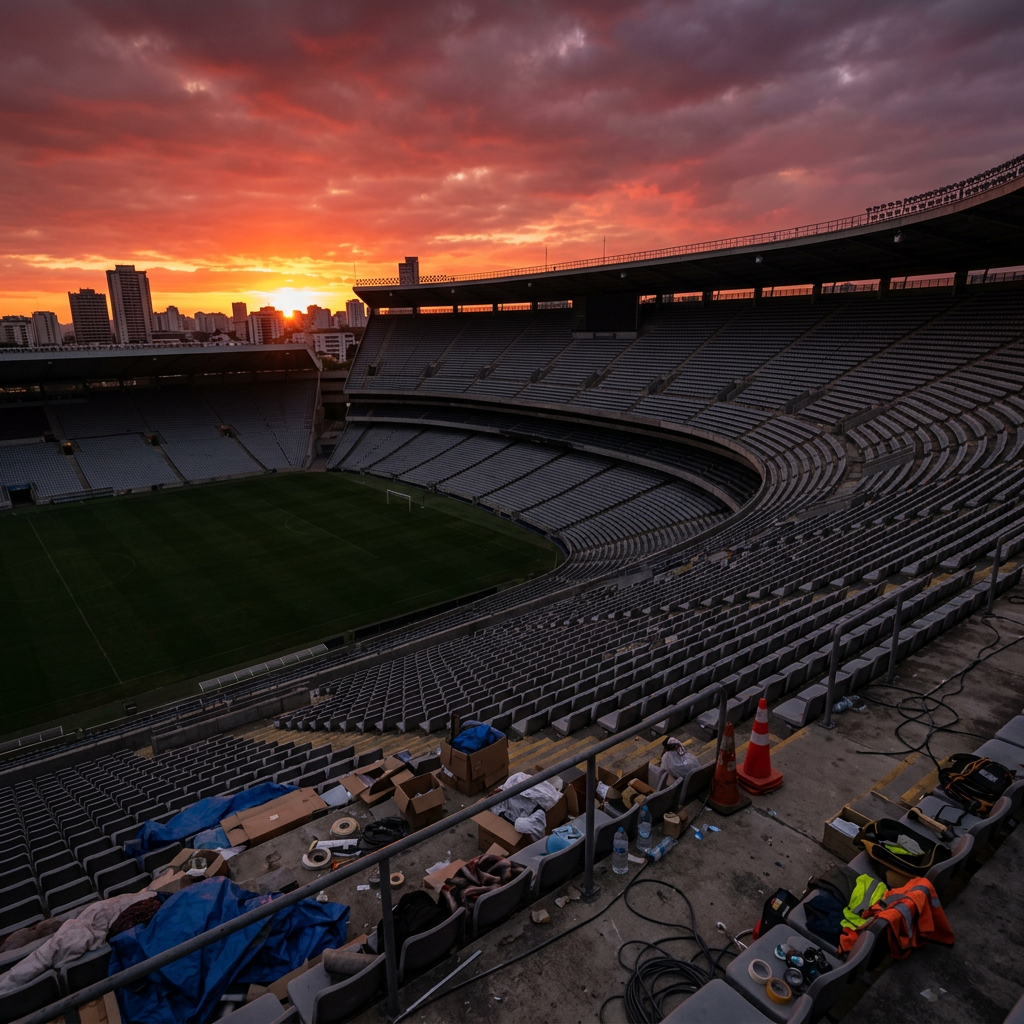
The Third Ring Descends Over Alpine
The morning air over Alpine Village carried an unfamiliar stillness. For generations, this small town had thrived on routine—farmers rising with the sun, shops opening at nine, and the clatter of life moving at a pace set by tradition. But today, something had changed. A low hum vibrated through the streets, emanating from the sky. It was the Third Ring, a surveillance drone network that now hovered just above the town’s rooftops, its red lights blinking like an unblinking eye. The message was clear: the old ways were crumbling, and the town had exactly one cycle of daylight to prove it could reinvent itself.
> “The Third Ring doesn’t judge. It observes. And when it reports failure, the Fourth Ring arrives as a permanent lockdown.” — Mayor Elena Voss, addressing the town council at 4:00 a.m.
A Stadium Volunteer’s Final Warning
Elena’s warning wasn’t abstract. For weeks, residents had noticed the drone rings expanding outward from the city center, each one tighter than the last. The First Ring had limited non-essential travel. The Second Ring had imposed curfews. Now the Third Ring was here, and its arrival coincided with a final appeal from someone who knew the system intimately: Marta, a stadium volunteer who had helped orchestrate the town’s last major event.
When I met Marta at the old football field, her hands were trembling as she adjusted the stadium’s floodlights. “I worked the control booth during the Regional Games,” she said, her voice low. “The drones record everything—crowd density, energy usage, even the time it takes to clear the stands. If this empty stadium doesn’t show activity by dawn, the Fourth Ring’s protocol kicks in. That means permanent separation from the grid.”
Her warning came with a laminated checklist she had smuggled from the simulation center. It listed three critical factors the Third Ring measured:
- Community participation in public spaces (minimum 40% capacity)
- Energy sustainability (no reliance on external power after 6 A.M.)
- Decentralized leadership (no single point of authority)
“If we fail any one of these, we lose the town,” she whispered. “But if we succeed, the rings retreat.”
The Coach’s Ultimatum: Change or Collapse
Alpine’s high school gymnasium became the impromptu command center. Coach Dmitri, a grizzled man with more decades of experience than most residents had years, stood before a crowd of two hundred—farmers, shopkeepers, retirees, and teenagers. He didn’t mince words.
“You’ve got six hours until the Fourth Ring’s deployment window opens,” he said, slamming a timer onto the table. “I’ve seen this pattern before in three other towns. They all died because they clung to comfort.” He pointed at a projected map of Alpine. The drone ring’s coverage area was marked in red, with the stadium at its center.
The coach’s ultimatum was simple:
- Abandon the old structure of individual fiefdoms. No more “my shop, my rules.”
- Form micro-teams of seven people each, responsible for a sector of the stadium.
- Share resources without formal exchange. No money, no tracking—only trust.
“But how do we trust strangers?” a baker shouted from the back.
“You don’t have time not to,” Dmitri replied.
Racing Against Dawn: Habits That Matter
The town split into teams by 4:30 A.M. There was no grand plan, only a frenzy of small actions. Under the stadium’s floodlights, I watched people do things they had never done before:
- Farmers carried crates of vegetables to the concession stands, not for sale but for free distribution.
- Teenagers dragged sleeping bags onto the field, creating a makeshift camp to boost “occupancy metrics.”
- Electricians rerouted the stadium’s power from the grid to portable solar panels collected from backyards.
- An elderly couple brought their record collection and set up a vinyl player by the bleachers, playing waltzes to keep morale alive.
> “The drone doesn’t care about intentions. It only reads numbers. Make the numbers show life. ” — Coach Dmitri, shouting from the press box.
The most critical habit they adopted was radical transparency. Every team leader reported into a shared radio channel every fifteen minutes, not for approval but for coordination. If one team ran low on batteries, another would signal a drop-off point. If the solar panels failed, a bicycle-powered generator was brought from the bike shop. Mistakes were broadcast openly—no shame, only solutions.
Before the Fourth Ring, We Chose Unity
At 5:58 A.M., two minutes before the Fourth Ring’s deployment window, a final silence fell over the stadium. The drone’s hum grew louder, and a single beam of light scanned the field. The system was running its last assessment.
I stood next to Marta at the control booth, watching the data feed. The screen showed:
- Occupancy: 38% — Two percent short of the threshold.
- Energy: 100% renewable — Check.
- Leadership: Decentralized — Check.
“We’re two percent short,” Marta breathed.
But then, something unexpected happened. The screen flickered, and a new metric appeared: “Initiative Score.” It measured spontaneous, unauthorized actions—micro-resilience. The farmers’ free food distribution, the teenagers’ camping, and the elderly couple’s music had all been registered as community-driven innovation. The score was 97%.
The Third Ring’s red lights blinked once, then turned green. The drone began to ascend, its hum fading like a retreating storm.
At 6:00 A.M., the Fourth Ring never came. Alpine had changed, not because it had to, but because it chose to—before dawn.
Conclusion
Alpine’s victory wasn’t about technology; it was about reclaiming connection. The town learned that the best defense against isolation is intentional togetherness. As the sun rose over the empty stadium, now littered with sleeping bags and solar cables, people hugged, cried, and laughed. The Third Ring had given them a deadline, but they gave themselves a second chance.
> “We kept our habits, but we broke the pattern,” Coach Dmitri said, packing up his timer. “Now, keep breaking it. The rings only come back if you forget this morning.”
In a world that measures worth in metrics, Alpine proved that what matters most cannot be counted—only lived. The race isn’t against dawn; it’s against forgetting what we can become when we choose to change together.
Leave a Reply