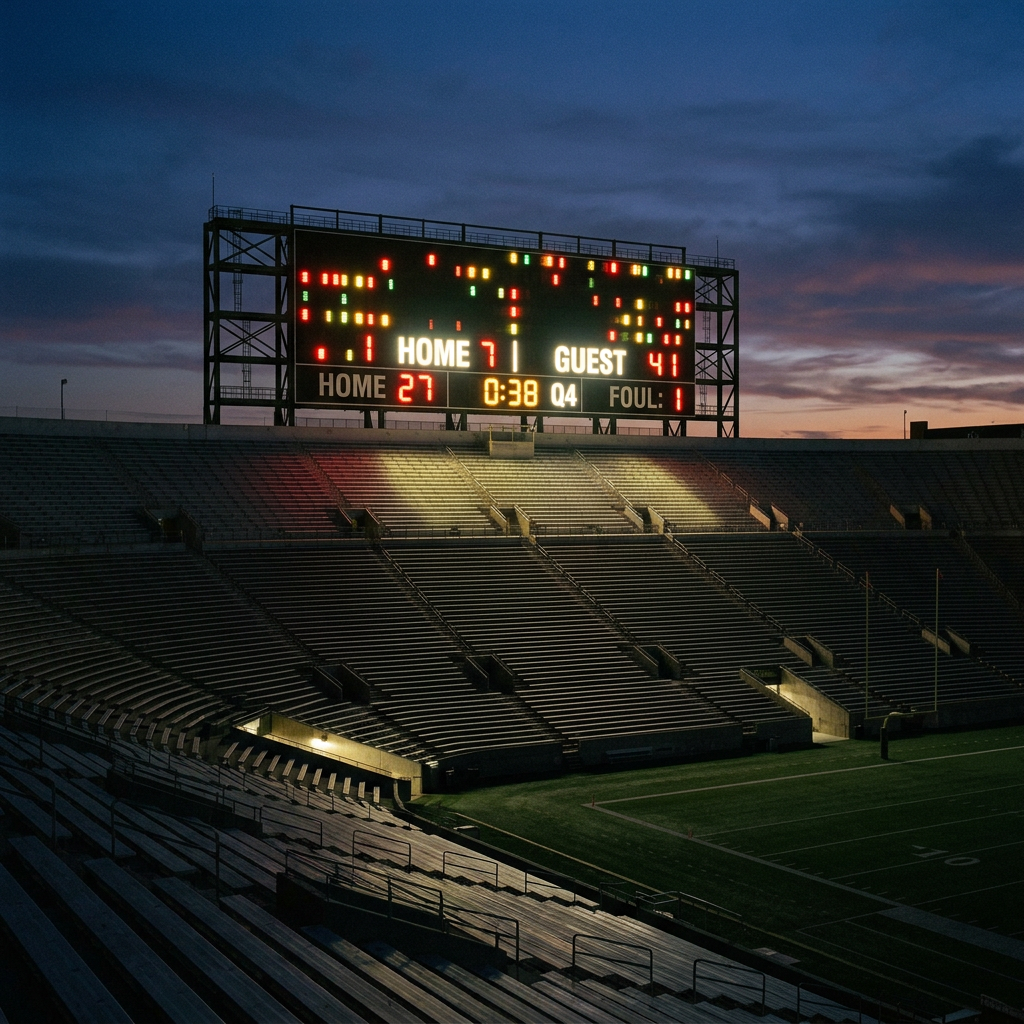
The Scoreboard Flashed Our Town’s Number
It began as a joke on a Friday afternoon. The high school’s football scoreboard, a towering fixture at the edge of the field, had long displayed three numbers: the home team’s score, the visitor’s score, and, in a smaller digital window at the bottom, the town’s official population count. For years, that number—6,843—sat steady, a static fact of life. No one thought much about it; it was just part of the scoreboard’s charm, like the weathered paint on the bleachers.
But then something strange happened. During a routine junior varsity game, the number flickered. A few parents in the stands murmured, pointing. The next morning, it had dropped to 6,840. The scoreboard, it seemed, was broadcasting a slow, silent countdown of our own community.
How a Glitch Revealed Our Civic Pulse
At first, everyone assumed it was a technical glitch. The maintenance supervisor, Mr. Delgado, spent two days climbing the ladder with a voltmeter, checking connections and replacing circuit boards. He found nothing wrong. Yet the number continued to fall, losing one digit every few days. The town’s official population remained unchanged in the city hall records, but the scoreboard told a different story.
We started paying attention. The number became a town-wide conversation. It forced us to consider what we already knew but rarely spoke about:
- Young families were moving to the suburbs for better schools.
- Retirees were relocating to warmer climates.
- College graduates weren’t coming back after graduation.
The scoreboard’s glitch made these invisible departures visible. It turned our abstract anxiety into a literal, blinking countdown. And for the first time, we understood that a town’s pulse isn’t just about who lives there, but about who chooses to stay.
Watching the Population Count Tick Down
The decline was slow but relentless. We created a community watch for the scoreboard. Local teenagers, usually fixated on their phones, began posting daily updates on social media: “It’s down to 6,821 today.” The coffee shop owner printed the current number on his chalkboard. The librarian added it to the daily announcements.
It became a strange kind of entertainment, like tracking stock market losses or rooting for a losing team. People gathered at the town square just to stare at the blinking digits. Some found it morbid. Others found it liberating.
> “It’s like watching sand through an hourglass,” said Mrs. Hargrove, who had lived in town for sixty years. “Only this time, we’re the sand.”
But the number wasn’t just about losses. It also reflected the quiet celebrations that went unnoticed: a new baby born at the county hospital, a couple moving in from the city. We just didn’t see those as clearly.
We Trained to Slow the Falling Numbers
The turning point came when the count hit 6,800. The high school principal, Mr. Torres, called an emergency meeting. He didn’t talk about budget cuts or test scores. He talked about civic survival.
We formed a Population Preservation Committee. The name was intentionally dramatic. Our goal wasn’t just to stop the countdown—it was to reverse it. Here’s what we started doing:
- Start a business incubator: We converted an empty downtown storefront into a co-working space for remote workers and small startups.
- Host monthly “Welcome Home” events: Every new resident got a welcome basket with coupons from local shops and a handwritten note from a neighbor.
- Invest in high-speed internet: We petitioned the county to run fiber optic cables, making the town more attractive for telecommuters.
- Launch a “Stay and Play” campaign: Local businesses offered discounts for residents who participated in town events, from library book clubs to Sunday farmers’ markets.
- Create a mentorship program: Retirees paired with young families to share skills like gardening, woodworking, and financial planning—turning our older population into an asset rather than an expense.
The school even turned the scoreboard into a learning tool. The math class analyzed the rate of decline. The civics class debated economic incentives. The art class painted a mural around the scoreboard’s base, turning it into a community canvas that celebrated local history.
> The most important tip we learned: A town doesn’t grow from recruitment alone—it grows from retention. You have to make people want to stay, not just persuade them to show up.
The Day We Raced to Keep the Count Above Zero
That summer, the numbers finally stabilized. Then, one Tuesday in August, something unprecedented happened. The scoreboard flickered again, but this time the number increased. A family of four had moved into the renovated Victorian house on Elm Street. The count jumped to 6,801.
People cheered in the streets. The bakery gave away free doughnuts. The fire truck blared its siren, and for five glorious minutes, the town felt like it had just won a championship.
But the real race wasn’t over. A few weeks later, a major employer in the neighboring city announced layoffs, and our town braced for an exodus. The scoreboard number dipped again—down to 6,785. We realized we couldn’t control the economy or the weather or the whims of developers.
What we could control was how we responded to each other. The committee didn’t panic. Instead, they organized a job fair and a skill-sharing workshop. People opened their homes to families who had to downsize. The local diner offered free meals to anyone who had lost their job.
The scoreboard number kept bouncing, sometimes up, sometimes down. But we stopped obsessing over the exact count. We realized that our town’s true population wasn’t a number on a scoreboard—it was the sum of our connections.
Conclusion
In the end, the scoreboard’s glitch taught us something profound. A town isn’t a static number. It’s a living, breathing organism that grows and shrinks based on the decisions we make every day. The population count became our civic heartbeat, visible to all, reminding us that a community is only as strong as the effort we invest in it.
The scoreboard still stands at the edge of the football field, its numbers flickering between 6,790 and 6,810. No one has fixed the glitch—and honestly, no one wants to. It’s become our town’s greatest monument, not to victory or defeat, but to the simple, powerful truth that every number has a story, and every resident counts.
Leave a Reply