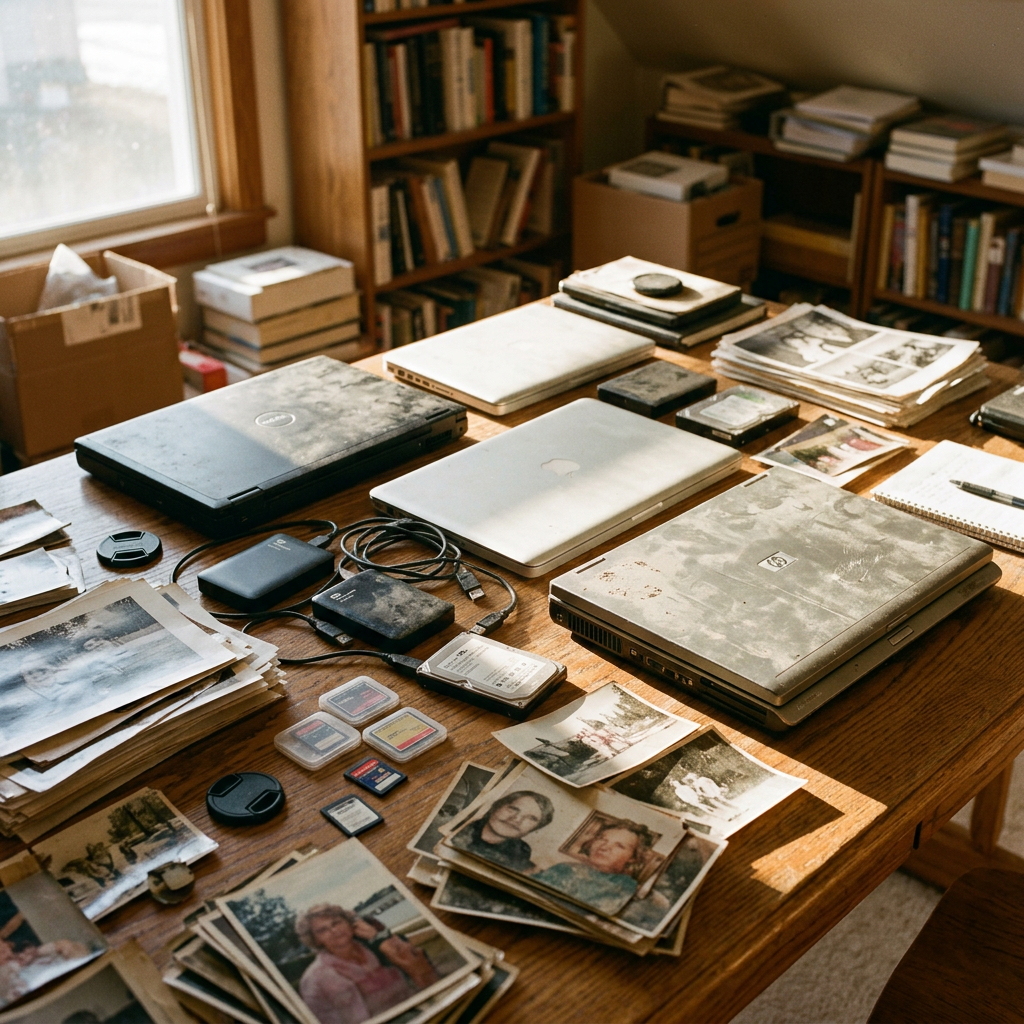
The Erasure That Brought Everything Home
It began without warning. On a crisp Tuesday morning, notifications pinged across the globe—not with alarms, but with silence. The global cloud infrastructure, the invisible scaffold holding our digital lives, had vanished. Every photo, every document, every playlist lovingly synced to servers in distant data centers—gone. For the first few hours, confusion reigned. People refreshed browsers, rebooted routers, and swore at their screens. But as the hours stretched into a day, a strange realization began to dawn: we had been living inside a borrowed memory.
The internet didn’t break. Websites still loaded, emails still sent. But the personal cloud—that place where we had entrusted our birthday videos, vacation snapshots, and love letters—had simply evaporated. The data centers stood dark, their blinking lights extinguished. It wasn’t hacking or a solar flare. It was, as engineers later called it, a massive, unrecoverable memory decay in the core storage algorithms. The cloud, it turned out, had forgotten us.
When the Cloud Poured Back Into Our Lives
Then came the second wave. Twenty-four hours after the erasure, people began finding their lost files again—not online, but in the most unexpected places. An old laptop, buried in a closet, suddenly booted up and displayed a decade-old photo album. A forgotten USB drive, tucked inside a dusty book, revealed a wedding video thought lost forever. External hard drives, once considered obsolete, were dusted off and found to contain entire archives of family history.
> “My grandmother’s voice—I thought I’d never hear it again. It was on a CD-R in a shoebox under my bed.” — A user’s testimonial from the recovery forums.
The world experienced a collective unearthing of its own digital archaeology. Tips for locating files began spreading like wildfire:
- Check old laptop hard drives that were never wiped, especially those from 2010–2015.
- Look inside abandoned dresser drawers for thumb drives and memory cards.
- Inspect external backup drives you may have labeled “junk.”
- Search through email attachments still stored locally in mail clients.
- Ask relatives if they have desktop computers that were never connected to the cloud.
This wasn’t a restoration; it was a physical retrieval of the digital past.
A World Without Digital Storage: First Reactions
The initial panic was palpable. Social media exploded with frantic posts: “Anyone have my wedding photos?” “Does someone still have my thesis from 2017?” But soon, the tone shifted. A strange relief began to seep through the surface. Without the cloud, people started talking to each other. Phone calls replaced message notifications. Neighbors knocked on doors to share USB drives. Physical sharing became a necessity, then a joy.
People discovered that their memories had not been destroyed—they had simply been relocated from the ethereal to the tangible. The irony was rich: we had spent years migrating our lives to the cloud for safety and convenience, only to find our most precious items had been right under our noses all along.
The first 48 hours brought a series of revelations:
- Local backups that had been ignored for years were suddenly goldmines.
- Printed photographs regained their sentimental value, as people realized physical copies could never be erased by a server crash.
- Old phones—the ones sitting in junk drawers—were now prized personal archives.
- Community libraries and local computer clubs turned into retrieval hubs, where people taught each other how to scan and extract data from obsolete formats.
> Tip: Always keep a local copy of irreplaceable files—on a physical drive labeled with the date and contents. The cloud is a convenience, not a vault.
Rediscovering Lost Files From Forgotten Machines
The search turned personal. I remember pulling out a Windows 98 laptop from 2002, its battery swollen, its screen cracked. But the hard drive still spun. After hours of coaxing, I found home videos of my sister’s first steps—files I had uploaded to a cloud service in 2010 and never thought to keep locally. They were pixelated, slightly corrupted, but they existed. The feeling was indescribable.
Others shared similar stories:
- A journalist found the only draft of her unpublished novel on a floppy disk inside a storage unit.
- A musician recovered master recordings of his early band from a zip drive labeled “Tax Returns 1999.”
- A family discovered a hundred-year-old audio reel of their great-grandfather’s voice, digitized decades ago and then forgotten.
The process of recovery became a cultural movement. People created memory maps—lists of every device they had ever owned, cross-referenced with what might still be inside. Hard drives were extracted from printers, game consoles, and even old GPS units. Data recovery software saw a renaissance. Engineers, hobbyists, and data hoarders became heroes, sharing free tools and tutorials.
> Important: Do not attempt to recover data yourself if you suspect hardware damage. Seek professional help to avoid permanent loss.
The New Dawn of Personal Memory Ownership
In the aftermath, a profound shift occurred in how we thought about our digital lives. The cloud’s failure taught us a lesson no amount of marketing ever could: memory is not a service you rent; it is a treasure you steward. People began adopting what experts called the “three-location rule” —one original device, one external backup, and one physical archive (like a printed photo or a DVD).
Digital hoarding was replaced by intentional preservation. We became curators, not collectors. Families sat together, labeling drives with names and dates. Communities founded local memory banks—physical spaces where people could store backup drives in fireproof safes, accessible to each other.
The cloud returned eventually, rebuilt with more transparency and decentralization. But we no longer trusted it blindly. Our relationship with digital storage had matured. We learned that the most reliable server is your own home.
> Quote from a recovery volunteer: “We didn’t lose our memories. We just forgot where they lived. The cloud was never the home—it was just a window. The files were always inside your walls.”
Conclusion
The day the cloud returned our memories was not a day of catastrophe, but of rediscovery. It forced us to look away from the screen and into our own spaces—our closets, our drawers, our attics. We found that the past is not as fragile as we feared. It lingers in physical forms, waiting patiently to be found again.
The lesson is both simple and profound: back up your life, but hold it close. The cloud may offer convenience, but the real guardians of your history are the devices you own and the hands that preserve them. When the digital sky went dark, it wasn’t the end of our stories—it was the beginning of a new appreciation for where memories truly belong.
Now, go check that old drawer. You might be surprised what you find.
Leave a Reply