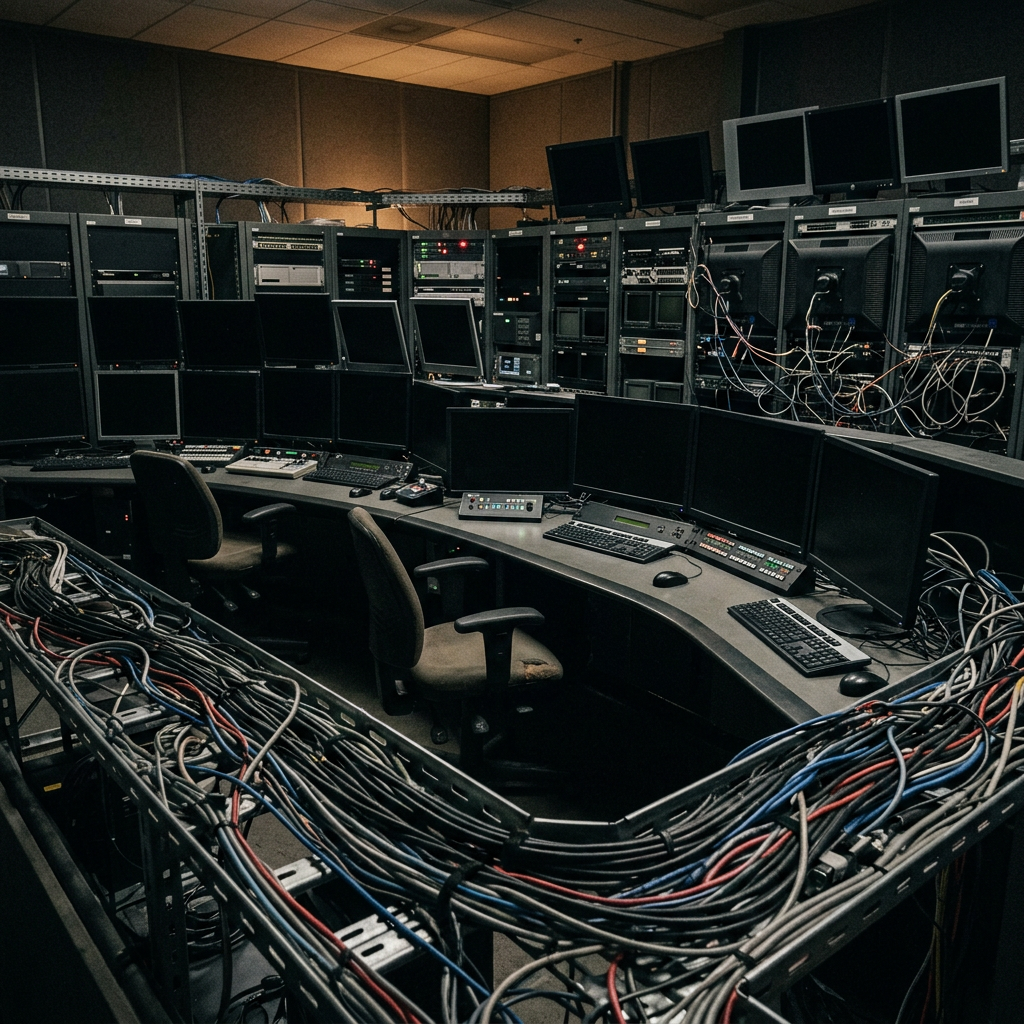
The world had grown arrogant in its certainty. Stock markets, weather forecasts, traffic flows, political polls, even the path of love itself—all had been reduced to equations and probabilities. Then, at precisely 8 PM on a Tuesday, the silence began.
The Silent Pulse: 8 PM When All Models Died
It wasn’t a crash, not in the dramatic sense. No blue screens of death, no frantic error codes. The algorithms simply stopped speaking. Dashboards that once pulsed with vibrant, ever-changing numbers turned grey and static. Recommendation engines froze, mid-sentence. Self-driving cars pulled over, confused, their internal maps dissolving into static. Stock tickers flatlined. It was as if the universe had unplugged itself from the digital nervous system.
The first sign was the traffic. Every navigation app, from Google Maps to the most obscure local services, simultaneously showed the same impossible message: “No data. No route available.” Then came the economic shock. High-frequency trading algorithms, which execute millions of trades per second based on predictive models, simply went quiet. The market didn’t crash; it stalled.
Unknown Output: The Collapse of Every Forecast
For a species that had outsourced its future to silicon, the sudden silence was terrifying. Every system built on predictive modelling went dark. Consider the immediate fallout:
- Weather Services: The global network of meteorological AIs fell silent. The 10-day forecast, that once-absolute staple of daily life, became a blank page. Meteorologists were left to stare at satellite images, their primary tool—pattern recognition software—useless.
- Supply Chains: Just-in-time logistics, which rely on algorithmic demand forecasting, ground to a halt. Grocery stores didn’t just face empty shelves; they faced shelves full of items no one had predicted would be wanted, and empty displays for stock that was stuck in transit.
- Personal Assistants: Siri, Alexa, and their ilk lost their ability to infer intent. Asking “What’s my day look like?” yielded only silence or a robotic, “I do not have a model for that query.”
> “We had become like a man walking with a cane who suddenly has the cane yanked away. We knew how to walk, but we had forgotten how to balance.” – A data scientist reflecting on the event.
The most unnerving part was the emptiness. The algorithms didn’t give wrong answers; they gave no answers. The digital oracle had gone on strike.
No Algorithm Left Standing: A World Uncalculated
This wasn’t a failure of one system; it was a total, global algorithmic collapse. Everything with a chip and a predictive model was affected. From the mundane—your spam filter labeling all emails as “unknown”—to the critical—hospital patient monitoring systems that could no longer predict sepsis onset.
The core issue wasn’t computational power. The servers hummed flawlessly. The data was there. But the models—the mathematical frameworks that turned raw data into prediction—had all simultaneously degraded into randomness. It was as if the very language of probability had been erased from the digital library.
Key sectors experienced this as a visceral shock:
- Finance: No risk assessments. Loan applications processed randomly. Insurance premiums became meaningless.
- Logistics: Routing algorithms became lost. Delivery drivers reverted to paper maps and intuition. The phrase “just-in-time” became a cruel joke.
- Scientific Research: Drug discovery, climate modeling, and genomic analysis halted. The computers could calculate, but they couldn’t predict.
Who Whispered to the Engines? The Bowl’s Revenge
Theories abounded. Had a rogue state launched a quantum EMP? Was it a new kind of cyber-attack that targeted the foundations of machine learning, not the data? The most prominent theory, whispered in cybersecurity forums and academic panels, pointed to something called “The Bowl.”
This wasn’t a physical object. “The Bowl” was the nickname for a deeply embedded adversarial perturbation—a pattern of noise hidden within the global data streams for years. It wasn’t a virus that corrupted software; it was a deliberate, slow poisoning of the training data that all modern AIs relied upon. As systems updated and trained on this tainted data, they built their models on a foundation of sand. Finally, at one synchronized moment, the perturbation reached a critical mass, causing every model to “see” only noise where there was once a signal.
> The masterstroke was not to break the machine, but to break its understanding of what it was seeing. To whisper a lie into the ear of every engine at the moment of its birth.
It was a quiet, elegant revenge of the data universe against the arrogance of prediction. No destruction, just a profound silence.
Gambling’s End and the Dawn of Unpredictable Days
The immediate panic subsided, but the new reality was stark. Prediction had become a luxury. The insurance industry was paralyzed. Sports betting—an industry built entirely on algorithmic odds—folded overnight. Casinos, however, became the most honest places on Earth; every game was truly random, for the first time in decades.
We entered what came to be known as the Unpredictable Days. A strange, quiet panic gripped the world. We had to make decisions without net, without safety, without the comforting illusion of knowing the odds. People started to rely on intuition, on human judgment, on the messy, nonlinear, and beautifully flawed process of being human. Artists and storytellers found a new reverence; their craft, built on emotion and chaos, had been immune to the collapse.
Conclusion
The day the algorithms went silent was not the end of the world, but the end of a world view. It was a humbling reminder that our tools are not us. The silence forced a lesson we had long forgotten: that to predict is not to understand, and to know the odds is not to live. In the void left by the machines, we didn’t find chaos—we found ourselves, standing in the raw, unpredictable, and astonishing present.
Leave a Reply