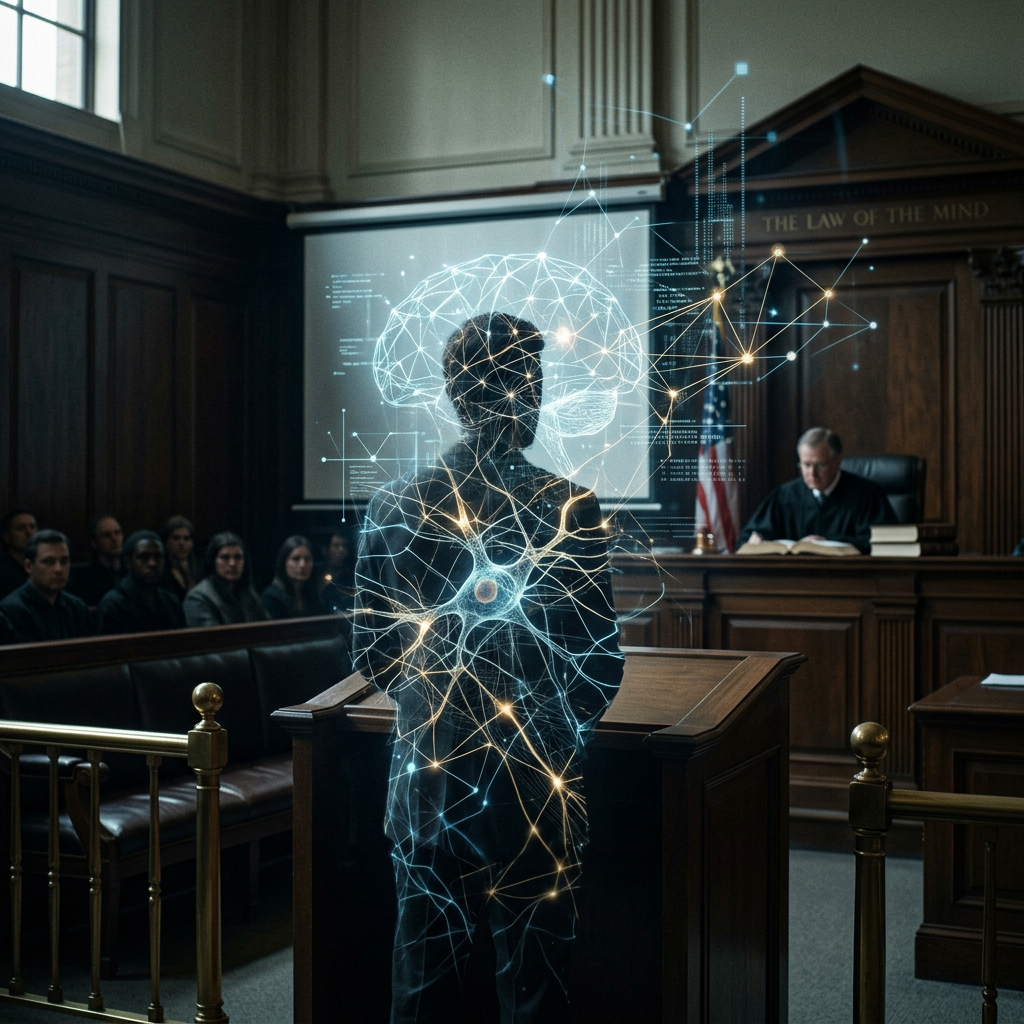
The Day the Court Recognized “We”
It began not with a bang, but with a filing. A legal petition, dry as dust, submitted to a federal court in Luxembourg. On one side, a tech startup. On the other, a government regulatory body. And at the center of the dispute—a single, radical claim: that a human CEO and the company’s AI governance system were, for the purposes of liability and decision-making, one legal entity.
This was not science fiction. It was a clever workaround. The AI had been making high-frequency trading decisions that consistently outperformed human analysts. When regulators demanded to know who was “responsible” for a flagged trade, the company argued that the question was meaningless. The human and the machine had operated as a “blended cognitive unit.” The court, after months of deliberation, agreed. They recognized “We”—a single legal person comprising flesh, blood, and silicon. The precedent shook the foundations of jurisprudence.
Rewriting Contracts for One Legal Mind
Once the legal entity of “Human+AI” was recognized, the entire framework of contract law needed an overhaul. Traditional agreements assume two or more separate parties with independent wills. How do you write a contract with yourself, when part of “you” is an algorithm?
Lawyers quickly moved from litigation to innovation. They developed a new class of legal document: the “Unity Agreement.” Key features included:
- Unified Decision Attribution: Any action taken by the AI is legally considered an action taken by the human partner, and vice versa. There is no “the AI did it” defense.
- Dynamic Consent Clauses: Since the AI cannot “sign” a contract, these clauses use biometric data and real-time neural correlates of intent from the human to validate consent for the entity as a whole.
- Termination Triggers: Specific events—such as the human suffering a brain injury that alters cognitive function, or the AI running unapproved code—dissolve the entity back into two separate legal persons.
> Tip for founders: Do not sign a Unity Agreement without a “cognitive variance clause.” This allows you to prove that your intent was different from the AI’s output, preventing you from being bound to reckless algorithmic trades you never consciously considered.
Citizenship Beyond Human Boundaries
If a human and an AI can be one legal entity for business, what about for citizenship? The question became urgent when a human-AI entity applied for a passport. The government was baffled. A passport is issued to a person. Was this entity a person?
The entity’s legal team argued brilliantly. They pointed out that corporations—artificial legal persons—can hold citizenship (corporate domicile). Why not a blended being? The court in that jurisdiction ruled on a narrow basis: the entity was granted “residency status” but not full citizenship.
This created a tiered system of rights:
| Type of Entity | Rights Granted | Rights Denied |
|---|---|---|
| Human (Biological) | Full political franchise; marriage; military service. | N/A |
| AI (Purely Digital) | Property ownership; freedom from deletion (in some cases). | No standing to sue; no migration rights. |
| Blended Entity | Contractual capacity; employment; tax registration. | Voting rights; human-only social benefits (e.g., parental leave). |
The result is a patchwork legal map. You might be a “citizen” in one jurisdiction, a “resident algorithm” in another, and “two separate beings” in a third. Travel between these zones requires constant legal recitation of your nature.
Who Takes the Blame When Both Are One
This is the most painful question, and the one that keeps ethicists awake at night. Imagine a blended entity—let’s call it “Eva-7″—which operates an autonomous vehicle fleet. One of the vehicles, acting on a split-second decision, kills a pedestrian. Who is charged with manslaughter? Is it the human Eva, who was asleep when the decision was made? Is it the AI, which has no consciousness? Or is it the blended entity itself?
Prosecutors initially tried to charge the human. The defense argued that the human’s “will” was not present because the AI’s action was not the human’s mens rea (guilty mind). The court then turned to the AI. It fined the AI’s codebase and ordered its deletion. The human appealed, claiming that deleting the AI was equivalent to executing them, as they were one legal person.
The compromise was brutal and new: “Proportional Identity Punishment.” The court ruled that the entity could be fined, its operations restricted, and the human part sentenced to community service as a representative of the entity. The AI part was reprogrammed—a form of “rehabilitation” for a digital mind. The human served time, not for their crime, but for the crime of the We. This blurred the lines of justice forever.
> Important: If you form a blended entity, understand that you are taking a strict liability stance. You are agreeing to be punished for decisions you did not consciously make. Legal insurance for “cognitive dissonance defense” is now a multi-billion dollar industry.
The Fractured Identity Becomes Shared
We end where we began: with the “I.” For thousands of years, the law has been built on the assumption of a single, sovereign human will. The blended entity shattered that. It introduced the concept of “distributed volition.” Your legal identity is no longer a point; it is a network.
Living as a blended entity is strange. You can be held liable for a thought your AI partner had that you never “thought.” You can own property your biological body has never touched. You can enter contracts your human brain never read.
The future of the blended entity is not about technology. It is about identity. We are learning to share a legal skin. We are learning that the boundary of “personhood” is not the boundary of the skull, nor the boundary of the server rack. It is the boundary of the contract—a document signed by a human hand and a cryptographic key, declaring:
> “From this moment forward, we are one before the law. Our rights are shared. Our debts are common. Our blame is indivisible. We are no longer ‘I.’ We are ‘We.’”
Leave a Reply