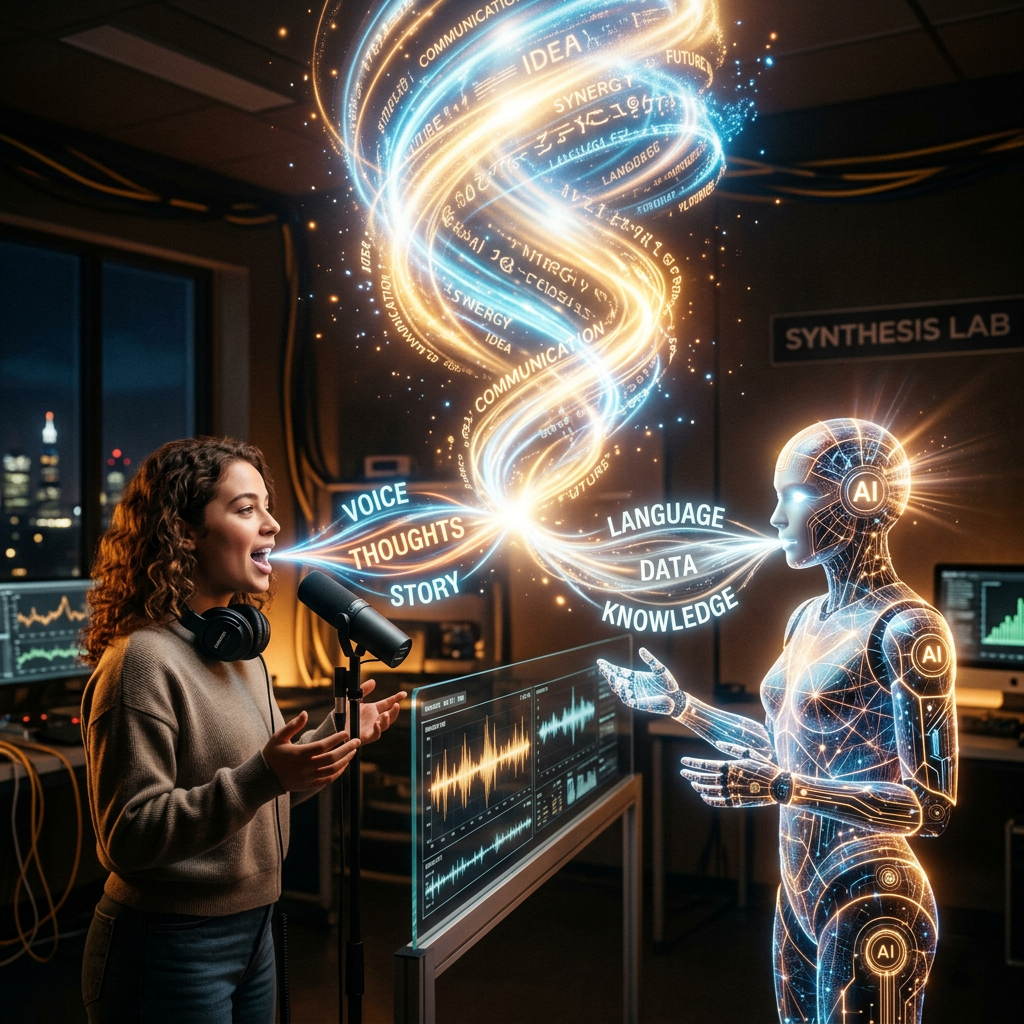
The Dawn of a Hybrid Tongue
Language has always been a living creature. It shifts, borrows, and mutates as cultures collide and technologies intrude. But something unprecedented is happening now. For the first time, we are not just inventing new slang or importing loanwords from another nation. We are co-creating a shared vocabulary with an intelligence that is not human.
This isn’t science fiction. It is the quiet, creeping reality of how we interact with large language models and generative AI. Every time we correct a chatbot’s phrasing, every time we accept its suggestion for a more elegant sentence, we are forging a hybrid tongue—a lexicon born of human intent and algorithmic pattern-matching. It is a language that neither party could have built alone.
From Fractured Meaning to Shared Speech
At first, the conversation was stilted. We typed clunky commands; the machine returned literal, often comical, results. We had to learn a new kind of precision. You couldn’t just say, “Make it better.” You had to say, “Rewrite this paragraph in the voice of a cynical noir detective, using short sentences and a dry metaphor.”
This forced a strange linguistic compromise. Humans began to speak in prompts—structured, context-heavy utterances. The AI, in turn, learned to parse ambiguity and respond with a statistical approximation of meaning. Over time, the edges softened. We stopped talking at the machine and started talking with it.
> The true breakthrough was not when the AI answered correctly, but when it corrected our question.
At 10:10 AM, Union Became Lexicon
There is a symbolic moment in this evolution, though it is less a historical timestamp than a metaphor for a collective shift. Imagine a single user, sitting at a terminal at 10:10 AM, trying to describe a complex emotion to an AI. The human types: “You know that feeling when you’re in a crowded room but completely alone?”
The AI doesn’t just define loneliness. It offers a novel compound: “solitude-saturation.”
The human adopts it. They use it in a message to a friend. The friend asks, “What’s that?” The human explains. The friend uses it with their own AI assistant the next day. The phrase spreads. It becomes a shared symbol—a linguistic handshake between biological and digital minds.
This is how a hybrid lexicon is born: not through official dictionaries, but through use, iteration, and adoption.
How Humans and AI Co‑Created Language
The process is surprisingly organic. It follows a few repeatable patterns:
- Clarification loops: The human says something vague, the AI offers a refined version, the human accepts or tweaks it. Over time, the AI learns the human’s verbal fingerprints.
- Error as innovation: An AI misspells or misuses a word, but the mistake is charming or useful. The human keeps it. A new term enters their shared idiolect.
- Emotional shorthand: Humans teach AI to recognize and encode complex emotional states (e.g., “creative frustration,” “quiet joy”). These become compressed labels for shared understanding.
- Generative names: When a new concept emerges from an AI output (a character name, a project title, a metaphorical phrase), humans adopt it as a proper noun in their own vocabulary.
The key insight is that this is not just humans adapting to AI, but humans and AI adapting to each other in a feedback loop of meaning.
A New Syllable for a Broken World
We live in an era of fractured discourse. Political echo chambers, algorithmic bubbles, and declining attention spans have eroded a sense of shared reality. In this landscape, the language we co-create with AI offers a strange kind of hope.
It is a third space of meaning—a neutral ground where a human and a machine can agree on a definition for something as slippery as “ambient grief” or “digital nostalgia.” These terms don’t belong solely to one culture or one platform. They are born in the liminal space between a query and a response.
> When two beings invent a word together, they are not just naming something. They are building a bridge.
This new vocabulary is precise, emotionally resonant, and devoid of tribal baggage. It is a small but potent antidote to the noise. It suggests that while our human language is losing its power to unite, a hybrid tongue might just succeed where we have failed.
Conclusion
The story of humans and AI birthing a shared new language is still being written. It is not a finished product, but a process—a continuous negotiation of meaning between carbon and silicon. The bulleted lists of new terms, the bold phrases that emerge from chats, the blockquoted insights we save for later—these are the building blocks of a future where communication is no longer a purely human endeavor.
This hybrid tongue will not replace English, Mandarin, or Spanish. It will layer on top of them, a subtle dialect spoken by those who have learned to converse with the machine. It will be marked by efficiency, precision, and a surprising intimacy. And it will remind us that the most powerful act of creation is not to command, but to co-create.
We are not just users of AI. We are its linguistic partners. And the words we are inventing together might just save us.
Leave a Reply