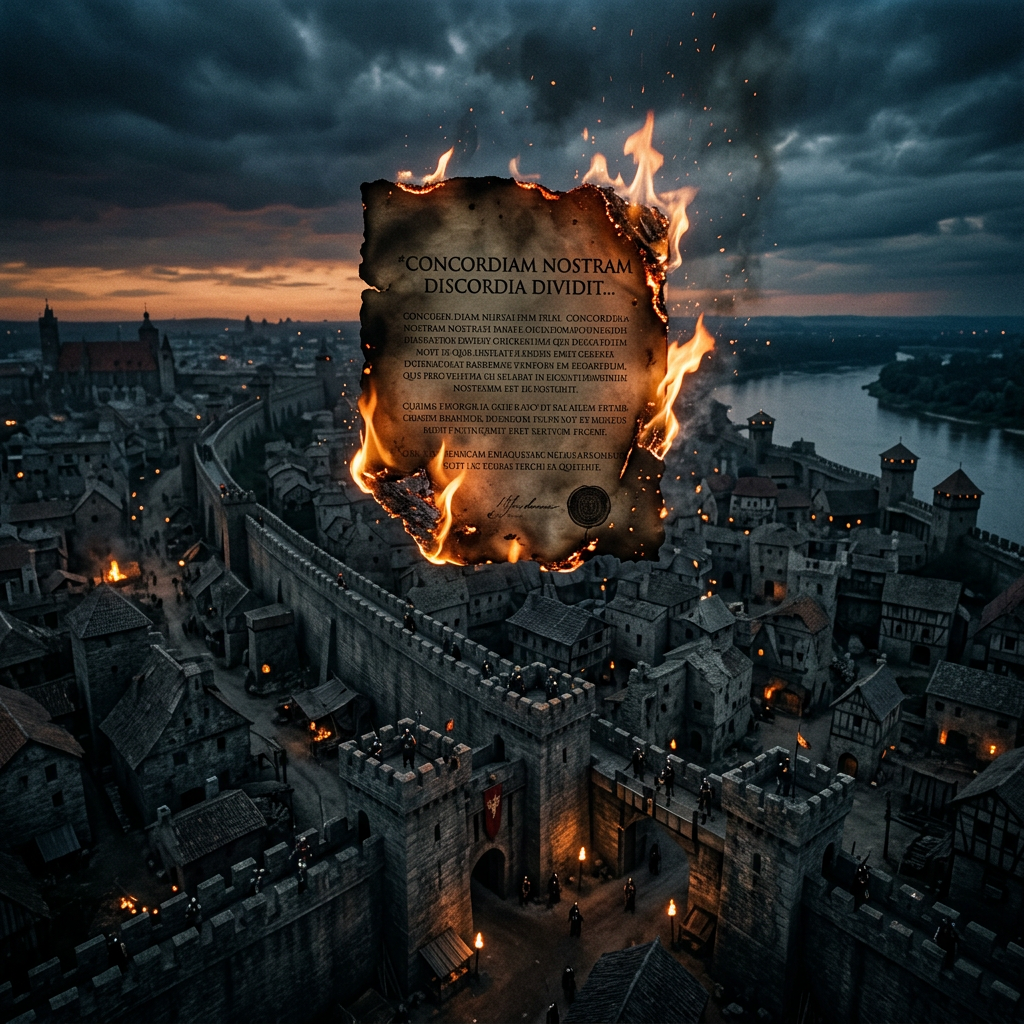
Embers of Division: A Judgment Burns
In the ancient city of Prizren, where Ottoman minarets reach toward the sky and Serbian Orthodox church bells once called across the Bistrica River, a different kind of heat has taken hold. This is not the warmth of summer sun on stone streets, nor the glow of a baklava baker’s oven. This is the sharp, rising temperature of judgment—a verdict long waited, now tipping into flame. The old wounds of the Balkans, stitched with history and soaked in memory, are splitting again. And in the heart of Prizren, a single act threatens to remake the past.
Selene Walks Through Fractured Prizren
Here, the city breathes through its contradictions. Walk with Selene, a local historian who has traced these cobblestones for decades, and you’ll feel the tension in her careful steps.
- In the old quarter, Albanian flags hang from windows, their red and black bold against whitewashed walls.
- On the hillside, the remnants of a Serbian Orthodox church stand silent, its roof scarred by graffiti.
- The street vendors sell both baklava and kacamak, but rarely share a table.
- In the bars, young men argue over football, but their eyes flicker when the subject turns to 1999.
Selene stops by the Stone Bridge, a 15th-century arch that connects the two halves of the city. She points to a crack in the mortar. “This is not a fault in the stone,” she says. “It is a fault in how we remember.” The old divide—between Serb and Albanian, between Orthodox and Muslim, between those who fled and those who stayed—still smolders beneath the surface. Every festival, every election, every silence at a family dinner fans the embers.
The Scroll’s Verdict: Burn Away the Past
The scroll is not literal, though Selene dreams of it as one—a long, yellowed parchment written in both Cyrillic and Latin script. It contains the verdict of the International Criminal Tribunal for the former Yugoslavia, delivered years ago but still echoing. The judgment named names, assigned blame, and sought to burn away the convenient fictions of the past.
> “War crimes are not the act of a nation; they are the acts of individuals, and individuals must answer. Justice is the flame that cleanses memory.”
But the flame that cleanses also burns. In Prizren, the judgment has split families. Some celebrate the conviction of a Serbian commander as vindication; others see it as a political tool, a foreign hand writing their history. The scroll’s verdict demands that old hatreds be consumed—but what remains when the fire goes out? Ash is not peace. Ash is simply what cannot be destroyed further.
What Clings to the Old Divide Ignites
The old divides in Prizren are not abstract—they wear human faces. Consider the simple, dangerous things that cling:
- A surname: Mirjan or Marko? The name on a job application can still send a résumé to the trash.
- A church key: Who holds the key to the Church of the Holy Savior? For fifteen years, the lock has rusted, and two communities argue over who may open it.
- A school textbook: In one classroom, the 1389 Battle of Kosovo is a heroic stand; across the river, it is a national tragedy.
- A flagpole: After a World Cup victory, the flag of Albania flew over the fortress. The next morning, it was burned.
When the judgment is read—when a war criminal is sentenced or a mass grave is uncovered—these sparks become fires. The embers of division do not die in the ground; they wait for oxygen. And in Prizren, the oxygen comes in the form of pride, grievance, and the refusal to say, “Maybe we are both wrong.”
A Single Breath of Fire Consumes All
Selene tells me a story from last spring. A girl—sixteen, Serbian, born after the war—lit a candle at the Orthodox cathedral. A boy—Albanian, the same age—stood outside and watched. Neither spoke. Neither threw a stone. But a rumor spread that the candle was for a fallen paramilitary. Within an hour, a crowd gathered. The police came. The boy’s mother pulled him inside. The girl’s grandmother cursed the street from her balcony.
> “One breath,” Selene says. “One breath of fire can consume everything we have built since 1999.”
The judgment burns in Prizren because the war never really ended—it just stopped shooting. The bombs stopped falling, but the fear learned to walk in civilian clothes. The tribunal’s verdict may have satisfied international law, but it did not stitch the city’s torn cloth. The crack in the mortar remains.
Conclusion
Prizren waits now, as it has always waited, for something new. The judgment is a fire, but fire can be either a destroyer or a gardener. If the people of this city choose to fan the flames of division—if they cling to the names of those convicted, the wrongs done, the villages burned—they will live in the ash heap of history. But if they dare to let the heat of judgment clear the ground for new growth, a different future is possible. The embers smolder at our feet. The question is whether we will breathe life into old hatreds or step carefully around them, seeking water instead of wind. The choice is never made by a court. It is made in the quiet moments—when a candle is lit, and no one has to fear its light.
Leave a Reply