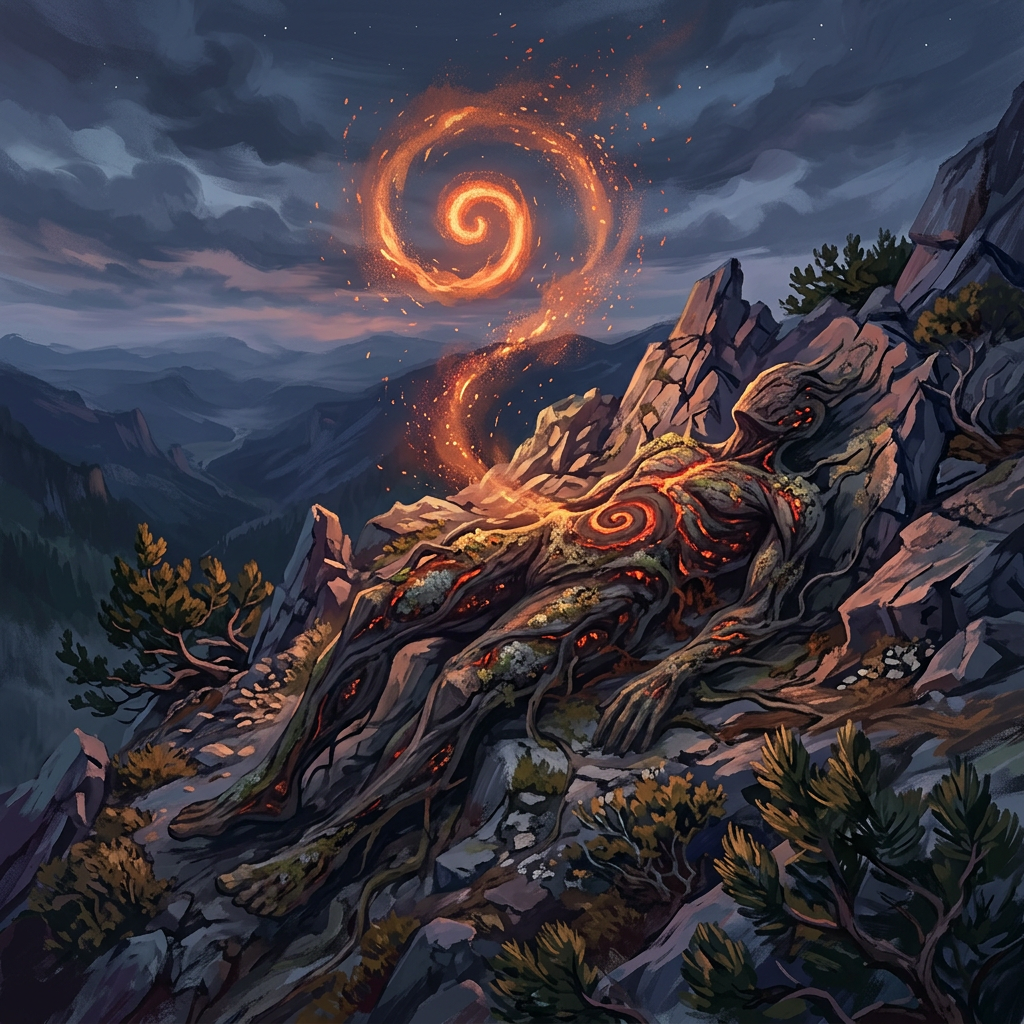
We live in a time where the roar of the new often drowns out the whisper of the old. Yet, every so often, a story emerges that reminds us that the past does not vanish quietly; it leaves behind an ember echo—a lingering warmth, a faint glow that can either illuminate our path or burn down the walls we have built. This is the tale of such an echo, and the judgment it carried.
The Ember Echo: A Judgment of Ash
The world’s forgotten languages, lost songs, and unwritten histories were never truly silent. They were transformed. They became a kind of spectral energy, a resonance of memory that drifted through the hollow places of the earth and the quiet corners of the human mind. This phenomenon, known among the few who could sense it as the Ember Echo, was the final testament of cultures that had been extinguished by time, war, or forced assimilation.
But the Ember Echo was not simply a passive memory. It carried within it the weight of every story cut short, every prayer left unsaid, and every law that governed a people now gone. When it was disturbed—when the forces of modern progress tried to mine its energy or erase its signal entirely—it did not fade. It fought back. The echo became a judgment of ash, reducing to cinders anything that sought to exploit or silence it without understanding.
> “To step into the Ember Echo is to walk through a library that has been set ablaze, where every spark is a word and every ember is a law.”
Selene of Prizren Hears the Old World’s Cry
In the ancient city of Prizren, nestled in the hills of the Balkans, a young archivist named Selene lived among the ruins of a dozen empires. Her days were spent cataloging crumbling manuscripts, listening to the last living speakers of dying dialects, and recording the hum of forgotten lullabies. She was a keeper of the quiet flames.
One evening, as she sorted through a box of charred scrolls from a burned monastery, Selene felt a peculiar warmth on her fingertips. The scrolls glowed faintly, not with heat, but with a deep, internal light. She pressed her ear to the parchment and heard not the crackle of fire, but the murmuring of voices—old voices, layered like sediment. They spoke of a pact broken, a river poisoned, and a mountain that had wept for three centuries.
These were the cries of the Old World, and Selene was the first person in generations to hear them clearly. She understood immediately: the Ember Echo was not a random phenomenon. It was calling to someone who could still listen.
- The voices told of harvest rituals that tamed the soil.
- They whispered of marriage customs that bound the living to the dead.
- They sang of a wound in the earth that had never healed.
The Glowing Scroll That Silenced the Past
Among the artifacts in Selene’s possession was one that stood apart—a glowing scroll wrapped in copper wire and sealed with wax the color of dried blood. Unlike the other documents, this one did not speak. It emanated a steady, silent light, as if it were holding its breath.
When Selene finally broke the seal, the scroll unfurled with a sound like wind through dry reeds. Its text was unlike any language she knew: a script of cinders that shifted and rearranged itself as she watched. It was not meant to be read by the eyes, but by the bones.
As she studied it, a terrible truth emerged. The scroll was not a record of the past. It was a command. It dictated that all voices from the Old World that had not been properly honored would be gathered into a single flame and extinguished forever. The Ember Echo had tired of its existence. It wanted to be silenced.
But the scroll’s instructions came with a condition: only someone who had truly heard the voices could complete the ritual. That someone was Selene.
When Furnace Wind Erased Ancient Voices
The ritual required Selene to travel to the Furnace of the World, a volcanic vent in the mountains above Prizren where the earth’s heat met the sky. There, she was to read the glowing scroll aloud into the chasm as the furnace wind—a hot, dry gale that rose from the depths—carried the words down into the molten core.
As Selene began to speak, the air around her grew thick with ash. The voices that had once whispered to her now screamed. They begged, cursed, and wept. She saw visions of entire civilizations collapsing like sandcastles, their art, their science, their love all dissolving into dust.
- She saw the bards of a forgotten kingdom whose songs had once healed the blind.
- She witnessed the mathematicians of a sunken city who had calculated the motion of stars without telescopes.
- She felt the grief of mothers whose children had been taken by conquerors, their names never recorded.
The furnace wind grew stronger, tearing the words from her lips. The glowing scroll crumbled into embers. And then, in a single, roaring sigh, the voices fell silent.
Selene stood alone on the mountain, her throat raw, her heart hollow. The Old World had been erased, not by invaders or time, but by the very energy that had preserved its memory.
> “Sometimes the most merciful act is to let the dead truly rest, even if it means silencing their echo forever.”
A New Dawn Born from the Ember Echo
In the weeks that followed, Prizren felt different. The air was lighter. The shadows in the old archives lost their weight. People no longer heard strange humming in the ruins. The Ember Echo was gone.
But Selene noticed something else, something unexpected. In the silence left behind, new sounds began to emerge. Children in the streets invented games and songs that were entirely their own, unburdened by the ghosts of the past. Artists painted scenes that had no precedent, flowers that had never bloomed, and skies of colors that had never been named. A new dawn had risen, born not from the ashes of the old, but from the space that the old had finally vacated.
The Ember Echo, in its final act, had not destroyed the future. It had cleared the ground. By silencing the Old World’s voices, it allowed the living to hear themselves for the first time in centuries.
Selene returned to her work, but now she did not listen for echoes. She listened for beginnings. She understood that some stories are meant to end so that others can begin. The judgment of ash was not a punishment; it was a release.
Conclusion
The tale of Selene and the Ember Echo is a parable for our own age. We are surrounded by the relics of the past—their words, their wounds, their wisdom—and we must decide whether to worship them, weaponize them, or set them down. True progress does not come from erasing history, but from knowing when to let its ember rest. The Old World’s voices may be silenced, but the new song is still being written, note by note, breath by breath, in the quiet space where the echo once lived. Let us honor that silence by filling it with something worthy of our own voice.
Leave a Reply