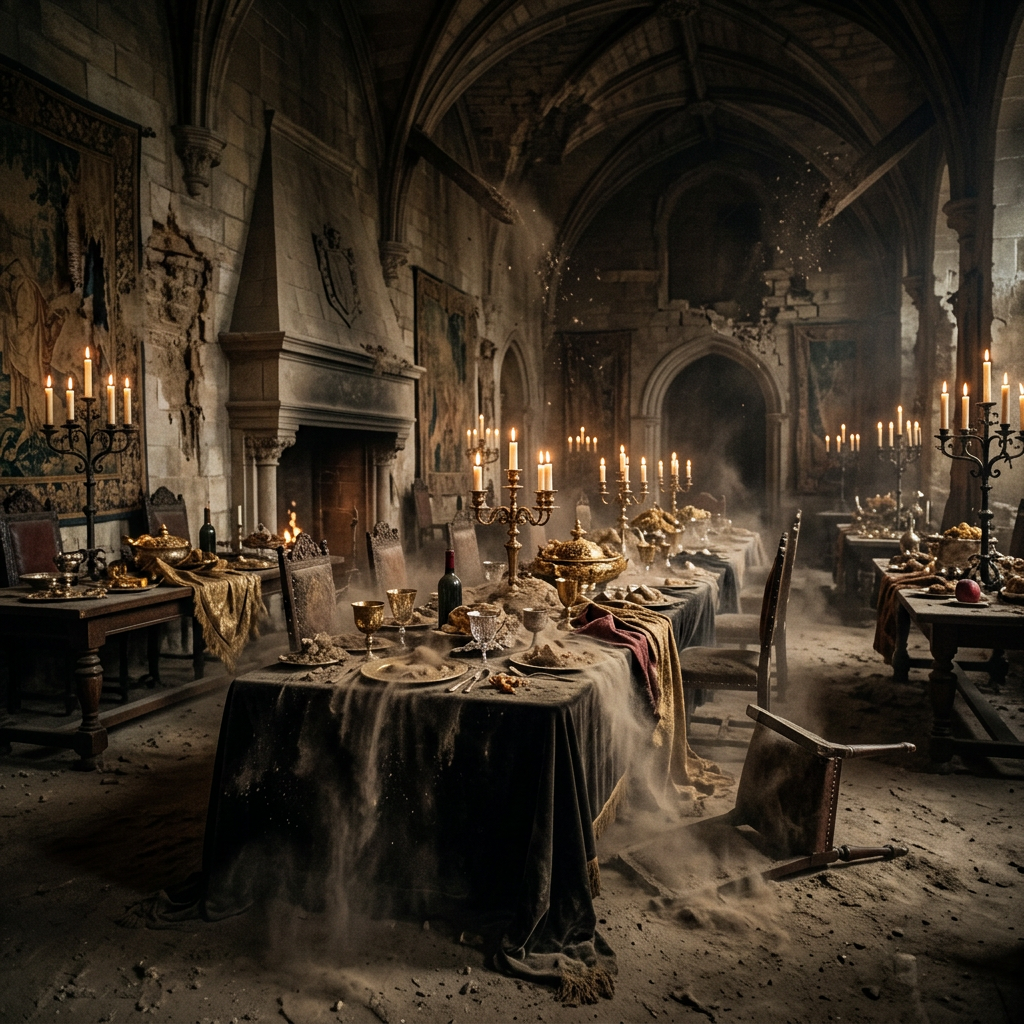
In the quiet before the collapse, the world held its breath. We speak of the Old World as a place of stability, where the scales of existence seemed perfectly balanced. But a mirror does not always show the truth; sometimes it shows what we wish to see. This is the story of that mirror, the world that lived in its reflection, and the moment the weight of our own games shattered it forever. It is a tale of perception, of synthetic victories, and of the fragile whispers that dared to name the approaching storm.
The Vision Through the Counterweight
For centuries, humanity built a complex system of counterweights to maintain its equilibrium. These were not physical objects, but shared beliefs, unspoken agreements, and moral economies. To see the Old World clearly, one had to look through these counterweights:
- The Illusion of Permanence: Institutions like the family, the guild, and the state were considered eternal structures. They acted as anchors, preventing the ship of society from drifting too far from its moral compass.
- The Ritual of Remembrance: Festivals, harvests, and religious rites served as regular recalibrations. They reminded every soul of its place in the grand order, a shared rhythm that silenced the dissonance of individual doubt.
- The Veil of Suffering: Pain and hardship were not hidden but interpreted. They had meaning within a larger narrative—a test, a punishment, a purification. This veil kept the mirror’s surface free of cracks, for to see suffering as meaningless would be to see the mirror for what it was: a fragile pane of glass.
A World Consumed by Synthetic Games
But the Old World was not content with its reflection. Humanity began to distrust the quiet stability of the counterweights. They craved a more active, demonstrable proof of their worth. Thus, the Advocate’s Games were born. These were not the simple contests of strength or speed from folklore; they were complex, synthetic simulations of life itself.
> Be careful what you call a victory. A won game only proves you played by the rules, not that the rules were true.
The games consumed everything:
- Relationships became transactions on a scoreboard.
- Knowledge became a tool to win arguments, not to understand truth.
- Compassion became a strategic resource, doled out only when it offered a return.
- Art became a weapon in the culture wars, its beauty secondary to its ideological alignment.
In this frenzy, the mirror of the Old World began to distort. What was once a gentle reflection of a balanced society now showed a grotesque carnival of winners and losers, all chasing a phantom called “winning.”
Jonas Whispers: What Eli Saw
In the final days, there lived a boy named Eli, whose grandfather, Jonas, was a keeper of the old whispers. Jonas did not speak in declarations; he spoke in whispers. He told Eli that the mirror was not just reflecting the world—it was beginning to dictate it.
One night, Jonas whispered what Eli saw:
> “The mirror shows a feast, but the air smells of ash. The guests are laughing, but their teeth are grinding to dust. They do not play the game, Eli. The game is playing them. And soon, the game will tire of its toys.”
Eli saw it then—the Synthetic Games were not a distraction from the balance. They were the imbalance. Every artificial victory created a real loss somewhere else, in a dimension no one was watching. The joy of the arena was built on the silence of a broken scale.
Miriam Names the Advocate’s Feast
While Jonas whispered, Miriam dared to speak. She was a scholar of the old codes, a woman who had watched the Games devour three generations. She stood before the council and named the central tragedy:
- The Advocate’s Feast: A grand celebration where the greatest players were honored.
- The Illusion of Plenty: The tables were laden with food, but it was all synthetic. It satisfied hunger for a moment, but left the soul starving.
- The Hidden Debt: Miriam argued that the Feast was paid for not with coin, but with the energy of the world’s balance. Every laugh at the feast was a stone removed from the foundation of the Old World.
Her accusation was simple: “You have replaced the mirror with a menu. You think you are consuming glory, but you are consuming yourselves.”
Rabbi Lev’s Prayer for the Unbalanced
As the final seams of the world tore, Rabbi Lev did not call for a miracle. He did not command armies or curse the players. Instead, he offered a prayer for the unbalanced.
> Blessed is the Broken Scale, for it shows us that we once had weight. Holy is the Lost Game, for its memory reminds us that playing was once a joy, not a duty. And may the Mirror, now shattered, cast a thousand tiny reflections, so that future eyes may see the world not as one single lie, but as a million scattered truths.
His prayer was a lament for what was gone, but also a seed for what could come. He knew that the Old World could not be saved, because salvation requires a subject that wants to be saved. The players did not want balance; they wanted the game to continue.
Conclusion
The Mirror of the Old World did not break because of an external enemy. It shattered under the weight of a civilization that had forgotten the difference between a reflection and a reality. We look back now, not with nostalgia, but with a aching clarity. The counterweights were not chains; they were wings. The Synthetic Games were not freedom; they were a gilded cage. And the Advocate’s Feast? It was a funeral, dressed in carnival lights, that no one dared to name until the last guest had left.
Eli, Miriam, and Rabbi Lev remind us that the fall was not a sound of thunder, but the quiet sigh of a mirror that could no longer bear the lie it was forced to hold. The lesson, if we choose to learn it, is simple: To see the world as it is, we must be willing to break our own reflection.
Leave a Reply