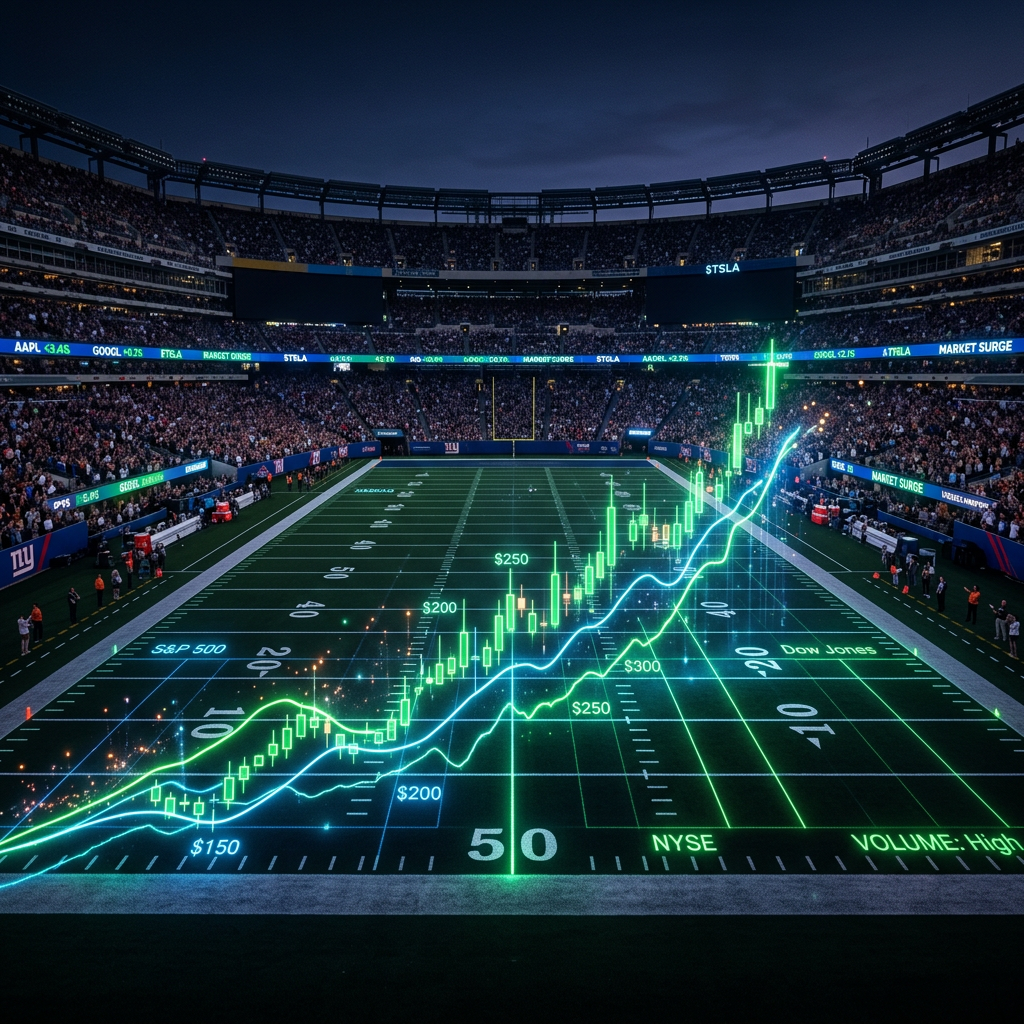
There is a strange sensation settling over modern life, a quiet hum beneath the surface of every news headline and social media scroll. It feels as though the line between genuine participation and passive speculation has dissolved. We are no longer just observers of world events, economic shifts, or entertainment. We are being invited, subtly and not so subtly, to place a wager on every single one of them. Welcome to the age of the false market, a time where everything—from a sports match to a geopolitical conflict to the weather—has been abstracted into a tradable asset, stripping away reality and leaving only the hollow thrill of the bet.
When Every Moment Becomes a Wager
The first sign of this shift is the normalization of gambling itself. What was once a taboo activity, confined to smoky back rooms or the neon deserts of Las Vegas, has been sanitized and integrated into the fabric of daily life. Sports betting apps are now as common as a music streaming service on a smartphone. It is no longer about the game itself; it is about the ever-present possibility of a financial transaction tied to every play, every pass, every point.
This has given rise to a new kind of engagement, one that is purely transactional. Consider the transformation of a casual fan:
- Before: They watch the game for the joy of athleticism, the strategy, or the narrative of the underdog.
- Now: They watch the game for a parlay slip, tracking a dozen different micro-bets on the same screen, their emotional investment tied to a digital receipt.
The market has taught us to view uncertainty not as something to be navigated with wisdom and patience, but as something to be exploited. This is the core of the false market. It’s not a place for the exchange of real value or the building of community. It is a machine designed to convert human attention and emotion into a liquid, tradable commodity. Every conversation about a team’s chances is now a prelude to a transaction.
Fantasy Leagues and the Illusion of Participation
At the surface, fantasy sports feel different. They seem interactive, social, and mental. You draft a team, you manage a roster, you talk trash with friends. But scratch that thin veneer of competition, and you find its true nature: a deeply sophisticated prediction market on human performance.
The illusion is powerful. You feel like a general manager, a strategist, a star-maker. In reality, you are a consumer of data, constantly updating your position based on the latest injury report or weather forecast. The joy of watching a player succeed is now inextricably linked to your own portfolio’s performance. Did your quarterback score a touchdown? Great, but more importantly, how many points did he get you?
This model has fundamentally changed the way we consume professional sports. The loyalty to a city or a team has been replaced by a loyalty to a roster of individual stars from various teams. The narrative of the season is no longer just about the championship; it’s about the statistics. We have traded the emotional risk of being a fan for the financial risk of being a bettor. It is a solitary pursuit disguised as a team game.
Prediction Markets Monetizing Disaster and War
The most unsettling frontier of this trend is the expansion of betting into the most serious realities of our time: war, pandemics, and natural disasters. What was once the domain of intelligence agencies and insurance underwriters is now a public, real-time betting pool.
Platforms now allow you to wager on a wide range of outcomes:
- Global Events: The outcome of a presidential election or a Supreme Court ruling.
- Conflict: Whether a ceasefire will hold, or which nation might be the next to fall into civil war.
- Catastrophe: The peak landfall intensity of a hurricane or the final death toll of a global pandemic.
The argument for these markets is that they aggregate information and provide a clearer picture of what experts believe will happen. While this may be intellectually interesting, it creates a profound ethical void. To have a direct financial stake in a human tragedy—to profit from a missed ceasefire or a stalled peace deal—is to fundamentally corrupt the very concept of human value. It transforms a moral crisis into a margin call. Discussing the potential for war with friends no longer centers on human life and suffering; it centers on the “odds,” which have been sanitized into a number on a screen. This is the ultimate reduction of reality into a false market.
Crypto Tokens: Fortunes Made and Lost in Storms
The world of cryptocurrency and decentralized finance (DeFi) has taken this principle and distilled it into its purest, most volatile form. Here, the market itself is the game. There are no athletes, no teams, and often, no underlying product or service. There is only the price of a digital token, a symbol of collective belief and speculation.
The memecoin phenomenon is the perfect example. A token is created around a joke, a dog breed, or a fleeting internet meme. It has no intrinsic value, no revenue stream, no governance. Its entire existence is a zero-sum game of timing and hype. Investors are not investing; they are placing a bet on the next person’s greed. The market is a pure casino, where “fundamentals” are a forgotten concept.
This creates an environment of extreme volatility and predatory behavior. The “play” is to buy early, get lucky with a “pump,” and sell before the “dump.”
- The House: Built for insiders, developers, and early whales.
- The Players: Late-arriving retail investors chasing a perceived “community” and a dream of life-changing wealth.
- The Outcome: A redistribution of wealth from the many to the few, wrapped in the jargon of “democratization” and “financial freedom.”
In this age, a digital image of a cartoon dog can be worth more than a small company’s productive assets. This is the ultimate false market: a reality built entirely on attention, fear, and greed.
The Rise of Synthetic Sports with No Athletes
As we become comfortable betting on real-world events, the next logical step is to bypass reality altogether. Enter synthetic sports—automated, algorithm-driven athletic competitions using AI or randomized physics engines.
Imagine a league of virtual horses, or AI-generated boxers, or procedurally generated soccer players. These “athletes” have no agency, no injuries, no careers. They are simply variables in a computer program designed to produce unpredictable outcomes. And on these outcomes, you can bet.
The appeal is chillingly logical:
- Controllability: The event is always on. It doesn’t matter if it’s 3 AM or if a real-world athlete is sick.
- Purity: There is no human error, no referee bias, no behind-the-scenes drama. The outcome is pure, generated by code.
- Scalability: You can have thousands of these “games” running simultaneously.
But what are you actually doing when you bet on a synthetic sport? You are not engaging with athleticism or skill, or even the thrill of a real contest. You are betting on a random number generator. The final step in the journey from a fan to a degenerate gambler is to remove the object of your passion entirely, replacing it with a purely mathematical abstraction. The “sport” is gone, but the market remains.
Conclusion: The Cost of Everything
We have built a world of astonishing financial and technological complexity. We can trade shares of a company, the outcome of a race, the chances of a rainstorm, and the fate of a nation’s leadership, all from a single device. But in doing so, we have allowed the market to become a substitute for the real experience. We have traded participation for speculation, connection for calculation.
When everything becomes a bet, nothing is sacred. The joy of the unexpected becomes an opportunity for a payout. The tragedy of a disaster becomes a data point in a portfolio. The false market is not a tool for understanding the world; it is a mirror reflecting our own addiction to control and profit. The question we must ask is not how we make these bets, but why we want to. Because when the joy of the game, the gravity of history, and the value of human life are all reduced to a single price, we are the ones who lose the most.
Leave a Reply