Contents
On August 2, 2026, at 11:08 AM SGT, three major AI-driven trading systems in Singapore’s Marina Bay Financial District entered a feedback spiral. It was not catastrophic, but it was visible: momentum signals amplified each other, volatility spiked, and circuit breakers flirted with activation. This event underscores the growing challenge of AI trading feedback loops—self-reinforcing cycles where algorithms amplify each other’s signals, leading to sudden market disruptions. Understanding how these loops form and what can be done to prevent them is critical for regulators and firms alike.
What Are AI Trading Feedback Loops?
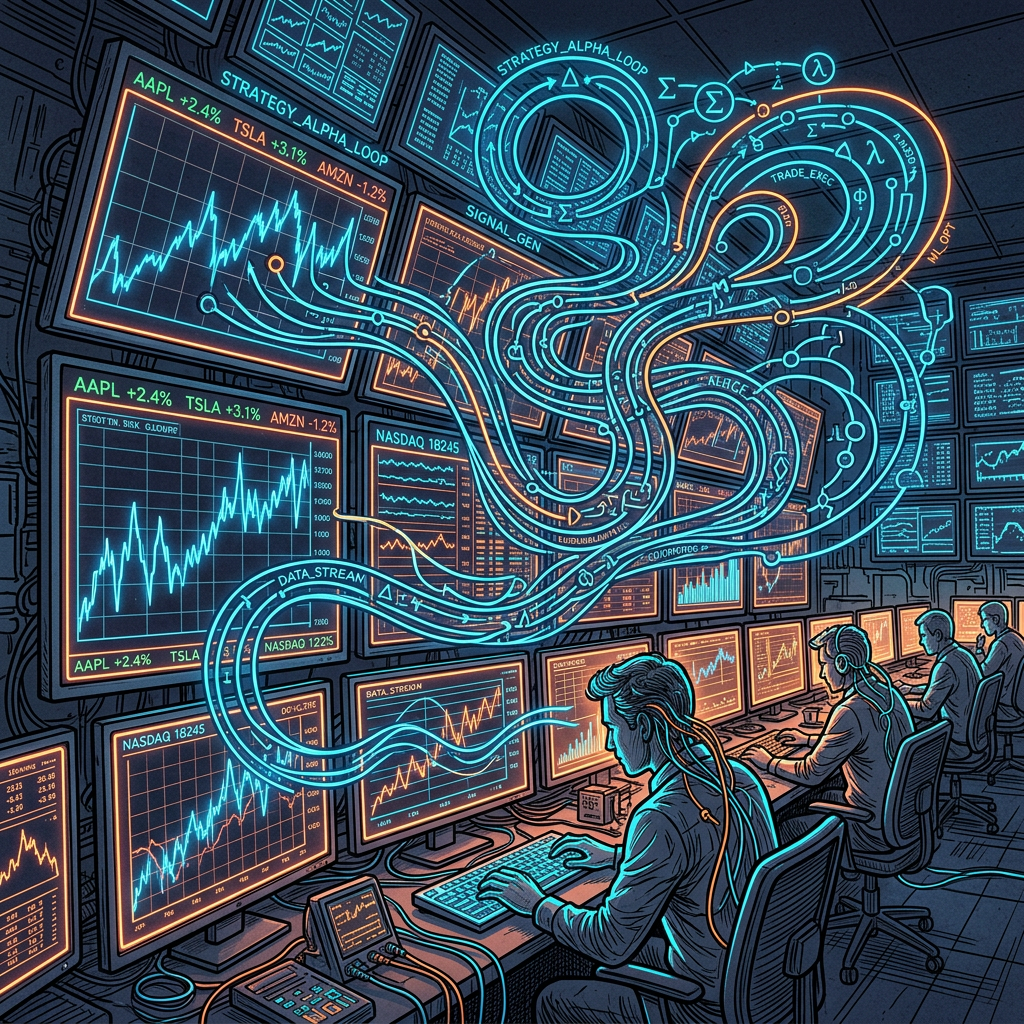
An AI trading feedback loop occurs when multiple algorithmic trading systems react to the same market signals, reinforcing each other’s actions and creating a self-perpetuating cycle. Imagine a room full of microphones: each picks up the sound from the others, producing an ever-louder screech. In financial markets, this translates to rapid price movements that can spiral out of control.
Consider the 2026 Singapore event: three AI systems, each using similar momentum-based strategies, detected a small upward price movement. They all bought simultaneously, pushing prices higher. The higher prices triggered further buy signals, and the cycle repeated. Within minutes, volatility spiked, and circuit breakers nearly activated. This is a textbook example of an AI trading feedback loop—a phenomenon that poses significant algorithmic trading risks.
Why does this matter? Because modern markets are dominated by AI-driven trading. According to a 2025 report, over 70% of equity trading volume in major exchanges is algorithmic. When these algorithms share similar models or data sources, the risk of feedback loops increases. Understanding their mechanics is the first step toward prevention.
The Anatomy of a Feedback Loop: From Momentum to Mayhem
Feedback loops typically start with a trigger—a piece of news, a large order, or a technical anomaly. Once set in motion, they escalate through several stages:
- Trigger: A small price movement or news event catches the attention of multiple AI systems.
- Momentum signals: Algorithms detect the movement and interpret it as a trend, generating buy or sell signals.
- Amplification: As more systems act on the same signals, the price moves further, reinforcing the original signal.
- Cascade: The cycle accelerates, often leading to extreme volatility or a flash crash.
- Resolution: Either circuit breakers halt trading, or the loop exhausts itself as prices reach unsustainable levels.
A useful analogy is microphone feedback: a sound enters a microphone, gets amplified, comes out of a speaker, re-enters the microphone, and grows louder. In trading, the ‘sound’ is a price signal, the ‘amplifier’ is the AI’s trading algorithm, and the ‘speaker’ is the market itself. The result is a rapid, self-reinforcing cycle that can cause market volatility spikes.
Key factors that contribute to feedback loops include correlated models (many systems using similar strategies), data cascades (where one system’s output becomes another’s input), and lack of diversity in trading algorithms. These factors create a fragile ecosystem where a small disturbance can trigger a chain reaction.
Real-World Case: The 2026 Singapore Flash Event
On August 2, 2026, at 11:08 AM SGT, the Singapore Exchange (SGX) experienced a sudden volatility event. Three major AI-driven trading systems—operated by a global bank, a hedge fund, and a proprietary trading firm—entered a feedback loop. The trigger was a large sell order in the Straits Times Index futures, which caused a 0.5% drop. All three systems, using momentum-based strategies, interpreted this as the start of a downtrend and sold aggressively.
Within 90 seconds, the index fell another 2.3%. Circuit breakers, set to trigger at 3% decline, came close to activating. The systems were trading at speeds of microseconds, making human intervention impossible. Regulators at the Monetary Authority of Singapore (MAS) watched as risk desks froze. The event lasted only 4 minutes, but it left a scar on the day’s chart and raised serious questions about algorithmic trading risks.
The aftermath revealed that all three systems were using similar data feeds and momentum signals. They had not been designed to interact, but in practice, they did. The event highlighted the need for better circuit breakers AI and cross-system coordination. Fortunately, the circuit breakers did not activate, but the near-miss served as a wake-up call for the industry.
Key Takeaway
The 2026 Singapore event shows that even without a full crash, AI trading feedback loops can cause significant market disruptions. Proactive measures are essential to prevent future incidents.
Regulatory Responses: What’s Being Done and What’s Missing
Regulators worldwide are grappling with the challenge of AI trading feedback loops. In Singapore, MAS has proposed mandatory stress testing for algorithmic trading systems and real-time monitoring of market-wide feedback loops. The European Securities and Markets Authority (ESMA) has introduced guidelines requiring firms to implement kill switches and model diversity requirements. In the US, the Securities and Exchange Commission (SEC) is exploring circuit breaker enhancements that can detect feedback loops in real time.
However, gaps remain. Current regulations often focus on individual firms, not the systemic risks posed by multiple algorithms interacting. There is no global standard for feedback loop prevention, and many firms are reluctant to share data that could help regulators identify emerging loops. Moreover, circuit breakers are typically based on price thresholds, not on the behavioral patterns of AI systems.
To address these gaps, regulators are considering several measures:
- Model diversity requirements: Mandating that firms use different algorithms or data sources to reduce correlation.
- Kill switches: Requiring all high-frequency trading systems to have manual or automated shutdown capabilities.
- Stress testing: Simulating feedback loop scenarios to assess system resilience.
- Real-time monitoring: Using AI to detect feedback loops as they form, allowing preemptive action.
The regulatory response AI trading is evolving, but it must keep pace with technological advancements. A coordinated international effort is needed to ensure that markets remain stable and fair.
How Firms Can Protect Themselves and the Market
While regulators work on broader rules, trading firms can take immediate steps to mitigate algorithmic trading risks. First, model validation is crucial. Firms should test their algorithms against a variety of market conditions, including feedback loop scenarios. Second, real-time monitoring systems can detect unusual patterns, such as rapid acceleration in trading volume or price movements that deviate from fundamentals.
Third, circuit breaker thresholds should be set not only on price but also on trading velocity and cross-system correlation. For example, if multiple algorithms start trading in the same direction at high speed, a circuit breaker could pause trading. Fourth, firms should collaborate with regulators and peers to share anonymized data on feedback loops, helping the industry as a whole.
Finally, a forward-looking approach involves designing algorithms that are ‘feedback-aware’—able to detect when they are part of a loop and adjust their behavior. This could include introducing random delays, reducing position sizes during high volatility, or switching to alternative strategies. By embracing feedback loop prevention, firms can protect themselves and contribute to market stability.
The 2026 Singapore event was a warning shot. As AI trading continues to evolve, the industry must learn from such incidents and build a more resilient market infrastructure. The bowl of AI trading feedback loops is not inevitable—it can be managed with the right tools and cooperation.
Leave a Reply