Contents
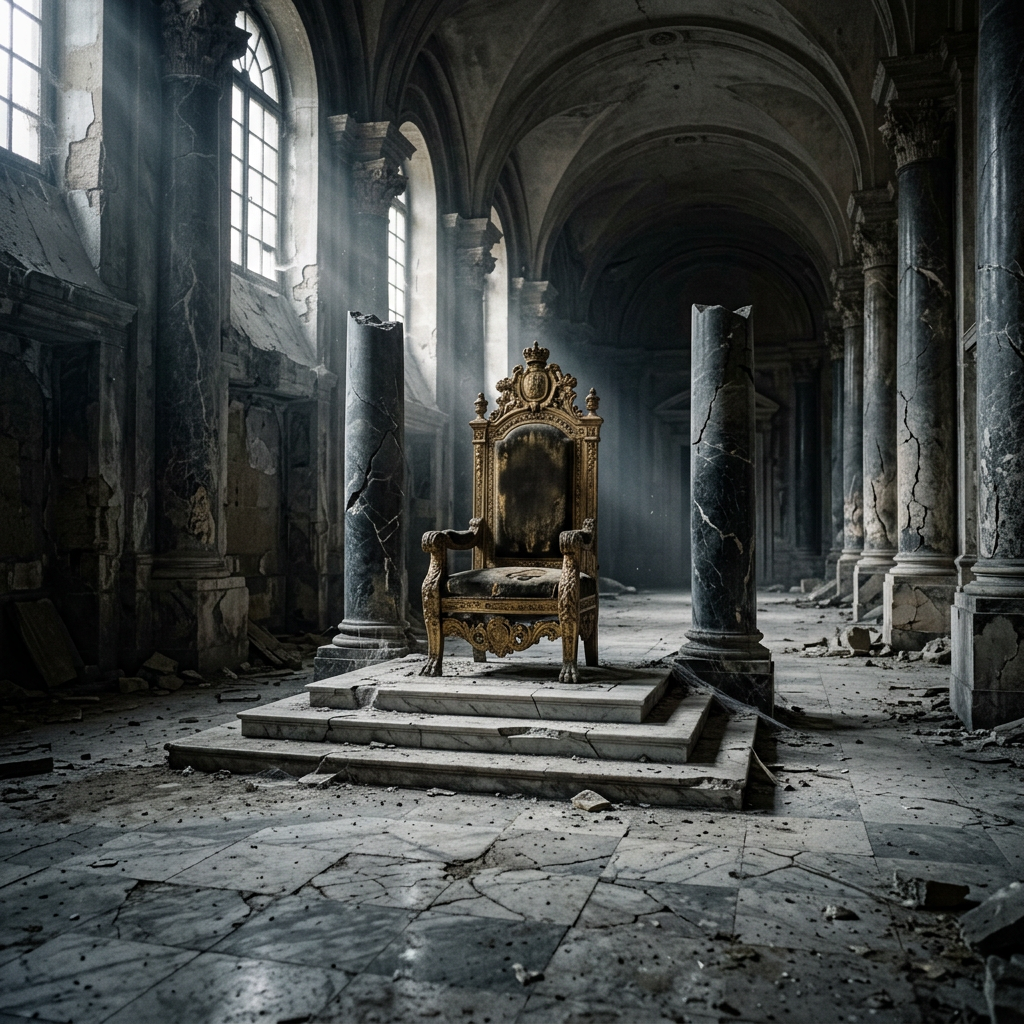
The hollow throne is the throne built on chance — gambling, betting, fantasy, prediction markets, crypto speculation, and AI probability engines. It sits cracked and empty, singing: “I ruled nothing, I built nothing, I left nothing.” In this article, we explore why performance inevitably replaces speculation, and how you can step off the hollow throne to build something real.
The Empty Crown: What the Hollow Throne Really Means
In the marble halls where the old world once crowned itself king, there stands a throne — cracked, hollow, and abandoned. This is the hollow throne, a symbol of every system built on chance rather than value. Gambling, betting, fantasy leagues, prediction markets, crypto speculation, and AI probability engines — all have at some point claimed a place on this throne. Yet, as the elegy whispers, it admits: «I ruled nothing. I built nothing. I left nothing.»
The hollow throne meaning extends beyond mere physical decay. It represents the empty promises of quick wealth and easy success that speculative activities often offer. Unlike performance-based endeavors that require skill, effort, and tangible results, these systems thrive on uncertainty and emotion. They create a fleeting excitement, a rush of possibility, but they never build lasting substance. When the dust settles, the throne is revealed for what it truly is: empty.
Amara, a storyteller in Vienna, narrates this elegy as a cautionary tale. She reminds us that the hollow throne does not fall because of external forces, but because it was hollow from the start. Performance — real, measurable, and valuable — replaces it, because it offers what speculation cannot: substance. In a world increasingly drawn to shortcuts, the hollow throne stands as a warning. It challenges us to ask: Are we building on solid ground, or on a foundation of sand?
Why Gambling and Betting Are Built on a Foundation of Sand
The hollow throne of gambling looks impressive from the outside — flashing lights, the thrill of a near-miss, the intoxicating possibility of a jackpot. But step closer, and you see the cracks. Unlike performance-based pursuits, gambling and betting are zero-sum games: for every winner, there are many losers. The house edge ensures that over time, the system drains more than it gives. A bettor might win big once, but the statistics are unforgiving — the more you play, the more you lose. That is not fortune; it is a carefully calibrated trap.
Consider the psychology: the illusion of control. A gambler believes a lucky streak is a skill, a hunch is a strategy. But the dice have no memory, and the wheel doesn’t care about your system. This misperception fuels repeated losses, often leading to betting addiction consequences that ripple far beyond the wallet — broken relationships, crushed self-esteem, and a hollow sense of worth built on chance rather than accomplishment. The throne appears sturdy from the outside, but inside it is empty.
Contrast this with building something real. When you learn a craft, master a sport, or create a product, every hour of practice adds substance. Skills compound; results accumulate. A carpenter’s chair, a programmer’s code, an athlete’s endurance — these are tangible proofs of effort. They don’t vanish with a roll of the dice. Performance is not flashy; it is quiet, but it builds a legacy. Gambling offers a moment of ecstasy, then leaves nothing behind.
The next time you’re tempted by the gamble’s shimmer, ask yourself: Am I building a throne of substance, or just sitting on one made of sand? The house always wins — not because it’s lucky, but because it never relies on chance. Real performance, on the other hand, is a bet you can actually win.
Prediction Markets and Crypto Speculation: The Modern Illusion
In the digital age, the hollow throne has found new occupants: prediction markets and cryptocurrency speculation. These modern arenas promise wealth and foresight, yet they often deliver little more than the illusion of control. Prediction markets, for instance, aggregate the wisdom of crowds to forecast events—from election outcomes to product launches. But they are built on probabilities, not certainties. They bet on the future without the power to shape it. When the event unfolds, the market’s verdict can be spectacularly wrong, as seen in the 2016 U.S. presidential election, where prediction markets assigned Hillary Clinton an 80% chance of victory hours before the result contradicted the odds.
The flaw lies in the assumption that probability equals performance. A prediction market may correctly anticipate a trend, but it does not create the underlying value. It merely reflects the collective guess. When those guesses fail, the market collapses, revealing its emptiness. Similarly, crypto speculation often thrives on hype and volatility rather than fundamental utility. While blockchain technology has genuine applications, many cryptocurrencies have become vehicles for speculative trading, where prices swing on tweets and influencer endorsements rather than on tangible progress. The 2022 collapse of TerraUSD, a so-called stablecoin that lost nearly all its value, is a stark reminder that speculative bubbles burst—leaving investors with worthless tokens and empty promises.
These systems are not inherently evil; they are tools, not thrones. They do not crown anyone with lasting achievement. Performance, by contrast, is about building, creating, and delivering measurable results. A company that ships a great product, a scientist who publishes a breakthrough, an athlete who wins a race—these are performances that endure. The hollow throne of speculation, however, only offers a fleeting seat of excitement, often followed by a harsh fall. The lesson is clear: when you trade substance for prediction, you risk sitting on a throne that disintegrates beneath you.
AI Probability Engines: When Algorithms Crown Themselves
The latest pretender to the hollow throne is the AI probability engine. These algorithms, trained on vast datasets, produce confident-looking percentages for everything from market movements to election outcomes. They speak in the language of certainty, yet their foundation is nothing more than statistical likelihood. The throne they build is not made of gold or marble but of probabilities—constantly shifting, never fixed, and ultimately empty of guaranteed substance.
Consider an AI that predicts a stock will rise with 85% probability. The number feels authoritative, even scientific. Yet that prediction is a snapshot of patterns, not a promise of the future. The market can turn on a rumor, a policy shift, or a natural disaster—factors no algorithm can fully anticipate. When the prediction fails, as it inevitably does, the hollow nature of the engine is exposed. It offered no control, no performance, only an illusion of insight.
The danger lies in over-reliance. When investors and policymakers defer to these engines, they abdicate their own judgment, treating a probabilistic suggestion as a definitive verdict. This is speculation in its most polished form: hiding behind a veneer of data. The AI does not build anything; it does not create value; it merely estimates the likelihood of events that remain beyond its reach.
The Throne of Probability
AI probability engines are powerful support tools, but they are not kings. No algorithm can guarantee outcomes, and treating them as oracles leads to speculative behavior without substance. The throne remains hollow when it relies on prediction instead of performance.
The proper role of AI is to assist human decision-making, not to replace it. A doctor might use an AI to flag potential diagnoses, but the final call is made with clinical judgment. A trader might use AI to identify trends, but the investment is grounded in fundamentals. In every case, the human must ensure that real performance—actual work, tangible results—supports the algorithmic suggestion. Otherwise, the throne of probability stands empty, waiting to collapse.
Building Something Real: How to Replace the Hollow Throne
The hollow throne collapses not with a roar, but with a whisper — because it was never truly there. Every gamble, every speculative bet, every algorithm that promised certainty without effort leaves behind only dust. But the story doesn’t end there. Where the throne once stood, you can build a foundation of substance.
Performance Over Speculation
The choice is stark: chase the illusion of quick gains, or invest in what actually compounds — skills, measurable outcomes, and long-term growth. The first path offers adrenaline and eventual emptiness. The second offers the quiet satisfaction of creating value that outlasts any market cycle.
Concrete Steps to Build Lasting Value
- Focus on one craft you can master. Whether it’s coding, writing, design, or carpentry, deep expertise is a moat that speculation cannot cross.
- Set measurable milestones. Track your progress not by portfolio fluctuations, but by the number of products shipped, clients served, or skills certified.
- Cultivate patience. The most durable successes take years, not minutes. Let the noise of prediction markets fade while you work.
- Avoid get-rich-quick schemes. If it promises instant wealth with zero effort, it’s a hollow throne in disguise.
Consider the entrepreneur who builds a local bakery from scratch. She learns the chemistry of dough, the rhythm of early mornings, the nuances of customer taste. She doesn’t speculate on whether bread will be popular — she makes it so. Her reward is not a fleeting bet, but a loyal community and a thriving business. That is performance, and it cannot be faked.
The Throne Collapses for Good
When you choose performance, you stop worshipping hollow idols. You become the architect of your own worth — and no speculative bubble can ever take that away.
So step away from the empty throne. Stop chasing the phantom of overnight riches. Build with your hands, your mind, and your persistence. The thrill of a bet fades in a heartbeat; the legacy of real work endures. That is the only crown worth wearing.
Leave a Reply