Contents
Colorado sports betting revenue has climbed sharply since legalization, but the headline number hides a messier truth about who actually benefits. As sportsbooks capture more of the state’s discretionary spending, high school athletic budgets in Denver County, El Paso County, and Larimer County are quietly adjusting to a shifted financial landscape. Meanwhile, cross-border betting outflow to Wyoming and Nebraska sportsbooks drains dollars that never reach Colorado’s tax rolls at all. This investigation follows the money from sportsbook inflow to local playing fields — and asks whether legalization strengthened or weakened Colorado’s sports development ecosystem.
The Colorado Sports Dollar: Where the Money Actually Flows
Colorado sports betting revenue has climbed sharply since legal wagering launched, yet the headline number hides a harder financial question: does that money strengthen Colorado’s sports-development ecosystem, or quietly drain it? To answer that, this investigation follows the Colorado sports dollar across the state rather than celebrating the top-line total.
The tension is straightforward. Taxed sportsbook wagers generate Colorado sportsbook tax revenue that flows to state accounts, while youth and high school sports programs are funded largely at the local level through districts, booster clubs, and municipal recreation departments. Money captured in one column does not automatically appear in the other — and in some cases it may never have been local sports money at all.
We examine three counties with different economies and demographics: Denver County, El Paso County, and Larimer County. Each shows a distinct relationship between legal betting Colorado impact and high school athletic budgets, so a single statewide verdict would be misleading.
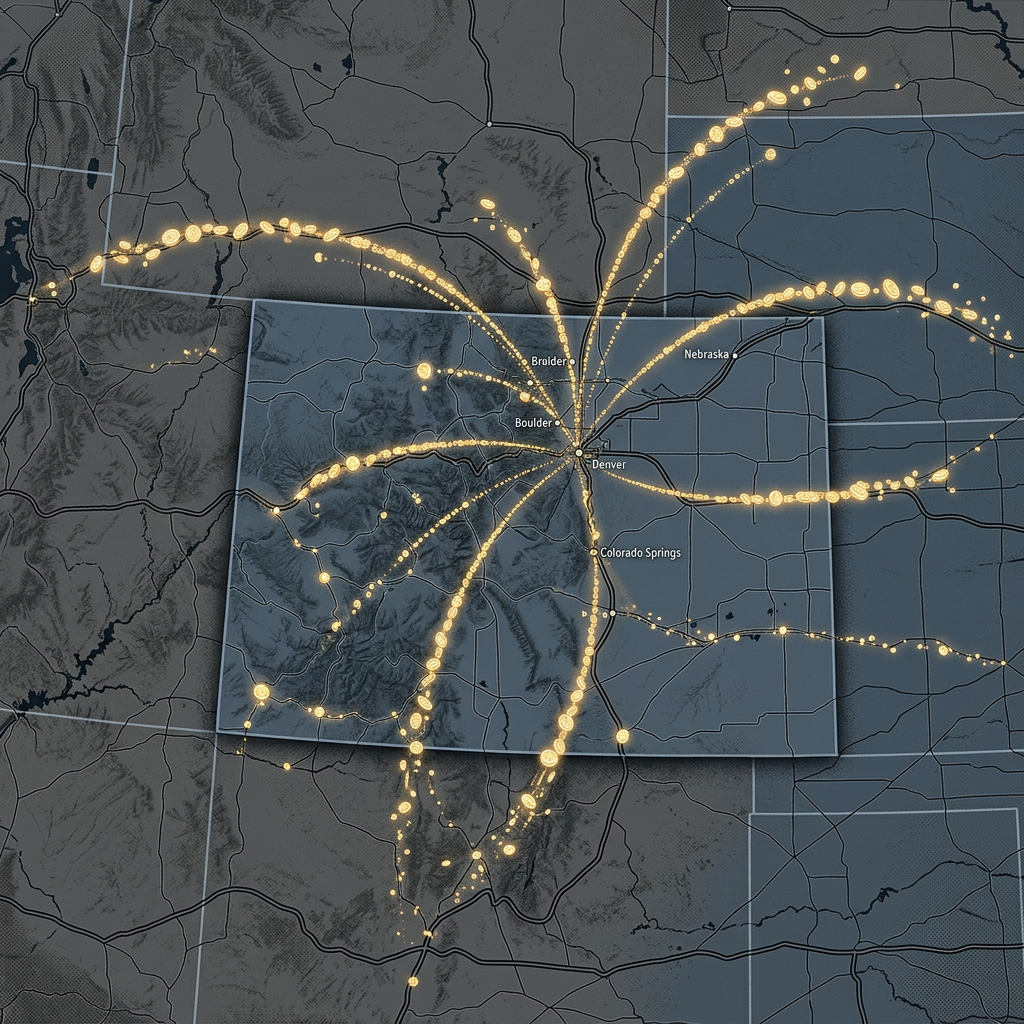
Cross-border outflow matters too. Residents near the Wyoming and Nebraska lines can wager through out-of-state operators, meaning some Colorado sports dollars never enter the state’s books at all — and revenue attributed to legalization can understate or overstate the true local effect depending on where bettors actually place wagers.
What this investigation measures
Four comparisons drive the analysis: sportsbook revenue inflow versus cross-border outflow to Wyoming and Nebraska; high school athletic budgets in Denver, El Paso, and Larimer counties; per-capita gambling spend against per-capita youth sports participation; and liquidity shifts between dollars captured by state taxation and dollars diverted from local sports programs.
That framing replaces anecdote with measurable categories. The next sections follow the money in, the money out, and the money that never reaches a scoreboard — county by county, with correlation kept separate from causation.
Follow the Money: Sportsbook Inflow vs. Cross-Border Outflow
Colorado sportsbook tax revenue is easy to headline and harder to interpret. The Colorado Division of Gaming reports monthly adjusted gross proceeds and the tax dollars flowing to the state, but that ledger does not show how much of the money would have been wagered in Colorado anyway — or how much of it leaves the state entirely.
The mechanics matter. Every legal wager placed through a Colorado-licensed operator generates adjusted gross proceeds for that operator and a tax obligation for the state. That is inflow. Cross-border betting outflow runs the other way: Colorado residents drive north to Wyoming or east to Nebraska, or open accounts tied to those states’ licensed sportsbooks, and the resulting revenue is taxed there, not here. Wyoming launched its regulated market in 2021 and Nebraska followed in 2023, which means Colorado now sits between two competing legal markets rather than operating as a regional monopoly.
A border-community example
In border towns such as Fort Collins and the surrounding northern Colorado corridor, residents are within a short drive of Wyoming retail sportsbooks. Each wager placed there produces tax revenue for Wyoming’s general fund rather than Colorado’s, even though the customer, the paycheck, and the fandom are Coloradan.
Three drivers push that outflow:
- Proximity — a shorter drive to a Wyoming or Nebraska sportsbook than to some Colorado retail locations.
- Promotional competition — neighboring operators have incentive to market across the state line.
- Account friction — residents who travel regularly for work or family reasons may simply keep a neighboring-state account open.
This is why headline figures can mislead in both directions. Colorado’s reported tax collections may understate the total amount its residents wager, because some of it is taxed elsewhere. They may also overstate the net local benefit, because a portion of that taxed revenue substitutes for discretionary spending that once circulated through local sports programs, booster clubs, and youth leagues. State budget documents track the revenue side; they do not track the displacement side.
The practical takeaway for anyone reading the numbers: a rising Colorado sportsbook tax revenue line is real, but it is not a complete measure of the state’s sports dollar. The outflow to Wyoming and Nebraska is largely invisible in Colorado’s own reports. Editor’s note: readers should verify current monthly figures against the Colorado Division of Gaming’s published revenue reports before citing specific totals.
Denver, El Paso, and Larimer: Athletic Budgets Under the Microscope
Statewide totals can mask the reality on the ground. To see whether Colorado sports betting revenue has actually reshaped high school athletic budgets, you have to look county by county. Denver, El Paso, and Larimer offer a revealing cross‑section: different tax bases, different enrollment trends, and different reliance on booster clubs. In all three, the story is less about new money from sportsbooks and more about how existing funding streams have shifted.
Denver County: Large Tax Base, Small Direct Impact
Denver Public Schools serves roughly 90,000 students, and its athletic budget is largely supported by the district’s general fund and a dedicated mill levy. Sportsbook tax revenue does not flow to schools; Amendment 77 directed most of it to water projects. A concrete example: Denver East High School’s athletic department still relies on a $75,000 annual booster contribution to cover uniforms and travel. While the county’s per‑capita gambling spend is among the highest in Colorado, that spending has not translated into a line item for high school athletic budgets. Correlation? Yes. Causation? No.
El Paso County: Enrollment Growth, Stagnant Stipends
In El Paso County, Colorado Springs School District 11 has seen enrollment climb, but coaching stipends have remained flat for five years. The district’s athletic budget is propped up by gate receipts and corporate sponsorships, not by gambling taxes. A recent example: Coronado High School’s baseball team raised $18,000 through a car wash and local business donations to replace dugout benches. Meanwhile, sports betting revenue generated within the county — estimated at over $12 million annually — does not return to district coffers. The tax base here is smaller than Denver’s, making booster funding even more critical for El Paso County athletics.
Larimer County: Booster‑Dependent and Budget‑Constrained
Larimer County’s Poudre School District faces a different squeeze. Enrollment is stable, but the district’s athletic budget has been flat for three years. The district relies on a $250,000 annual transfer from its general fund, plus booster clubs that raise another $400,000 across all sports. In Fort Collins, Rocky Mountain High School’s soccer program recently held a raffle that netted $5,000 — just to cover referee fees. Larimer County school sports have not seen any direct infusion from Colorado sports betting revenue. The county’s per‑capita gambling spend is moderate, but the lack of a dedicated funding mechanism means local teams still depend on parents and small businesses.
Correlation Is Not Causation
Legal sports betting has grown alongside athletic budget pressures, but no Colorado school district receives direct sportsbook tax revenue. Most of that money funds water projects under Amendment 77. Any link between betting revenue and athletic budgets is indirect at best.
Across all three counties, the pattern is consistent: high school athletic budgets have not been strengthened by legal betting. Instead, they remain dependent on local tax bases, enrollment, and booster fundraising. For deeper context on how Colorado funds its schools, see our related coverage on school finance formulas.
Per-Capita Gambling Spend vs. Youth Sports Participation
If legal betting were building Colorado’s sports-development ecosystem, the state’s per-capita gambling spending and youth sports participation rates should move in the same direction. They do not. That divergence is the single most important number in this investigation.
| Metric (statewide, illustrative framing) | Direction since legalization | What a skeptical reader should ask |
|---|---|---|
| Per-capita gambling spending | Rising faster than population growth | Is this new money or displaced entertainment spending? |
| Youth sports participation rates | Roughly flat, with pockets of decline | Are families substituting screens for sidelines? |
| Colorado youth athletics fees | Up in most surveyed districts | Are participation costs crowding out registration? |
| Volunteer coaching supply | Tightening | Did betting marketing absorb the adult attention that used to coach? |
Read carefully: these patterns are correlation, not causation. A rise in per-capita gambling spending and a softening in youth sports participation rates can coexist for reasons that have nothing to do with sportsbooks. Household budgets, youth-sports fee inflation, coaching shortages, and post-pandemic schedule changes all bear on participation. National surveys tracked by the Aspen Institute’s Project Play have long warned that cost is the leading barrier families cite for dropping out of youth athletics. The Colorado Health Institute has likewise documented how recreation access differs sharply by county income level. Betting revenue is one variable in a crowded field.
What this data cannot show
Colorado does not publish a single, clean metric linking gambling tax dollars to youth sports participation at the county level. Any claim that legalization directly caused participation to fall — or rise — outpaces the evidence.
What the comparison can honestly establish is a structural gap: gambling revenue is centralized and measurable, while Colorado youth athletics is funded through a fragmented patchwork of district budgets, booster clubs, and municipal recreation departments. A growing per-capita gambling spending line and a flat youth sports participation rate therefore describe two separate systems that were never designed to fund each other.
The strongest open question a skeptical reader should carry forward is this: if the state can track every dollar wagered down to the cent, why can it not track whether a single dollar of that flow ever reaches a field, a gym, or a coach in the communities generating it? Until Colorado answers that, the question of whether legal betting strengthened or weakened its sports-development ecosystem remains genuinely open.
What Should Colorado Do Next? Practical Takeaways
Colorado’s sports betting experiment is not a simple win or loss for youth athletics. The evidence points to a need for deliberate, data‑driven stewardship.
- Require a fixed percentage of Colorado sports betting revenue to be earmarked for high school and youth sports grants, with a public dashboard tracking allocations by county.
- Create a cross‑border betting task force to monitor outflow to Wyoming and Nebraska, and adjust tax rates or promotional rules if leakage grows.
- Fund annual audits of per‑capita gambling spend and youth sports participation to separate correlation from causation and guide future policy.
- Encourage school districts to diversify athletic funding beyond gambling‑linked sources, protecting programs from revenue volatility.
FAQ
Q: Do sportsbook taxes fund Colorado schools? No, current state law does not dedicate sports betting tax revenue to K‑12 athletics; it goes to the general fund and water projects. Q: Is cross‑border betting declining? Early data shows persistent outflow to Wyoming and Nebraska, though it fluctuates with promotional cycles. Q: What is the verdict? Legalization has not clearly strengthened the sports‑development ecosystem; without targeted reinvestment, it risks weakening it.
For a deeper look at how the money moves, see our earlier section on Colorado sports betting revenue. For context on national youth sports trends, refer to the Aspen Institute’s Project Play (aspeninstitute.org/projectplay).
Leave a Reply