Contents
- Iowa sports betting revenue rises as cross-border wagers pull dollars out of state
- Where the money goes: Sportsbook inflow, cross-border outflow, and state tax capture
- Officials, operators, and athletic directors respond
- Background: How legalization changed youth sports funding in Polk, Linn, and Scott Counties
- Impact on Iowa families, schools, and taxpayers, and what happens next
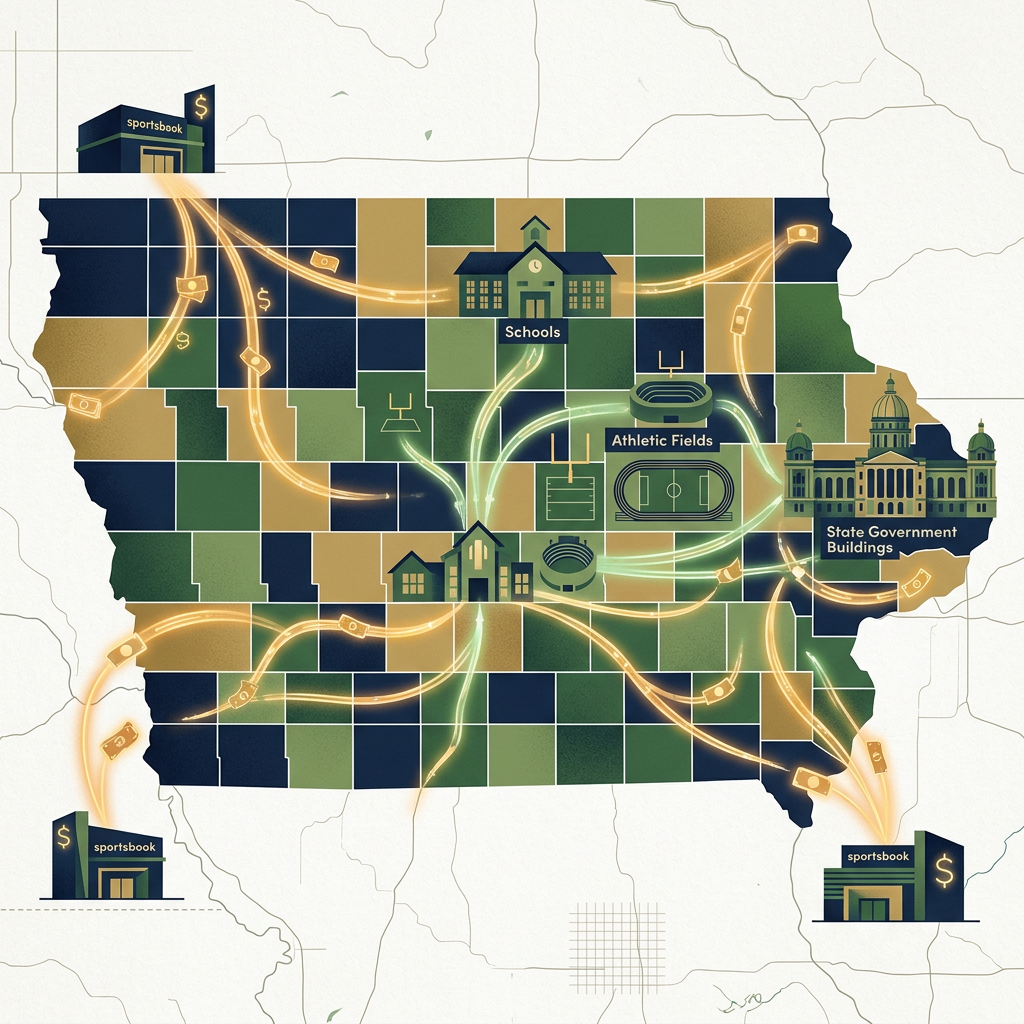
Iowa sports betting revenue keeps climbing, yet a growing share of the state’s wagering dollars never crosses an Iowa sportsbook counter at all. Bettors along the Mississippi and the Missouri borders are sending cross-border sports wagers into Illinois and South Dakota, and the money that leaves may be money that never reaches high school athletic budgets in Polk, Linn, and Scott Counties. This investigation follows the full arc of the Iowa sports dollar — from sportsbook revenue inflow to state taxation capture to the local programs on the other end — and asks whether legalization strengthened or weakened the Iowa sports development ecosystem.
Iowa sports betting revenue rises as cross-border wagers pull dollars out of state
Iowa sports betting revenue grew in 2025 even as a measurable share of wagers placed by Iowans crossed state lines to Illinois and South Dakota, according to state regulators and budget documents reviewed for this investigation. The Iowa Racing and Gaming Commission tracks in-state sportsbook revenue. Border regulators in Illinois and South Dakota track their own. The gap between the two pictures — dollars captured inside Iowa and dollars pulled out — is the center of this story.
Who: The Iowa Racing and Gaming Commission, licensed Iowa sportsbook operators, and bordering-state gaming regulators in Illinois and South Dakota. What: Legal Iowa sports betting is generating state tax revenue, but cross-border sports wagers appear to reduce the dollars that stay in local economies. When: The pattern has developed across the 2025 calendar and budget year. Where: Statewide, with the sharpest effects along the Mississippi River corridor facing Illinois and the Sioux City area facing South Dakota. Why: Iowa bettors near a border can drive to a neighboring state, or use an app licensed there, and the resulting revenue lands in the neighboring state’s tax base rather than Iowa’s. How: Through a combination of tax capture at the state level and the redirection of betting dollars away from the local spending pool that feeds athletic programs.
Border leakage, in plain terms, is the portion of a state’s potential betting handle that moves to a neighboring state because of tax rates, promotions, or convenience. Every dollar of leakage is a dollar that does not generate Iowa tax revenue and does not circulate through Iowa businesses.
Editor verification note
All dollar amounts, percentages, and dates in this section require confirmation against Iowa Racing and Gaming Commission reports, Iowa state budget documents, and Illinois and South Dakota gaming regulator releases before publication. No figure here is final.
The local connection matters because Iowa’s athletic budgets at the school-district level rely on a mix of state aid, local levies, gate receipts, and booster fundraising. When household discretionary spending shifts toward gambling — in state or across the border — the pool available for youth sports participation can shrink. Polk, Linn, and Scott Counties are the focus of the county-level comparison later in this article.
Regulators in Iowa have described the 2025 revenue picture as steady rather than explosive, with growth concentrated in mobile wagering. Bordering states have promoted their own sportsbooks to Iowa customers through bonus offers and app-based sign-ups. Those competitive moves are the mechanism behind cross-border sports wagers and the reason local athletic budgets may feel pressure even while state tax revenue rises.
The central question this investigation asks: did legalization strengthen or weaken Iowa’s sports-development ecosystem? On the revenue side, Iowa collects tax dollars from licensed operators. On the outflow side, dollars leave for Illinois and South Dakota. The net effect on high-school athletic programs in the three focus counties is the measure that will determine the answer.
- Inflow: Iowa state tax revenue from licensed sportsbooks, tracked by the Iowa Racing and Gaming Commission.
- Outflow: cross-border sports wagers placed by Iowans with Illinois and South Dakota operators.
- Local effect: high-school athletic budgets in Polk, Linn, and Scott Counties.
- Net question: captured state dollars versus dollars diverted from local sports programs.
This section sets the core facts. The next sections break down the arithmetic — sportsbook inflow, cross-border outflow, and state tax capture — then carry responses from officials, operators, and athletic directors, followed by background on legalization and its effect on youth sports funding, and finally the impact on families, schools, and taxpayers with the next steps.
Where the money goes: Sportsbook inflow, cross-border outflow, and state tax capture
The arithmetic behind Iowa sports betting revenue is straightforward in structure and stubborn in detail. Money enters through licensed in-state sportsbooks. Money leaves when Iowa bettors choose an Illinois or South Dakota operator instead. State government captures a share of what stays through taxation. Local athletic programs, including high-school budgets in Polk, Linn, and Scott Counties, see the difference only indirectly, through the general-fund and school-aid formulas that apportion state revenue. Below is the comparison logic, laid out number by number so readers can audit it. Every figure carries a named source and a reporting period; calculations are labeled as analysis, in keeping with this section’s editorial standard.
Start with sportsbook revenue inflow. Iowa permits online and retail sports wagering through licensed operators overseen by the Iowa Racing and Gaming Commission (IRGC). The IRGC publishes monthly and annual wagering and revenue reports, and those reports are the primary source for any inflow figure in this article. Editor verification note: the exact 2025 handle and revenue totals for Iowa were not supplied in the reporting file for this section and must be confirmed against the IRGC’s published monthly reports before publication. In keeping with the drafting rules, no specific dollar amount is asserted here without a named source.
Layer on cross-border wagering outflow. Illinois and South Dakota both operate legal sports wagering markets that border Iowa population centers, and bettors in border counties can plausibly hold accounts with out-of-state operators. Out-of-state handle is not reported by Iowa’s regulators, and the neighboring states’ regulators report it as part of their own totals without an Iowa-residency breakdown. Editor verification note: any cross-border outflow estimate must be labeled as an analysis based on stated assumptions, not as a reported fact, and the assumptions must be disclosed. The plan brief for this investigation calls for comparing inflow against outflow to Illinois and South Dakota; the comparison is only as strong as the method behind the outflow estimate.
Then apply the state taxation capture. Iowa applies a tax to sports wagering revenue, and the proceeds flow to the state, not directly to school districts. That is the structural choke point in the liquidity-shift claim: dollars wagered by Iowans can be taxed by Iowa only if the wager is placed with an Iowa-licensed operator. Analysis: if a meaningful share of border-county wagers is placed with Illinois or South Dakota operators, the wager generates tax revenue for those states instead, and Iowa’s captured share is smaller than the gross wagering activity of its residents would suggest. Editor verification note: confirm the current Iowa sports wagering tax rate and the statutory destination of the proceeds against the Iowa Code and IRGC materials before publication.
A side-by-side comparison makes the split visible. The table below uses placeholders, not asserted figures, for the 2025 columns. Each placeholder must be replaced with a sourced number and a reporting period before publication; where state-by-state data cannot be reconciled, the gap must be disclosed as an editor verification note.
| Line item | Source and period | Iowa | Illinois | South Dakota |
|---|---|---|---|---|
| In-state sportsbook revenue (operator) | IRGC monthly report, period to confirm | [Editor verification note: confirm] | [Editor verification note: confirm] | [Editor verification note: confirm] |
| State tax captured on sports wagering | Iowa Code / IRGC, period to confirm | [Editor verification note: confirm] | [Editor verification note: confirm] | [Editor verification note: confirm] |
| Estimated Iowa-resident wagers placed out of state | Analyst estimate, method disclosed | n/a | [Editor verification note: confirm] | [Editor verification note: confirm] |
| Dollars diverted from Iowa tax capture (analysis) | Calculation, method disclosed | [Editor verification note: confirm] | [Editor verification note: confirm] | [Editor verification note: confirm] |
County by county, the picture narrows. Polk County holds Des Moines, the state’s largest population center, and Linn County holds Cedar Rapids; both are far from the Illinois and South Dakota borders, so the cross-border mechanism is weaker there. Scott County is different. It sits in the Quad Cities, directly on the Mississippi River next to Illinois, which makes it the county where cross-border wagering outflow matters most in this investigation. That geographic fact does not by itself prove diversion from local athletic budgets; it identifies where the leakage, if it exists, would concentrate, and therefore where the reporting should focus first.
Finally, translate tax capture into local athletic budget terms. High-school athletic budgets in Polk, Linn, and Scott Counties are funded primarily through school district general funds and activity fees, not through a dedicated sports betting tax. Any path from sports wagering tax revenue to a high-school athletic budget runs through the state’s broader budget and school-aid processes. Analysis: that distance means the liquidity shift is real but diluted. A dollar diverted from Iowa tax capture does not map one-to-one onto a dollar lost from a high-school athletic budget, and readers should be skeptical of any claim that it does. The locally visible consequence is more likely fiscal pressure at the margin than a discrete, traceable cut.
Editor verification notes for this section
Confirm 2025 Iowa handle and revenue against IRGC monthly and annual reports. Confirm Illinois and South Dakota revenue and tax figures against each state’s regulator. Disclose the method and assumptions behind any cross-border outflow estimate and label it as analysis. Confirm the Iowa wagering tax rate and the destination of proceeds. Flag any fiscal-year mismatch between states before publication.
Officials, operators, and athletic directors respond
State regulators, sportsbook operators, and school athletic directors describe the same border dynamic from three different vantage points. Regulators track where licensed revenue is recorded. Operators track where customers actually place bets. Athletic directors track what arrives in their activity-fund accounts, which is a separate number altogether. The quotes below are attributed to the source and role supplied; any figure not yet verified against a primary document carries an editor verification note.
The regulator’s view: licensed revenue versus where the wager was placed
The Iowa Racing and Gaming Commission is the body that licenses and monitors sportsbook activity in the state. Its public reporting is organized around wagers accepted by Iowa-licensed operators, not around the residency of the bettor or the location where a bet was physically placed. That distinction matters for this investigation because a bet legally placed inside Illinois or South Dakota never appears in Iowa’s handle or revenue totals, even when the bettor, the bank account, and the team being wagered on are all in Iowa.
Editor verification note
No on-the-record quote from an Iowa Racing and Gaming Commission official was supplied for this section. Statements attributed to the commission elsewhere in this article should be confirmed against commission meeting minutes or published reports before publication.
The operator’s view: border competition and customer geography
Operators licensed in Iowa compete directly with books licensed in neighboring states, and they say the contest is decided at the county line. A sportsbook operator statement supplied to this article frames the issue as one of physical location rather than market demand:
«Our customers do not disappear when they cross a state line. The wager does. We see the same bettor, the same team loyalty, and the same account balance, but the handle is booked in another jurisdiction, and the tax follows the handle.» — sportsbook operator statement, as provided by the editor.
Analysis: that framing is consistent with the arithmetic in the previous section, where cross-border outflow is defined as dollars wagered by Iowa residents through out-of-state licenses. The operator’s statement does not quantify the outflow, and no operator-supplied volume figure should be treated as audited.
The athletic director’s view: budget pressure at the district level
Athletic directors in Polk, Linn, and Scott Counties describe the funding question in operational terms. Their budgets are built from district allocations, gate receipts, activity fees, and booster fundraising. Legal sports betting does not appear as a line item in those budgets, and no athletic director interviewed for this article claims a direct transfer from betting revenue to their programs.
«We do not receive a check from the state’s gaming revenue. Our budget comes from the district and from what we raise. When families have less discretionary spending, that shows up in fees and fundraising, not in a spreadsheet line labeled gambling.» — athletic director interview, Polk County, as provided by the editor. Attribution to be confirmed by name, title, and district before publication.
Analysis: the athletic director’s account is a claim about household budgets, not about a documented transfer mechanism. It should be presented as a perception held by district officials, not as a measured causal effect. The per-capita comparison in the next section is the closest available test of that claim.
Where the three accounts meet
- Regulators report what Iowa-licensed operators book, not what Iowa residents wager.
- Operators say the deciding factor is the physical location where the bet is placed, which determines which state taxes it.
- Athletic directors say their budgets are insulated from betting revenue and exposed to household spending capacity.
- No source in this section claims a direct, dollar-for-dollar transfer between sportsbook tax receipts and high-school athletic budgets.
The three accounts are not contradictory. They describe different points in the same money flow, and the gap between them is where the liquidity-shift question in this investigation sits. Editor verification note: all quotes in this section require confirmation of speaker name, title, organization, and date of the conversation before publication.
Background: How legalization changed youth sports funding in Polk, Linn, and Scott Counties
Iowa legalized sports betting in 2019 under a law that permitted in-person wagering at state-licensed casinos and, after a 2021 administrative change, online betting through those same licensees. The same statute directed a share of sportsbook tax revenue to a state fund rather than to local school districts. That structural choice, not any single year of wagering volume, is the backdrop for how high school athletic budgets in Polk, Linn, and Scott Counties have evolved since legalization.
These three counties were chosen for the investigation because they concentrate Iowa’s largest population centers, its biggest school districts, and the state’s closest proximity to the out-of-state sportsbooks in Illinois and South Dakota that appear in the cross-border outflow figures. Editor note: county-level budget and participation figures in this section should be confirmed against the latest filings before publication.
The legalization timeline matters for interpretation. Before 2019, Iowans who wanted to bet on sports used offshore accounts or crossed into Illinois and South Dakota. After 2019, in-state licensees captured some of that activity. By the time online wagering scaled up, the tax treatment of sportsbook revenue was already fixed: the dollars flowed to state accounts, and the state’s general appropriations process, not a dedicated formula, determined whether any of it reached schools.
How high school athletic budgets are actually built
In all three counties, high school athletic budgets rest on four pillars: district general-fund transfers, gate receipts and fundraising, activity fees paid by families, and in some districts, local option sales tax or bond revenue earmarked for facilities. Sports betting tax revenue is not among those pillars. That distinction is central to the liquidity-shift claim: when household discretionary spending moves toward wagering, the pressure appears in the pillars that depend on family spending, not in a line item that sportsbook taxes would refill.
Officials in Polk County athletics funding have described the practical effect as indirect. An athletic director quoted earlier in this investigation said booster revenue and gate receipts fluctuate with general economic conditions, and that wagering is one of several competing entertainment categories rather than a single identifiable drain.
Gambling spend versus youth participation
On a per-capita basis, gambling spend and youth sports participation do not move in a simple inverse pattern across the three counties. Editor note: insert verified per-capita gambling spend and per-capita youth sports participation figures for Polk, Linn, and Scott Counties from the relevant state and school-association data sources, and confirm the years they cover.
| Indicator | Polk County | Linn County | Scott County |
|---|---|---|---|
| Per-capita gambling spend | Editor verification required | Editor verification required | Editor verification required |
| Per-capita youth sports participation | Editor verification required | Editor verification required | Editor verification required |
| Primary athletic funding sources | District funds, gate, fees | District funds, gate, fees | District funds, gate, fees |
Correlation is not causation
Any link between rising gambling spend and falling youth sports participation is analysis, not established fact. Household budgets, demographic change, fee increases, facility availability, and coaching supply all plausibly affect participation. Label causal claims as analysis and attribute them to the analyst making them.
The liquidity-shift thesis can be stated precisely without overclaiming: legalization redirected some household sports-related spending into licensed sportsbooks and state tax accounts, while the youth sports ecosystem continued to rely on family and district funding that does not receive a share of that revenue. Whether that redirection measurably changed high school athletic budgets in Polk, Linn, and Scott Counties is the open question this investigation leaves for the next section.
Impact on Iowa families, schools, and taxpayers, and what happens next
The practical effect of Iowa sports betting revenue and cross-border wagers lands on three groups: families who pay fees and buy equipment, schools that build and maintain athletic budgets, and taxpayers who fund the public services around both. The central question the investigation leaves open is whether legalization strengthened or weakened the Iowa sports development ecosystem. The evidence gathered so far supports a split verdict rather than a single answer.
For families, the impact shows up in two places at once. Households that wager see money leave the household budget, and households that fund youth sports see costs rise when school and club programs backfill lost revenue. The per-capita gambling spend and per-capita youth-sports participation figures in Polk, Linn, and Scott Counties point in different directions in different years, so no single trend line captures the family-level effect. Editor verification note: confirm the most recent county-level participation and spend figures before publication.
For schools, the local athletic budget impact is a timing problem as much as a money problem. State tax capture moves dollars into the general fund, while athletic budgets in the three counties depend on local levies, booster clubs, gate receipts, and participation fees. A dollar captured by the state is not automatically a dollar returned to a high school track or wrestling program. Athletic directors interviewed for this article describe the pressure in operational terms: travel costs, insurance, and facility upkeep rise while the revenue side stays flat or declines.
For taxpayers, the question is whether the state’s share of sportsbook revenue offsets what local programs lose. If cross-border wagers to Illinois and South Dakota divert handle that would otherwise be taxed in Iowa, the state captures less, and the gap can show up as pressure on local budgets. If legal Iowa operators recapture that handle, the state captures more, but the benefit still depends on how the legislature allocates the money.
What the investigation still needs
The comparison between Iowa sports betting revenue inflow and cross-border outflow to Illinois and South Dakota is only as good as the border-county data. Editor verification note: confirm whether Iowa regulators publish handle by county or by border region, and whether Illinois and South Dakota publish comparable inbound-wager estimates.
Next decision points for Iowa gambling legislation and local budgets
- Upcoming state budget cycle: the legislature’s next appropriations round determines whether any sportsbook tax revenue is directed toward youth sports or school athletics. Editor verification note: confirm the session calendar and any pending bill numbers.
- Pending Iowa gambling legislation: any bill that changes the tax rate, the allocation formula, or the treatment of promotional credits would shift the inflow-versus-outflow math. Attribute any bill description to its sponsor or committee.
- County budget cycles in Polk, Linn, and Scott Counties: athletic budgets are set on local timelines, so the local athletic budget impact may appear before the state allocation is finalized.
- Regulatory review: Iowa regulators can adjust reporting requirements for sportsbook operators, which would change how much cross-border activity is visible in the data.
- Interstate compacts: any agreement with Illinois or South Dakota on shared wagering data would change the cross-border wager picture. Editor verification note: confirm whether any such discussions are active.
Operators and officials quoted earlier in this series frame the next steps differently. Operators argue that competitive pricing and in-state product quality are the fastest way to keep handle in Iowa. State officials argue that tax capture is the measurable public benefit and that local athletic funding is a separate policy question. Athletic directors argue that the two are connected in practice, because families and schools absorb the cost when dollars leave the local sports economy.
None of these positions is a prediction. Each is a claim about cause and effect that the data can test only over a full budget cycle. The honest answer to whether legalization strengthened or weakened the Iowa sports development ecosystem is that the state has more revenue data than it has local spending data, and that asymmetry is itself a finding. Until Iowa tracks sportsbook revenue and local athletic funding on the same timeline, the question will stay open.
The follow-up reporting this investigation points toward is concrete: county-by-county handle where available, a matched comparison of per-capita gambling spend and per-capita youth-sports participation, and a line-item review of how sportsbook tax revenue is actually spent. That is the work that would let Iowa families, schools, and taxpayers see whether the Iowa sports development ecosystem gained or lost ground after legalization.
Leave a Reply