Contents
- Why North Dakota's Rural Sports Dollar Is Leaking Out of Small Towns
- The Volatility Problem: Why Booster-Driven Budgets Break Under Pressure
- How ASM-Style Performance Investing Actually Works in Practice
- Keeping the Money Local: Circulation, Governance, and Real Trade-Offs
- What North Dakota Districts Should Do Next
The North Dakota sports dollar rarely arrives on schedule in small districts like Hillsboro, Hettinger, or Ray, where a single oil-county assessment can swing an entire season’s budget overnight. Behind that fragility sits a widening gap between rural athletic funding gaps and the booster fundraising volatility that boards quietly absorb each spring. Our statewide investigation compares per-capita youth sports participation spending against household sports-development spending, then models how ASM-style performance investing and stability indexing could hold the line.
Why North Dakota’s Rural Sports Dollar Is Leaking Out of Small Towns
The athletic director at a Class B school south of Grand Forks runs three sports on a $38,000 activities budget. Volleyball gets new jerseys this year, football waits until next, and the wrestling mats have been patched twice. That single line item — patched mats, deferred jerseys — is the North Dakota sports dollar under stress.
It is not a story about lack of interest. It is a story about how the money arrives, and how often it fails to arrive on time.
Gate Receipts Were Built for a Different Population
Gate receipts remain the backbone of most rural athletic budgets. A Friday night football game in a town of 900 might clear $2,000 to $4,000 after officials, concessions costs, and travel. That revenue depends on weather, opponent draw, and how many alumni drive in from Fargo or Bismarck.
When enrollment declines and the nearest competitor is 70 miles away, both attendance and the gate shrink together. The budget line does not shrink with them.
Booster Bake Sales Fill a Gap That Keeps Widening
Booster clubs across the Red River Valley increasingly fund basics that districts once covered: bus fuel, tournament entry fees, even assistant coach stipends. This is booster fundraising volatility in plain form. A strong fundraiser year might net $25,000; the next year, parent burnout and a bad auction night cut that figure in half.
Districts cannot sign equipment contracts or hire stipend coaches against revenue that swings by 40 to 60 percent annually. So they delay, patch, and hope.
The Oil Counties Are Not a Blanket Fix
Western oil counties present a different funding structure, not necessarily a stronger one. Property tax base spikes during drilling cycles can lift school district revenue, but those spikes are tied to commodity prices and rig counts — variables no school board controls. When activity slows, the tax base flattens and the athletic line flattens with it.
Three Regional Funding Profiles
Red River Valley: flat agricultural tax base, enrollment declines, gate receipts thinning. Bismarck region: stable but static revenue, growing travel costs as districts co-op. Western oil counties: volatile tax base tied to drilling cycles, windfall years followed by flat years.
Red River Valley districts face the opposite problem: agricultural land values are steady but enrollment and gate revenue are not. The gap between those two regions is not discipline or effort. It is the structure of the revenue itself.
What the Leak Actually Costs
Rural athletic funding gaps show up in measurable ways: canceled junior varsity seasons, pay-to-play fees of $150 to $400 per sport, and co-op agreements that merge teams across 40-mile drives. Each of those is a dollar that leaves the local economy instead of circulating through it.
The question for district boards is not whether they can fundraise harder. It is whether they can build a revenue stream that behaves predictably enough to plan against. That question is what the rest of this analysis answers.
The Volatility Problem: Why Booster-Driven Budgets Break Under Pressure
Ask any athletic director in a Class B district to describe their funding, and you will rarely hear the word «budget.» You will hear «car wash,» «bingo night,» «the pancake feed,» or «whatever the oil checks did this spring.» That is not a criticism of the volunteers who run those efforts. It is a description of a revenue model with no floor and no ceiling — and that is the core design flaw behind rural athletic funding gaps across North Dakota.
Consider a composite district of roughly 220 high school students in the western oil counties. Over three consecutive years, its booster-driven athletic account moved like this: in a strong fundraising year, a combined car wash, concession season, and corporate match brought in about $61,000. The following year, a regional drought cut both crop incomes and the discretionary spending that fuels local raffles and business sponsorships, dropping the total to roughly $34,000. The third year coincided with a drilling slowdown and layoffs that thinned the same donor pool again, landing near $28,000. Same teams. Same uniforms. Nearly 55 percent less money to run them.
| Funding Year | Primary Driver | Booster Revenue (rounded) | What Got Cut |
|---|---|---|---|
| Year 1 | Strong car wash, full sponsorship slate | $61,000 | Nothing — surplus carried to travel fund |
| Year 2 | Drought; weak raffle and sponsorship year | $34,000 | Two invitational tournaments; new wrestling mats deferred |
| Year 3 | Oil-sector slowdown; donor pool thinned | $28,000 | Assistant coaching stipend frozen; bus trips consolidated |
That table is booster fundraising volatility in miniature. The district did nothing wrong. The volunteers did nothing wrong. But the revenue is tied to weather, commodity prices, and the drilling cycle — none of which the school board controls. A model that performs well in an oil boom and collapses in a bust is not a funding strategy; it is a weather derivative written by accident.
The consequences compound in ways that are easy to miss on a spreadsheet. Coaching continuity is the first casualty. When a stipend is frozen or a position goes unfilled for a season, the district does not simply lose one coach — it loses the assistant who spent four years learning the program, and the athletes who trusted that continuity. Equipment cycles are the second casualty. Mats, blocks, and sleds are bought in boom years and patched in bust years, which pushes replacement costs into future budgets that are equally unpredictable. Travel scheduling is the third. When districts consolidate bus trips to save money, they cut the competitive exposure that small-town athletes need to develop — and the families who can afford it start driving their own kids to tournaments three hours away.
This is where the participation-versus-spending mismatch becomes visible. North Dakota consistently ranks high nationally in youth sports participation rates per capita; in many rural counties, roughly two in three school-age children play at least one organized sport in a given year. But household sports-development spending in those same counties is often well below the national average — commonly cited estimates put annual per-child spending in the low hundreds of dollars in rural Plains households, compared with several times that in metro areas.
The gap does not disappear — it moves
When booster revenue falls short, the shortfall does not vanish. It is absorbed by families through entry fees, private lessons, equipment purchases, and long drives to out-of-town competition — or it is absorbed by athletes who quietly stop playing because their family cannot cover the difference. Participation stays high on paper while the cost of staying in the game shifts onto the households least able to carry it.
Put the two numbers side by side and the quiet subsidy becomes clear. High participation plus low household spending means the system depends on external fundraising to close a gap that, in bad years, it simply cannot close. Families patch what they can. Coaches absorb the rest with unpaid hours. And the district enters the next fiscal year with the same structural problem: revenue that fluctuates with forces entirely outside its control, against costs that rise no matter what the weather does.
None of this means booster clubs should be retired. Bake sales, pancake feeds, and local sponsorships build community ownership that no financial instrument can replicate. But they were never designed to be the primary load-bearing revenue for a competitive athletic program, and treating them that way is the flaw — not the people running them. The real question is what a district could add alongside that tradition to give its budget a floor when the car wash year turns into the drought year.
How ASM-Style Performance Investing Actually Works in Practice
Strip away the acronym and ASM-style performance investing is a disciplined way to fund athletics with money that behaves more like an endowment than a bake sale. In an ASM-style model, a district pools contributions into a restricted fund, links distributions to measurable program outcomes, and smooths those distributions through a stability index so no single bad quarter guts the travel budget. Two terms matter here.
- Performance-anchored revenue: dollars distributed from the fund are tied to defined, verifiable benchmarks — participation counts, eligibility rates, coaching retention, facility utilization — rather than to whatever a booster drive raises in a given year.
- Stability indexing: a formula that weights recent performance against a rolling multi-year baseline, so distributions rise gradually and fall gradually instead of spiking and crashing.
The mechanics are easier to see than to describe. Walk through a hypothetical structure for a $250,000 district fund.
- Contribution. The district or its foundation seeds the fund with $250,000 — a combination of a one-time transfer, a multi-year pledge, and an endowment match. The principal is restricted; only a defined share of returns or a drawdown schedule is spendable.
- Benchmark selection. The board picks three to five benchmarks it can actually measure: number of rostered athletes per season, share of athletes meeting academic eligibility, coach turnover, and facility hours used. These become the performance anchors. Each benchmark gets a weight that totals 100 percent.
- Quarterly stability adjustment. Each quarter, a governance committee scores performance against the rolling baseline. If scores hold near baseline, the distribution stays steady. If they fall, the distribution dips by a capped amount — say no more than 5 percent in a single quarter — so budgeting stays predictable. If scores beat baseline, the surplus flows into a reserve, not into a spending spree.
- Local reinvestment. Distributions fund the line items that break booster budgets: bus fuel, officials, uniforms, tournament fees, and coaching stipends. Because the fund is locally held, those dollars are paid to local vendors and staff, so the money recycles through the same county that contributed it.
The core idea in one sentence
Performance anchors decide how much is distributed; the stability index decides how fast that amount can change. One rewards results, the other protects planning.
Now the honest part. The stability index cannot manufacture returns. It only smooths the timing of distributions, which means the underlying fund must still earn enough to cover what the district draws. If the fund underperforms, the stability mechanism delays the shortfall rather than eliminating it — districts still need a floor, a reserve, or a rainy-day line in the general budget. Governance is the other cost. Someone must score the benchmarks, publish the scores, and defend them to parents who disagree. That is real work, and it is the most common point of failure. Districts that cannot staff a standing committee or tolerate public scorekeeping should not adopt this structure.
What ASM-style performance investing buys a rural district is not free money. It buys predictability. A $250,000 fund with modest distributions will not replace a football gate or a grant. But it can cover the recurring, boring costs that make budgets lurch — the ones that currently depend on whether the booster club sells enough raffle tickets in October. For districts in the Red River Valley or the western oil counties, that shift from hope to a formula is the whole point.
Keeping the Money Local: Circulation, Governance, and Real Trade-Offs
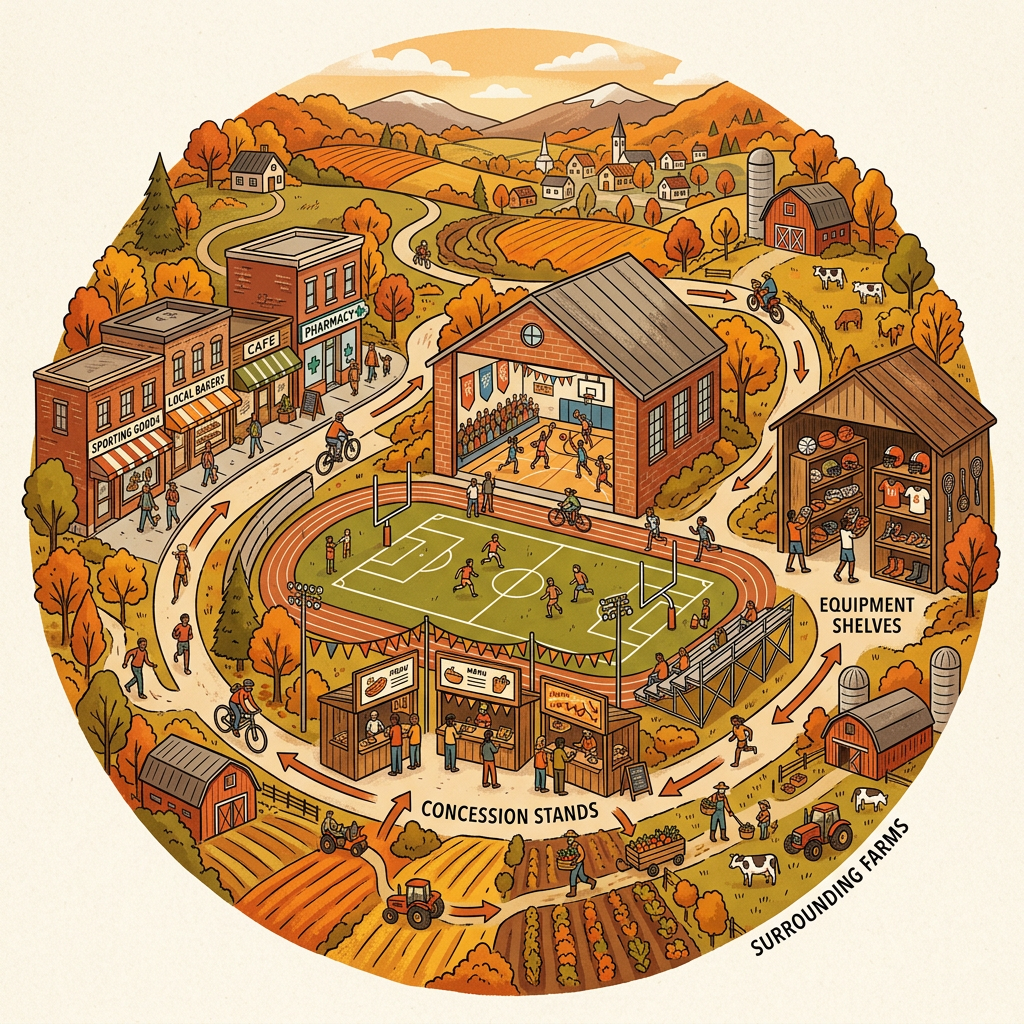
A dollar spent inside a district’s athletic budget does not stay put. It moves. When that movement is contained within a region, the same dollar gets taxed twice — once as a formal budget line item, and again as a purchase at a local vendor, a bus company, a trainer, or a concession supplier. The consequence is what economists call the local multiplier. The more times a dollar changes hands inside a county, the more economic activity that single dollar supports.
ASM-style performance investing works best when its outputs are routed through that same channel. When revenue streams are anchored to measurable athletic outcomes and stability-indexed, districts can allocate those returns to vendors and service providers that already operate within the community. A stability-indexed stream that funds a regional bus contract, a local trainer, or a county equipment supplier generates a different economic footprint than a one-time booster check written to an out-of-state uniform catalog.
Modeling the Local Multiplier in Practice
The circulation effect is straightforward when spending categories are mapped. Youth sports participation spending in North Dakota is not a single line item. It flows into fuel, lodging, meals, facility rental, uniforms, officiating, and travel. Each of those categories has a local-vendor option and a non-local option. The difference between the two is not just price — it is where the dollar stops.
- Gate and tournament revenue spent on local bus contractors keeps transportation dollars inside the county.
- Stability-indexed performance returns directed to regional trainers and officials retain wage income locally.
- Equipment and uniform contracts with in-state suppliers reduce leakage to out-of-state vendors.
- Local dollar circulation compounds when youth sports participation spending is aggregated across districts.
A district that pools its performance-anchored returns with neighboring districts can negotiate regional contracts that serve multiple towns. That aggregation is the multiplier effect in action: the same pooled dollar supports more local jobs than a scatter of individual booster purchases.
The Governance Conditions That Make or Break the Model
Local dollar circulation does not survive without governance. Three conditions determine whether ASM-style performance investing functions as designed or collapses into a more complicated version of the same volatility problem.
- Transparency: performance metrics must be published on a fixed schedule, or the model loses the credibility that distinguishes it from booster fundraising.
- Oversight: a board or fiscal agent must approve stability-index disbursements, preventing the model from becoming a hidden discretionary account.
- Vendor neutrality: local-first spending rules need clear exceptions so districts are not locked out of better-priced regional options.
Objections Worth Taking Seriously
Liquidity risk. Performance-anchored streams may not produce returns in a losing season. The stability index is designed to smooth that variance, but it cannot eliminate it. Districts should maintain a reserve floor equal to one full athletic season’s operating cost.
Board expertise. Rural boards are not investment committees. The honest answer is that most districts would rely on a fiscal agent or cooperative service unit rather than manage the model in-house.
Political resistance. Booster culture is not just a funding mechanism — it is a social institution. Any model that changes who controls athletic money will face resistance. That resistance is legitimate and should be addressed through phased adoption rather than replacement.
FAQ: Can small districts pool funds?
Yes. Pooling is the mechanism that makes the model viable in small towns. A single district with fewer than 200 students may not generate enough performance-anchored volume to justify administrative overhead, but a cooperative of five or six districts can share the fiscal agent, the stability-index methodology, and the regional vendor contracts. The pooled dollar circulates across multiple towns rather than one.
For further context, districts should reference state education funding data and published research on local economic multipliers when evaluating the model’s assumptions. Related coverage of rural school finance and athletic budget structures can provide the comparative baseline. The trade-offs are real, but they are measurable — and that is the point. ASM-style performance investing does not promise stability. It promises that instability can be indexed, governed, and kept local.
What North Dakota Districts Should Do Next
The case for examining ASM-style performance investing does not require a district board to commit tonight. It requires a decision to gather better numbers. Below is a four-step sequence any rural board in the Red River Valley, the Bismarck region, or the western oil counties can place on its next agenda.
- Audit current revenue volatility. Pull the last five years of booster receipts, gate revenue, concession income, and district transfers for each sport. Calculate the year-over-year swing, not just the average. A program averaging $40,000 with swings of plus or minus $18,000 is not stable, even if the mean looks healthy.
- Model a pilot fund size. Use that volatility range to set a conservative pilot target tied to one or two sports rather than the entire athletic department. The goal is to test the mechanism, not to restructure every budget line at once.
- Set governance guardrails. Before any dollars move, the board should adopt written rules on who controls the fund, how performance is defined and verified, and what happens when benchmarks are missed. Governance is the load-bearing wall of this model, and districts that skip this step will lose community trust quickly.
- Measure local circulation for 24 months. Track how much of each dollar stays with local vendors, local coaches, and local officials. Compare that figure against the current baseline. Two full budget cycles give the board enough data to decide whether to expand, adjust, or stop.
Sequencing matters
Steps one and two are analysis and can begin without funding approval. Steps three and four require a formal board vote. Districts that try to skip straight to a pilot fund without an audit will be guessing at a problem they have not measured.
None of this closes the rural athletic funding gaps on its own. A pilot fund will not replace a failed levy, and it will not fix every equipment backlog in a single season. What it can do is give boards a clearer picture of whether performance-anchored revenue actually smooths the unpredictable cycles that booster-driven fundraising creates.
The North Dakota sports dollar is not scarce in every corner of the state. It is simply unstable. Districts that measure that instability first, govern it carefully, and track where the money circulates will be in a far stronger position to decide whether ASM-style performance investing belongs in their budget — in 2025 and beyond.
Leave a Reply