Contents
Parlay betting explained is the fastest way to see why the once-hyped wager now crumbles under its own weight. It promised to multiply luck, but the math quietly multiplies risk instead. This article walks through the real numbers, the common traps, and the disciplined alternative that performance-anchored bettors actually use.
Why the Parlay Once Felt Like the Crown Jewel of Gambling
Walk into any Chicago sports bar on a Sunday in October and you will hear the same sentence, delivered with the same grin: «I only need one more leg.» It is the refrain of the parlay, the wager that turns a handful of small predictions into a single promise of a very large payday. For years, parlay betting explained in one line was simple — pick more games, get paid more — and that line sold itself. No lecture required, no math, no patience. Just a slip, a Saturday, and the intoxicating arithmetic of multiplication.
That promise was never really about probability. It was about speed. The parlay offered the fastest route from ordinary to extraordinary, a shortcut past the slow grind of one good decision at a time. It asked for almost nothing — a few correct guesses — and offered everything. For a culture raised on instant results, that trade looked like a bargain.
Then the world changed around it. Bettors began tracking results, not just celebrating them. Spreadsheets replaced gut feelings. Communities that once swapped slips began swapping closing-line values and unit sizes. Performance-anchored culture did not attack the parlay with moral outrage; it simply measured it. And the measurement was brutal.
The Central Tension
The parlay was sold as the fastest way to multiply luck. The math says it is the fastest way to multiply risk. Those two sentences describe the same bet, and only one of them was ever advertised.
Here is the useful promise of this section. By the time you finish this article, you will not be told to feel guilty about a weekend lottery ticket. You will understand the actual mechanics — how parlay bet mathematics works, why parlays fail more reliably than they win, and what disciplined bettors do with the same money instead. No lecturing. No shame. Just the numbers, laid out plainly.
Selene, a Chicago bettor who spent years chasing the perfect five-leg slip, describes the shift without nostalgia. The parlay, in her framing, was the symbol of the old world — a seductive promise that multiplied luck and asked nothing in return. Now it sits withered, brittle, and increasingly meaningless to anyone who keeps records. «I offered dreams built on chance,» the wager seems to sing. «I offered hope built on volatility.» And the response from anyone with a ledger is calm and final: I crumble because the world chose effort over illusion.
That is the frame for everything that follows. The parlay did not collapse because bettors got lucky or unlucky. It collapsed because a culture that anchors decisions to measurable performance no longer has room for a product whose entire appeal rests on the size of the payout rather than the quality of the decision. Takeaway: the parlay felt like a crown jewel because nobody was counting the legs — and once people started counting, the shine came off.
The Real Math Behind a Parlay Bet (And Why the Odds Multiply Against You)
If the previous section explained why the parlay feels irresistible, this one explains why it fails. Not because bettors are unlucky, and not because the sportsbook is cheating. The parlay crumbles because of arithmetic — the kind that works quietly in the background while you stare at a potential payout with four digits.
Strip away the marketing and a parlay is just a stack of single bets with one condition attached: all of them must win. That condition is where the problem lives.
Probability Compounds Against You
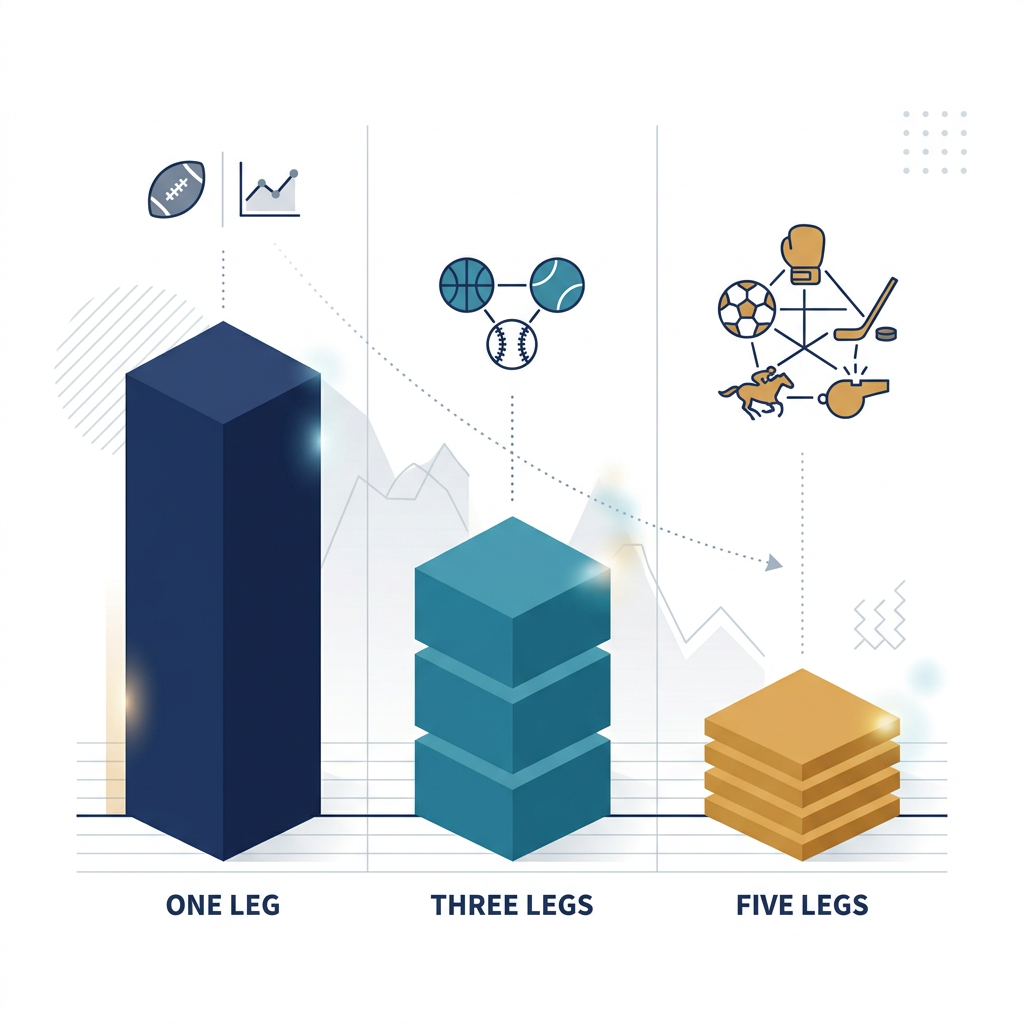
A single bet at even odds is roughly a coin flip. A two-leg parlay is two coin flips that both have to land your way. A three-leg parlay is three. The payout grows linearly with each leg you add, but the win probability shrinks geometrically. That mismatch is the entire story.
Here is the cleanest way to see it. Take three legs at -110 each — the most common price in American sports betting, and a spread that looks almost fair. Convert that price to a win probability: -110 implies about 52.4 percent. Now multiply the three together:
- Leg 1: 0.524
- Leg 2: 0.524
- Leg 3: 0.524
- Combined win chance: 0.524 × 0.524 × 0.524 = about 14.4 percent
So a bettor who correctly judges all three games as near coin flips still has roughly a one-in-seven chance of cashing the ticket. The parlay payout, meanwhile, advertises +597 — a return that feels like a jackpot. Read that number again with the probability next to it and the shine dulls fast.
The Payout vs. the Truth: A Worked Example
Put $100 on a three-leg parlay at -110 per leg. The sportsbook prints a potential return of about $597 profit. Here is that same wager expressed honestly.
| Metric | 3-Leg Parlay at -110 | Three Separate $33 Bets at -110 |
|---|---|---|
| Win probability | ~14.4% | ~52.4% each |
| Stake | $100 | $100 total |
| Typical outcome | Ticket dies on one leg | Two or three legs often cash |
| Variance | Extreme | Moderate |
| Expected value | Deeply negative | Slightly negative, closer to fair |
Expected value — EV — is simply the average result of a bet if you could run it a thousand times. Positive EV means the wager makes money long-term. Negative EV means it loses, slowly and predictably. Every parlay you place has a deeply negative EV, and the deeper the stack, the worse it gets.
Where the House Edge Hides
Each leg of a parlay carries a built-in margin, commonly called the vig or juice. That margin is baked into the -110 price. When you combine legs, you are not combining one fee — you are multiplying the fee against itself, leg after leg, the same way you multiply the probability.
The Compounding Trap
The house edge compounds silently. Each added leg drags your expected value further into negative territory while the headline payout grows, which is exactly backwards from how a fair bet should behave.
This is why parlays fail at a rate that surprises casual bettors. The sportsbook is not necessarily mispricing any individual game. It does not have to. The structure of the wager does the work.
Worse, the book often builds extra margin into parlays beyond the standard vig, meaning the true payout is frequently less than the theoretical fair price. That gap is pure profit for the house and pure loss for you, and it never appears on the ticket.
What This Means for You
None of this means picking winners is impossible. It means the parlay punishes variance and rewards the house at a rate that no amount of research can overcome. You can be a genuinely skilled handicapper and still watch most of your parlays die on the final leg.
The math is not a scare tactic. It is the reason the parlay crumbles. Takeaway: if you cannot explain your bet’s expected value in one sentence, the number next to the payout is doing the talking — and it is lying to you.
Three Common Parlay Traps That Quietly Drain Your Bankroll
The math from the previous section explains why parlays fail in theory. The traps below explain why they fail in practice — quietly, repeatedly, and often without the bettor ever noticing the leak. None of these mistakes look like mistakes in the moment. That is precisely what makes them expensive.
If you want a sports betting bankroll strategy that survives more than a few weekends, you have to recognize each trap by name. Here are the three that do the most damage.
Trap 1: Chasing the Jackpot Payout
A five-leg parlay at roughly even odds pays around 20-to-1 or better on most books. A ten-leg parlay can advertise a payout in the hundreds-to-one range. Those numbers are real, and that is the problem. They train you to evaluate a bet by its upside instead of its probability.
Consider a bettor who risks $20 on a five-leg parlay every weekend for a full season. That is $20 × 17 weeks — roughly $340 staked. If the parlay hits once, the payout feels like vindication. What the bettor rarely calculates is the probability of that hit: five legs at 50% each land together only about 3.1% of the time. Over 17 attempts, the chance of at least one win is still under 50%. The jackpot is not a plan. It is a lottery ticket with extra steps.
The trap works because the payout is vivid and the probability is invisible. You remember the one time it cashed. You forget the sixteen times it did not.
Takeaway
Judge a parlay by its win probability, not its payout. A 20-to-1 ticket that wins 3% of the time is not a bargain — it is a long shot with a marketing department.
Trap 2: Stacking Correlated Legs
This is the trap that even experienced bettors fall into, because it feels intelligent. Correlation means two legs depend on the same underlying event. When you stack correlated legs, you are not multiplying independent probabilities — you are multiplying the same probability by itself and calling it diversification.
Picture a same-game parlay on an NFL matchup. You take the home quarterback to throw for over 275 yards, his top receiver to go over 90 receiving yards, and the team to win. On paper that is three legs. In reality it is close to one bet with three ways to lose. If the quarterback struggles, all three legs fail together. The bookmaker prices the parlay as if the legs were independent, which inflates the displayed payout while the true win probability is far lower than the multiplied figure suggests.
Same-game parlays are not inherently dishonest — the book is transparent that these legs are related. The trap is on your side of the counter. You feel like you are building a diversified ticket when you are actually concentrating risk into a single storyline. One bad quarter and the whole thing crumbles.
Takeaway
Correlated legs do not diversify a parlay — they concentrate it. If one event can kill every leg at once, you are not stacking edges. You are stacking exposure.
Trap 3: Ignoring the Vig on Every Added Leg
The house edge is not applied once to a parlay. It is applied to every leg, and the edges compound in the bookmaker’s favor the same way the probabilities compound against you.
A single spread bet at -110 carries roughly a 4.5% hold. Stack two legs and the effective hold on the combined ticket climbs toward 9%. Stack five legs and the bookmaker’s margin on that ticket can exceed 20%. This is the quietest of the three traps because nothing on the bet slip announces it. The payout looks larger, so the ticket feels more valuable. In truth, each additional leg multiplies the bookmaker’s edge — not yours.
| Legs | Illustrative Effective Hold | What It Means for You |
|---|---|---|
| 1 | ~4.5% | Standard single-bet margin |
| 2 | ~9% | Edge roughly doubles against you |
| 5 | ~20%+ | Most of your long-run stake is margin |
The table is illustrative, not a precise quote from any book — actual hold varies by market, price, and sport. But the direction is consistent and it is the core reason why parlays fail as a volume strategy. You are not competing against the opponent on the other side of the game. You are competing against an edge that grows with every leg you add.
Takeaway
Every leg you add to a parlay multiplies the bookmaker’s edge, not your edge. If the single bet vs parlay question feels close, the vig is the tiebreaker — and it always favors the single.
What Performance-Anchored Bettors Do Instead
If the parlay crumbles on contact with real arithmetic, what survives? The answer is unglamorous: a process built on expected value betting, a written sports betting bankroll strategy, and enough patience to let small edges compound. Performance-anchored bettors treat the sportsbook the way an investor treats a market — they look for mispriced numbers, size positions sensibly, and measure results over hundreds of bets, not one Saturday afternoon.
The core shift is psychological before it is technical. The parlay invites you to ask, «What could I win?» The disciplined bettor asks, «Is this number wrong, and by how much?» That question reframes everything. You stop hunting a single life-changing ticket and start harvesting repeatable advantages. The single bet vs parlay contrast is not about excitement versus boredom; it is about whether your bankroll compounds or evaporates.
Build the Replacement Habit: Singles With a Reason
A flat single bet is not a lesser version of a parlay. It is the cleaner instrument. One selection means one probability, one line, and one clear record of whether your judgment was right. That clarity is what makes improvement possible. You can only refine a skill you can measure, and you cannot isolate skill inside a seven-leg ticket where six correct reads get erased by one bad bounce.
Start with a simple filter. Before placing any single, write down the price you believe is fair. If the book’s number is better than your number, it is a candidate. If it is worse, pass — even if you like the team. This is expected value betting in its most basic form, and it removes emotion from the decision.
Your First-Week Action Plan
- Open accounts at two or three reputable sportsbooks so you can compare prices on every selection before betting.
- Set a flat unit size of 1 to 2 percent of your total bankroll and commit to it for at least 100 bets, regardless of how confident you feel.
- Place only single bets for the first month. No parlays, no teasers, no live in-game chasing.
- Record every bet the same day: date, sport, selection, odds taken, best available odds, stake, and result.
- Review your log weekly and note where your line was worse than the best available number.
The One Rule That Matters Most
Never let a single wager exceed 2 percent of your bankroll. A flat staking plan cannot make you rich quickly, but it keeps you in the game long enough for your edge to show up. Survival is the strategy.
Line Shopping Is Free Money You Are Leaving Behind
The same selection is frequently priced differently across books. A half-point or a few cents of juice seems trivial on one ticket, but across a season it is the difference between a profitable year and a breakeven one. Checking two or three books takes seconds and costs nothing. Bettors who skip this step are quietly donating the margin they worked to find.
Make it mechanical: before confirming any bet, glance at your other books. If the price is better elsewhere, take it there. Over a few hundred bets, this habit alone can shift your results meaningfully without requiring you to predict anything better than you already do.
Track Results, Not Feelings
Memory is a poor accountant. It remembers the near-misses and forgets the slow bleed. A spreadsheet with six columns — date, selection, odds taken, best odds available, stake, result — gives you the truth. After 100 bets you will know your actual return on investment, your average closing line value, and whether your instincts deserve more trust or less.
| Metric | What It Tells You | Target Signal |
|---|---|---|
| Win rate | How often your picks cash | Context only — price matters |
| ROI | Profit per dollar wagered | Positive over 200+ bets |
| Average odds | Your typical risk profile | Consistent, not erratic |
| Line value | Odds taken vs. best available | Neutral or better |
The parlay promised transformation in a single ticket. Performance anchoring delivers something slower and far more durable: a measurable edge, protected by discipline, compounding quietly over a season. That is the trade. Effort over illusion — and the ledger will tell you which one you actually chose.
Frequently Asked Questions About Parlays and Smarter Betting
You have seen the math, the traps, and the alternative. Now the practical questions that come up when you are deciding whether to tear up your old parlay habit and start betting like a performance-anchored operator. Here are direct answers, plus a final word on why effort beats illusion every time.
Are parlays ever profitable?
In theory, yes — if every leg you add has positive expected value and you have a genuine edge on each one. In practice, that is extraordinarily rare. Sportsbooks build a margin into every leg, so stacking legs multiplies their edge against you. For a parlay to be profitable long-term, you need to overcome that compounded hold on every single selection, not just one. Most bettors do not have that level of predictive accuracy, and the few who might are better served by placing those edges as singles, where variance is lower and the house edge is not multiplied.
How many legs is too many?
Any leg beyond one increases the mathematical burden. Two legs already cut your win probability roughly in half compared to a single, while the payout does not double your expected value. By the time you reach five or six legs, your chance of cashing is often under five percent, even if each pick has a 60 percent win rate. The sweet spot for entertainment is one or two legs — but if you care about bankroll growth, the answer is zero. The more legs you add, the faster the parlay crumbles under its own weight.
Do parlays always lose?
No, they do not always lose. You will hit one occasionally — that is exactly what keeps the illusion alive. The problem is that the occasional win does not compensate for the steady bleed of small losses. A 10-leg parlay at +800 might pay 9-to-1, but your true odds of winning might be 500-to-1. The rare payout feels like vindication, yet over hundreds of bets the math grinds you down. The parlay does not need to lose every time to be a losing strategy; it only needs to lose more often than its payout justifies.
What is the single biggest mistake parlay bettors make?
Chasing the jackpot payout without accounting for the collapse in win probability. The second biggest is ignoring correlation — adding legs that are not independent, like a team’s moneyline and the over, which makes the true odds even worse than the multiplied estimate. Both mistakes stem from focusing on the size of the potential win rather than the likelihood of it. Performance-anchored bettors focus on the latter.
The bottom line on parlay betting explained
Parlays are not evil; they are just mathematically inefficient for anyone trying to grow a bankroll. They sell a dream of multiplied luck, but the multiplication works against you at every leg. The smarter path — single bets, flat staking, line shopping, tracking results — is not glamorous. It is simply effort over illusion. And effort, unlike a 10-leg lottery ticket, compounds in your favor.
The parlay once wore a crown. Now it crumbles because the world chose discipline over hype. If you want to bet like a performance-anchored operator, start by asking not «what could I win?» but «what is this bet actually worth?» That one question will change everything. For a deeper walkthrough of the math and the alternatives, revisit the earlier sections on parlay bet mathematics and single bet vs parlay strategy — and leave the withered crown behind.
Leave a Reply