Contents
The silent casino is not a place you visit — it is a verdict you hear. Inside the abandoned casinos of Monaco, Macau, and the metaverse’s forgotten betting floors, the old temples of chance now mourn their own irrelevance. Verified human performance did not defeat them with noise; it defeated them with proof. This is the requiem they never expected to sing.
The First Requiem: When the Halls of Chance Fell Silent
Amara speaks from Monaco, where the Mediterranean still polishes the same rocks it polished a century ago. She has walked the silent casino floors at dawn — the ones tourists photograph through locked glass, the ones with chandeliers still hanging above felt that no hand has touched in years. The lights are off. The chips sit in neat, unbroken racks. The dealers are gone, and no one has come to replace them.
The whisper of the halls
«We once believed we were eternal. We once believed we were powerful. We once believed we were the center of sport.»
A silent casino is not merely an empty building. It is a verdict. For most of the twentieth century, the temple of chance was treated as permanent infrastructure — a place where probability was dressed in velvet and sold as destiny. The roped-off abandoned casinos of Macau, Las Vegas, and the European riviera are monuments to a proposition that no longer holds: that opacity, ritual, and luck could stand as the center of gravity for millions of people who wanted to test themselves.
The silence is absolute because nothing replaced it with noise. There was no farewell tour. The crowds simply moved to surfaces where performance is measured, recorded, and independently verified — where a result is not a rumor but a record. In that world, the temples of chance did not lose an argument. They lost their function.
The requiem is not a eulogy for gambling alone. It is a eulogy for a model of trust: trust in the house, trust in the shuffle, trust in a payout that no one outside the cage could audit. Verified human performance removed the need for that trust by replacing it with evidence. A verified result does not ask to be believed. It can be checked.
This section is the first movement. What follows is the anatomy of the fall: how chance built its empire, how that empire eroded from the inside, what verified human performance actually is, and what rises where the old floors now stand empty. The halls fell silent for a reason, and the reason is measurable.
From Eternal to Irrelevant: How Casinos Lost Their Hold
For most of the twentieth century, the power of the casino rested on a paradox: it sold control while delivering randomness. The house did not need to cheat; it only needed to wait. Players, meanwhile, were invited to believe that skill, ritual, or intuition could bend probability. This fusion of chance and superstition created a psychological gravity that no other entertainment venue could match. The lights, the noise, the free drinks — all of it served one purpose: to make the unpredictable feel personal.
That gravity is now collapsing. The erosion did not happen overnight, and it did not happen because gambling was suddenly exposed as irrational. It happened because a competing model emerged that was measurable, auditable, and open to anyone: verified human performance. As that model spread, the foundations of the temples of chance began to crack.
The Old Architecture of Belief
Casino obsolescence began with a quiet realization: the house edge is not a mystery, it is arithmetic. Once that arithmetic became public — and once simulation tools let anyone compute exact expected values in seconds — the mystique thinned. Superstition survived only where numeracy was low or where emotional need was high. Academic studies on gambling psychology have long documented this pattern: near-misses, variable rewards, and the illusion of control keep players engaged, but they do not create lasting value. When a player can verify that a slot machine returns a fixed percentage over time, the spell weakens.
The same shift hit sports books. Not long ago, a bettor could walk into a casino and argue with a ticket writer. Today, odds are set algorithmically, adjusted in real time, and explained by models that most customers never see. The human interaction that once made betting feel like a duel has been replaced by a server response. The book no longer needs to persuade you that you can win; it only needs you to click. That efficiency is also its emotional hollowing.
The Slow Leak of Casual Liquidity
Prediction markets tell a similar story. In their early, chaotic years, they attracted casual participants who treated them as a smarter form of betting. But as these platforms matured, the casual liquidity drained away. The reason is structural: prediction markets reward accurate forecasting, not luck. Once the easy money from uninformed traders disappeared, the remaining participants were those who could actually model outcomes. The terminal replaced the table, and the terminal does not care about your gut feeling.
A pattern emerged across all three arenas — poker rooms, sports books, and prediction markets. The casual player left first. The semi-serious player followed. What remained was a smaller, more analytical core. In poker rooms from Atlantic City to Macau, this meant fewer tables and shorter hours. In sports books, it meant a shift from walk-in traffic to mobile apps. In prediction markets, it meant narrower spreads and higher barriers to entry. The temples of chance did not fall in a single dramatic moment. They were emptied by a thousand quiet decisions.
The identity shift
The deepest change was not in the games but in the players. A generation that once defined itself by luck — «I am a lucky person» — began to define itself by verified performance: «Here is my track record, audited and repeatable.» That shift, more than any regulation or technology, is what made the silent casino inevitable.
This is why the requiem is not a tragedy of vice but a story of substitution. Chance and superstition still exist, but they no longer organize identity. Verified human performance does. The casino lost its hold not because people stopped wanting risk, but because they found a better way to prove themselves: through measurable skill, transparent results, and open competition. The halls that once echoed with chance now echo with nothing — and the echo is the answer.
The Rise of Verified Human Performance
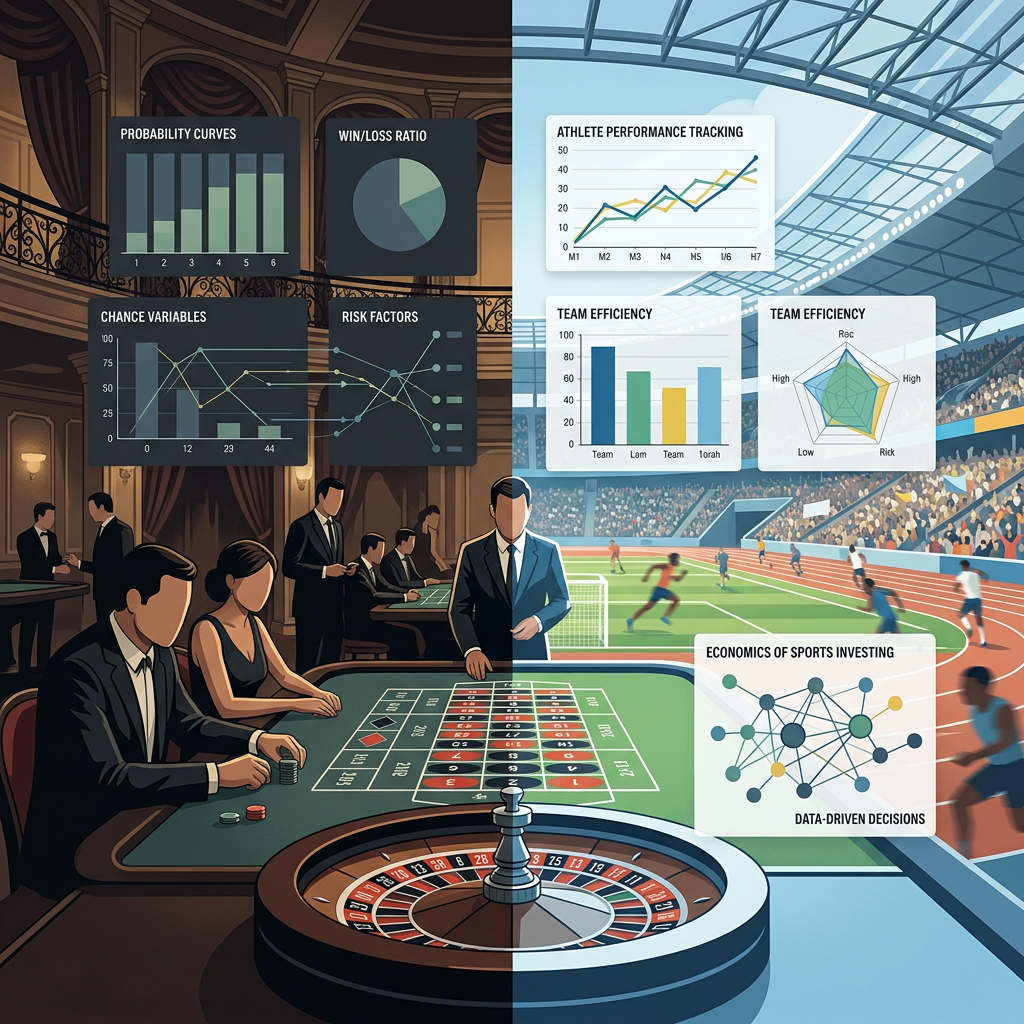
In the vacuum left by the silent casino, a new architecture is forming. It does not promise luck. It does not sell hope. It measures.
Verified human performance is the disciplined alternative to chance. It is performance that can be observed, recorded, and independently checked by anyone. No house edge. No hidden odds. Just evidence.
At its core, verified human performance rests on three pillars: transparent metrics, auditable history, and real-world stakes. Together, they form a system that outcompetes opacity because it survives scrutiny.
Pillar One: Transparent Metrics
In a casino, the rules are visible but the outcome is not. In verified performance, both are visible. A metric is only useful if everyone can see how it was produced.
Consider esports. A player’s accuracy, reaction time, and decision speed are logged in real time. The data is public. The replay is public. There is no debate about what happened—only about what it means.
The same shift is visible in athletics. Wearable sensors and optical tracking now capture stride length, heart rate variability, and fatigue curves. A runner’s performance is no longer a story told after the fact. It is a dataset that anyone can audit.
What transparency changes
When metrics are open, reputation becomes based on evidence rather than narrative. That is performance transparency in practice.
Pillar Two: Auditable History
A single good result proves little. A verifiable history proves everything. Auditable history means every past performance can be re-examined, not just remembered.
This is where prediction market terminals differ from betting floors. The old terminals offered odds set by opaque algorithms. The new ones record every trade, every position, and every resolution on an immutable ledger. You can trace not only who won, but how the market moved.
For workers, the shift is equally profound. A portfolio of verified projects, code commits, and client outcomes replaces the vague promise of a résumé. Hiring becomes less about trust and more about inspection.
Pillar Three: Real-World Stakes
Verification without consequence is a hobby. Verification with stakes is a career. Real-world stakes mean that performance has costs and rewards that extend beyond the screen.
In decentralized prediction platforms, participants stake capital on their forecasts. If they are right, they earn. If they are wrong, they lose. The feedback loop is immediate and unforgiving.
In sport, the stakes are physical and social. A verified time qualifies an athlete for competition. A verified loss removes them from contention. The clock does not negotiate.
This is why verified human performance outcompetes chance. Chance rewards the passive. Verification rewards the prepared.
Before and After: A Concrete Contrast
| Dimension | Old Model: Temples of Chance | New Model: Verified Performance |
|---|---|---|
| Basis of outcome | Randomness and house edge | Skill, preparation, and execution |
| Transparency | Opaque odds, hidden algorithms | Open metrics, public logs |
| Reputation | Built on anecdotes and luck | Built on auditable history |
| Stakes | Money lost to the house | Capital, career, and credibility at risk |
| Access | Anyone with cash, but few win | Anyone willing to train and verify |
The contrast is not moral. It is structural. A system that can be verified is a system that can be improved. A system based on chance can only be endured.
Why This Matters Now
The silent casino did not fall because people stopped wanting excitement. It fell because a better model arrived—one that offered meaning instead of mystery.
Verified human performance is that model. It is measurable. It is auditable. It is repeatable. And it is open to anyone willing to be seen.
In the next section, we will examine what replaces the temples of chance: the arenas, markets, and reputations that are already being built on this foundation.
What Replaces the Temples of Chance?
The silent casino leaves behind more than dust and dead carpet. It leaves a vacancy — a human hunger for stakes, risk, and proof that never went away. What changed is the object of that hunger. People still want to test themselves against uncertainty and against each other. They simply stopped accepting the house as the only referee. In its place, four structures have risen: skill-based arenas, verified competition circuits, open prediction markets, and reputation economies. Each is a descendant of the gambling hall, and each corrects the flaw that killed its ancestor.
Skill-Based Arenas: The House Becomes the Mirror
The first replacement is the skill-based arena. Where a casino floor sold spins of a wheel, a skill arena sells a stage. Outcomes are generated by the participants, not by a random number generator, and the margin is earned by whoever gives players a fair playing field — not by whoever hides the odds. Think of ranked ladders, timed trials, head-to-head leagues, and structured challenges where every run is logged. The thrill of the wager survives; the helplessness does not.
This matters because skill arenas convert hope into practice. A player who loses a match receives a data trail, not a superstition. The arena does not ask whether luck is on your side. It asks whether your recorded performance improved since last season — a question the old temples could never answer.
Open Prediction Markets: Transparency Instead of Opacity
The second replacement is the open prediction market. The prediction market terminals that once promised foresight in near-silence were built on thin, closed order books; their cousins now publish resolution rules, outcome histories, and participant records up front. An open prediction market treats a forecast as a claim that can be graded — publicly, after the fact. The difference is the same one that separates a marked deck from a scoreboard: provenance.
For anyone who once trusted a betting floor, open prediction markets offer a strange new feeling — legibility. You can see who is forecasting, how often they are right, and under what rules they lose. The house edge still exists in some venues, but it is disclosed rather than implied.
Reputation Economies: Your Record Is Your Capital
The third replacement is the reputation economy. In the temples of chance, history was worthless: the wheel did not remember your last spin, and the floor did not care. In a reputation economy, memory is the product. A verified track record — wins, losses, calibration, streaks, and mistakes — becomes transferable capital. It can earn entry into better competitions, unlock coaching, or attract collaborators who need a partner they can trust without taking a stranger’s word.
Practical Checklist: Evaluating a Performance Platform
1. Are results independently verifiable, or self-reported? 2. Is the ranking formula published, or hidden? 3. Can you export your record and leave with it? 4. Do losses remain visible, or vanish from your profile? 5. Is the fee tied to participation, or to your losses? 6. Are rule changes announced in advance with a changelog?
Use that list as a filter. A platform that fails questions one, two, or five is not a skill arena — it is a casino wearing new clothes. Red flags worth naming plainly: opaque matching, sudden rule rewrites, withdrawal friction, trophy-only scoring with no loss record, and any ranking that cannot be audited by a third party. None of these are proof of fraud on their own, but each one removes a layer of verification, and verification is the entire difference between the two eras.
How to Build a Verifiable Track Record
- Start small and public. Log outcomes on a platform that timestamps and preserves them.
- Accept losses as data. A record with no losses is a record with no credibility.
- Separate process from result. Track decisions, not just scores, so your method is visible.
- Consolidate across venues. A portable history beats five siloed profiles.
- Invite scrutiny. Third-party audit or peer verification turns a claim into evidence.
For readers who once relied on chance-based systems, the transition is less about abandoning risk and more about relocating it. The dice still roll; you simply hold them. If you are migrating from old betting floors, the practical sequence is straightforward: choose one verifiable arena, publish a baseline, compete for a season, and let the record — not a hot streak — decide what you are worth. In the next section, we return to the requiem itself and ask what the silent halls still have to teach us. For related reading, see our companion piece on verified human performance and our breakdown of open prediction markets.
The Requiem’s Meaning: What We Owe the Silent Halls
I stand in the atrium of the old Monte Carlo casino, and the silence is not empty. It is full. It holds the ghost of every chip that ever clicked, every wheel that ever spun, every heart that ever raced against a house edge that never wavered. The silent casino is not a tomb. It is a mirror.
We owe these halls neither nostalgia nor disdain. We owe them honesty. They were built on a simple promise: that chance could be mastered, or at least survived. That promise held for centuries, but it could not hold against the human performance era. When people learned to measure, verify, and repeat their own excellence, the temples of chance lost their congregation.
The requiem we sing is not a lament for what we lost. It is a graduation. The silence is clarity. It tells us that we no longer need to kneel before randomness. We can stand before our own verified effort.
Why the Silence Is a Gift
In the old model, the house always won because the game was designed that way. In the new model, the game is designed around what you can prove you did. That shift is not just technical. It is moral. It rewards discipline over luck, transparency over mystique, and long-term skill over short-term thrill.
The future of betting is not a louder casino. It is a quieter ledger. It is a verified performance record that you own and that anyone can audit. It is the end of the house edge as a business model and the beginning of the human edge as a life model.
Questions I Hear in the Silence
People ask me: «Amara, if the casinos are gone, where do I go for excitement?» I tell them: go where your effort is visible. Go where a win is not a payout but a proof. The thrill of a verified personal best lasts longer than any jackpot.
Others ask: «Was all of it a waste?» No. The temples of chance taught us how to dream of sudden fortune. Now we dream of earned fortune. That is not a smaller dream. It is a larger one, because it includes everyone who is willing to work.
And some ask: «Will chance disappear entirely?» Chance will always exist. But it will no longer be the center of gravity. It will be a footnote in a world that runs on verified human performance.
The Final Line of the Requiem
«We are silent because the world no longer needs us.» That is not a defeat. It is a release. The silent casino is free, and so are we.
So here is the next step, and it is a personal one. Look at your own life. Which systems still run on chance? Which habits, jobs, or relationships depend on luck rather than proof? The silent casino is a warning and an invitation. It warns that anything built on opacity will fall silent. It invites you to build something that speaks in the language of evidence.
You do not need a temple. You need a record. You do not need a wheel. You need a repeatable result. The requiem is over. The performance has just begun.
Leave a Reply