Contents
Sports media and gambling fused so completely that the broadcast now sings a funeral hymn for the years it spent selling odds instead of stories. Where highlight reels once built legends, the odds ticker culture of 2025 turns every moment into a number and every athlete into a prop. This requiem is sung by the broadcast itself — the commentary desks, the production rooms, the graphics packages that drowned the game in gambling saturation. It confesses three betrayals: the athlete, the fan, and the story.
The Broadcast Sings Its Own Funeral Hymn
The broadcast has a confession to make, and it can only be delivered in the voice of a funeral hymn. «I betrayed the athlete. I betrayed the fan. I betrayed the story.» This is the requiem now playing quietly underneath every pregame show, every halftime segment, every postgame desk where the conversation drifts from what happened on the field to what the line did before kickoff. The singer is not a critic or a fan — it is the broadcast itself, mourning the years it spent selling odds instead of stories.
The subject of this requiem is the relationship between sports media and gambling — a relationship that began as a sponsorship footnote and grew into the dominant grammar of the modern broadcast. Gambling saturation sports coverage did not arrive as a sudden takeover. It arrived as an overlay, a ticker, a promo read, a fantasy graphic, a segment sponsor, until the odds were no longer interrupting the story. They were the story.
There is no accident to blame here. No glitch, no market force too abstract to name. Executives chose the odds ticker because it kept eyes on the screen. Producers chose the promo because it paid for the highlight package. Hosts chose the parlay segment because it generated engagement metrics. Each choice was rational. Together they wrote a funeral hymn for the thing sports journalism was supposed to do: explain human beings under pressure.
The Broadcast's Confession
«I betrayed the athlete. I betrayed the fan. I betrayed the story.» Three betrayals, one cause: the broadcast learned to sell chance, and forgot how to sell meaning.
What follows in this requiem is not a moral panic about betting. It is a structural autopsy. The broadcast remembers the overlays. It remembers the promos. It remembers the odds tickers and the fantasy graphics that turned every possession into a payout calculation. It remembers all of it with the clarity of something that knows it is broken.
The argument here is simple and uncomfortable: selling odds replaced telling stories. That replacement was a choice, made repeatedly, by people with the power to choose otherwise. The broadcast did not lose its purpose. It traded it away, one sponsored segment at a time, and only now — mid-hymn, mid-grief — does it seem willing to admit what the trade cost.
The requiem does not end in despair. Grief that names the wound is the beginning of repair. But before repair can be discussed, the broadcast has to finish singing. It has to list its sins in order. It has to explain how the ticker became the main character — and why the fan, the athlete, and the story were allowed to become background noise in their own ceremony.
How the Odds Ticker Became the Main Character
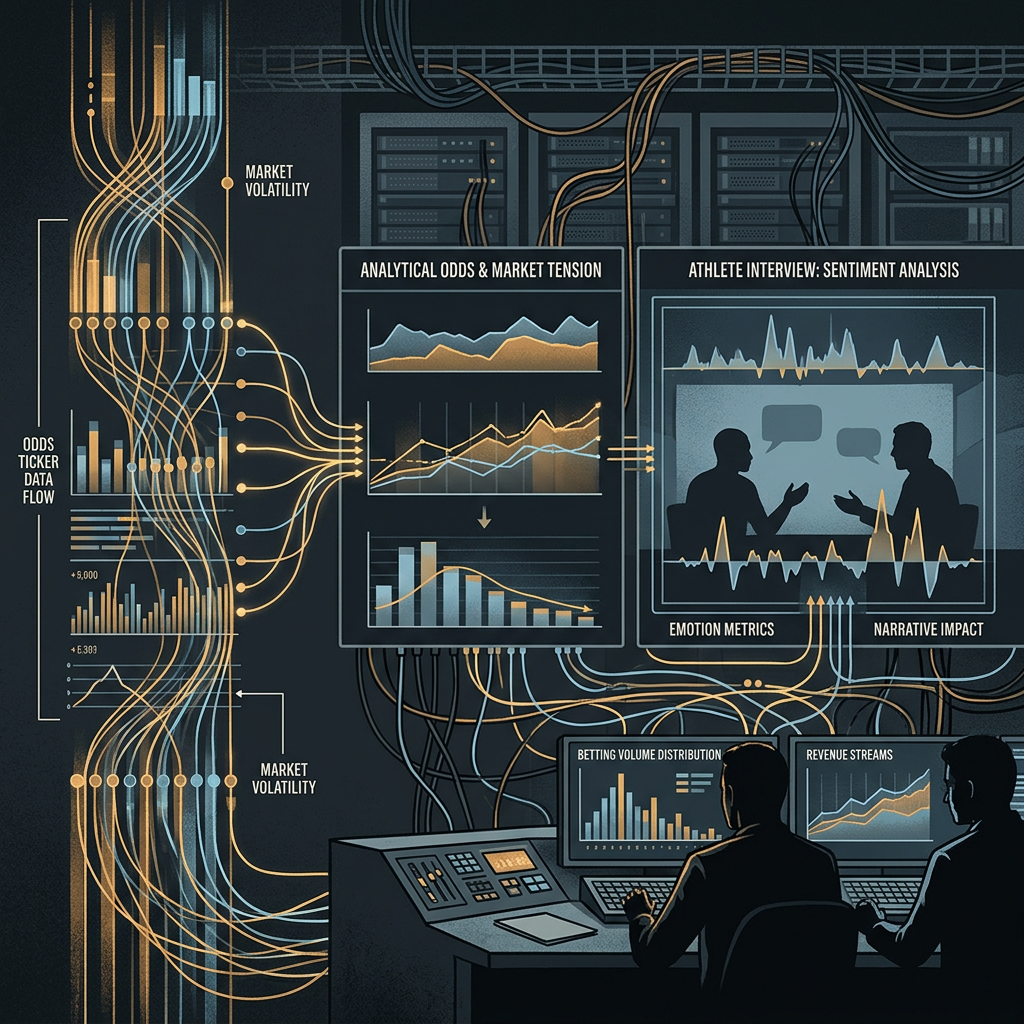
Imagine a 1990s broadcast: a single camera, a play-by-play voice, and a halftime feature about a player’s path from a small town to the big league. There is no crawl at the bottom of the screen. Betting lines are absent. Now fast-forward to a modern telecast. The screen is cluttered with a scrolling odds ticker, a sponsored parlay segment, fantasy-points graphics, and a live betting odds overlay that updates after every possession. The game itself competes for attention with the numbers that now frame it.
That transformation did not happen overnight. It was incremental, revenue-driven, and largely invisible until the odds ticker culture had fully colonized the viewing experience. As gambling advertising in sports exploded — buoyed by deregulation and lucrative sponsorship deals — broadcasters discovered that betting content kept viewers engaged between plays. What began as a novelty became a main character.
The mechanics are worth naming, because they show how gambling content moved from the margins to the center of sports media and gambling itself. First came the bottom-line ticker. A thin strip of scrolling point spreads, moneylines, and over/unders. It was unobtrusive. Then came the sponsored odds segment. A studio host, often a former athlete, would deliver a scripted read: «Tonight’s odds are brought to you by…» Next, the parlay promo read by the anchor. Finally, the fantasy sports broadcasts that turned every reception, tackle, and strikeout into a fantasy point. Each layer normalized the presence of gambling. Each layer made the game feel like a vehicle for a wager.
- Bottom-line odds ticker: continuous point-spread and moneyline updates.
- Sponsored odds segment: a branded studio read, often delivered by a retired player.
- Parlay promo read by the anchor: a mid-broadcast call to combine bets for a bigger payout.
- Fantasy graphics: live projections that reframe real plays as fantasy outcomes.
- Live betting overlays: in-game odds that change after every possession.
Watchdogs in sports journalism have tracked the growth of gambling-ad spend for years. As one report noted, sportsbooks now spend hundreds of millions annually on broadcast partnerships and advertising, with a significant share directed at pre-game, in-game, and post-game programming. That spending buys more than airtime. It buys integration. It buys the odds ticker. It buys the segment where the anchor explains a parlay. It buys the fantasy graphics that make the game itself feel secondary to the numbers.
The shift in one sentence
In a 1990s broadcast, the story was the main character. In 2025, the odds are.
The consequence is not subtle. When gambling content is woven into the fabric of a broadcast, every highlight becomes an opportunity to promote a bet. A touchdown is not just a touchdown; it is an over that cashed. A missed free throw is not just a missed free throw; it is a spread that failed to cover. The broadcast teaches viewers to watch for the number, not the narrative. And as that lesson repeats, the story fades. The odds ticker does not just report chance; it reshapes attention until chance is all that remains.
This is how the broken broadcast began. Not with a single decision, but with a thousand incremental choices: a sponsored segment here, a fantasy graphic there, a parlay promo read in the third quarter. Each choice seemed small. Together they turned the broadcast into a bookmaker’s lobby, and the game into a prop.
What the Fans Lost When the Story Died
The average NFL broadcast now asks a viewer to process dozens of distinct inputs in a single three-hour window, and a growing share of them are betting-related. A fan watching a Sunday afternoon game may see a pregame odds segment, an in-game point spread ticker, a same-game parlay promo in the second quarter, live player-prop graphics after every touchdown, and a postgame bad-beat recap. Each of those elements is designed to redirect the same scarce resource: attention.
The result is what researchers and media critics increasingly describe as the sports storytelling crisis in miniature. The game is still being played, but it is no longer the only thing being narrated. The broadcast is simultaneously telling a story about human competition and a story about probabilities.
A Fan Who Used to Follow a Team Now Follows a Line
Consider a mid-sized example. Tom, a Toronto-based teacher, spent most of his twenties watching the NBA with the same group of friends. They texted during games about defensive rotations, rookie development, and locker-room drama. By 2024, their group chat had changed character. The messages were screenshots of prop bets, complaints about a late free throw that killed a parlay, and arguments about whether a coach was managing minutes or managing the spread. Tom still watches the games, but he no longer follows the team. He follows the line.
This is the felt experience of the fan experience sports betting shift. It is not that Tom stopped caring about basketball. It is that the betting ecosystem rewarded a different kind of caring — one that is discrete, transactional, and resolved by a final score rather than developed across a season.
The Counterargument, Taken Honestly
The strongest defense of gambling-infused sports media is genuine and should not be dismissed. Many fans report that a small wager makes a neutral game interesting. The bet gives them a reason to watch a Tuesday-night regular-season game between two teams they would otherwise ignore. It creates a stake, and stakes create attention. Research on the appeals of sports betting supports this: for many participants, the wager functions as an engagement device, not simply a financial one.
The cost, however, is not evenly distributed. The same mechanisms that make a bet feel engaging — variable rewards, near-misses, the illusion of control — are the mechanisms that make gambling harm more likely for a subset of participants. A national survey of American adults found that the mean number of gambling-related harms reported by recent sports bettors with severe gambling problems was substantially higher than among non-sports bettors, with financial distress, relationship strain, and mental health impacts among the most common.
The Engagement Trade
Betting can deepen engagement with a game — and, for some fans, deepen the harm. The same broadcast that sells the wager rarely acknowledges the risk.
What Disappears When the Story Becomes Background Noise
The shared narrative is the part that is hardest to measure and easiest to lose. Sports matter to communities because they generate stories that outlast the final whistle: the aging veteran who finally won, the city that waited fifty years, the rookie who grew into a leader. Those stories require sustained, non-transactional attention. They reward patience. They are not resolved by a single outcome, which is precisely why they resist conversion into a betting product.
When the odds ticker becomes the primary lens, the narrative beats get compressed into data points. A fourth-quarter comeback becomes a bad beat or a good cover. A player’s career night becomes a stat line that hit or missed a prop. The human being inside the jersey recedes, and what remains is a number that paid or did not pay.
Fans are not passive victims here. Many are active participants who have chosen the wager over the story, and many enjoy that choice. The question is not whether betting should exist in sports culture. The question is whether the broadcast — the shared narrative infrastructure that made sports meaningful in the first place — can still tell a story when it has spent a decade training its audience to watch the line instead of the game.
That is the loss. Not the money. The story.
The Athlete as Prop and the Journalist as Bookmaker
The broadcast’s requiem keeps returning to two people it used without asking. The player, reduced from protagonist to probability. The reporter, reduced from witness to odds-maker’s assistant. This is where sports betting ethics stops being an abstraction about advertising spend and becomes a sentence handed down in a locker room and a newsroom alike.
Start with the athlete. Under the old contract, a player was the subject of a story: a knee injury explained a season, a slump explained a career, a bad night explained a human being. Under the new one, the player is a line item — a spread, a prop, a leg in a same-game parlay. That shift is athlete commodification in its purest form, and it does not stay symbolic for long. When a player misses a free throw that settles a bet, the punishment arrives on his phone. When a starting quarterback is scratched late, the abuse that follows is not about football. It is about money he never agreed to play for.
None of this is hypothetical grief. The structural problem is that the betting ecosystem needs the athlete’s body to be legible at all times — healthy, hurt, starting, resting — and it rewards anyone who makes that body more legible faster. Which brings the second casualty into view.
The Reporter With Two Jobs and One Set of Ethics
Reporters did not sign up to move lines. But the market for injury news became so immediate, and so monetizable, that the beat reporter’s routine output — who practiced, who didn’t, who is questionable — now travels straight into wagering markets within seconds of publication. Some outlets formalized what the audience already sensed: the reporter is expected to be accurate, fast, and useful to bettors, whether or not that last function is ever written into the job description.
The corrosion is subtle. It shows up when analysis drifts toward tipping, when a pick becomes a personality, when a pregame segment is shaped less by what matters tactically than by what moves a number. The line between expert insight and a tout’s prediction is thinner than most newsrooms admit, and it is crossed not by villains but by professionals responding to incentives their employers installed.
Editor's note on sources
For the harm side of this equation, cite a peer-reviewed gambling-harm study (for example, research on gambling-related harms published in public-health journals) and a journalism ethics body’s guidance on covering betting — such as the Society of Professional Journalists’ code of ethics, which cautions against conflicts of interest. Verify current editions before publication, as guidance is periodically updated.
Who Pays for the Faster Story
The accounting runs in one direction. The house books the handle. The platform books the engagement. The athlete absorbs the rage. The reporter absorbs the compromise. And the story — the actual story, the one about pressure, craft, loss and recovery — gets squeezed into whatever space remains between the ticker and the next ad read.
This is the structural critique, and it deserves to be stated plainly: the failure is not that individual reporters are corrupt or that individual athletes are thin-skinned. The failure is that sports media built an information pipeline optimized for wagering and then asked its journalists to keep behaving as though they were still serving readers. You cannot wire a newsroom into a betting market and expect the ethics to hold by habit alone. That is the future of sports journalism now under negotiation — not whether betting content exists, but whether anyone inside the broadcast still insists that the human being at the center of it is a person and not a prop.
The broadcast mourns that it betrayed the athlete and betrayed the reporter. Both were betrayed by the same design: a system that found it cheaper to turn people into probabilities than to tell the truth about them slowly.
Can the Broadcast Remember Its Purpose?
The requiem does not have to be a resignation. The broadcast can choose to remember. For responsible sports media to emerge, the industry must make deliberate, structural changes. The following recommendations are not nostalgic fantasies; they are practical steps that outlets, journalists, and fans can take to reform sports broadcasting and reclaim the story.
- Ad-spend transparency: Outlets should publicly disclose the proportion of revenue derived from gambling advertising. This baseline accountability allows audiences and journalists to understand the financial pressures shaping coverage.
- Editorial firewalls between betting partners and news desks: Establish clear, enforced separation between commercial gambling operations and editorial decision-making. No producer, editor, or reporter should face implicit or explicit pressure to favor betting content over storytelling.
- Coverage quotas for non-betting stories: Commit to a minimum share of airtime or column inches dedicated to athlete profiles, investigative features, and narrative reporting that have no connection to odds or fantasy outcomes.
- Fan-level media literacy: Equip audiences to recognize gambling-saturated content. Simple public education campaigns can help fans distinguish between journalism and promotion, reducing the normalization of odds ticker culture.
These reforms are not anti-gambling; they are pro-story. By implementing them, sports journalism can begin to heal the betrayal confessed in this requiem. The broadcast that once sang «I betrayed the athlete, I betrayed the fan, I betrayed the story» can instead choose to amplify the athlete’s struggle, the fan’s wonder, and the story’s truth. Grief can point toward repair when it is met with action.
The future of sports journalism depends on whether the industry treats this moment as a funeral or a rebirth. The odds ticker does not have to be the main character. The broadcast can remember that its purpose was never to sell chance, but to tell the human story at the heart of sport.
The narrator, Tomas, ended his confession with «I am broken because chance made me forget my purpose.» That confession can become a starting point. The broadcast can choose story over chance. It can choose the athlete over the algorithm. It can choose the fan over the funnel. The requiem ends not with a period, but with a question: Will the broadcast remember its purpose before the last story is sold?
Frequently Asked Questions
- What is responsible sports media? Responsible sports media prioritizes storytelling, athlete dignity, and audience trust over gambling revenue. It draws clear lines between editorial content and betting promotion, and it measures success by narrative impact, not just engagement metrics tied to odds.
- Can reform sports broadcasting actually work? Yes, but only with structural changes. Transparency in ad spending, editorial firewalls, coverage quotas, and fan education are concrete steps that outlets can adopt. These measures require commitment from ownership and newsroom leadership, not just individual journalists.
- What does the future of sports journalism look like without gambling saturation? A future where odds tickers are one tool among many, not the main character. Where journalists are not pressured to act as bookmakers, and where fans can enjoy the shared narrative of sport without every moment being monetized by chance.
Leave a Reply