Contents
- Why Dakar 2026 Is a Test Case for Africa's Sports Future
- The Baseline Problem: Measuring Youth Participation, Coaching, and Facility Access Before the Games
- Tracking What Happens After: Venue Use, Coach Retention, and Athlete Pathways
- The ASM Legacy Index: Four Measures That Reveal Whether the Games Lasted
- Funding the Future: Investment Vehicles for Academies, Coaching, and Sports Medicine After 2026
Dakar 2026 legacy will be judged not by the closing ceremony but by what still runs a year later. As the first Olympic sporting event held in Africa, the Youth Olympic Games give Senegal a rare window to turn new venues, trained coaches, and international attention into a permanent athlete-development market. The core question is whether an ASM approach can stop Dakar 2026 from becoming a temporary event economy by tying future capital to the verified performance of a lasting sports-development system.
Why Dakar 2026 Is a Test Case for Africa’s Sports Future
On October 31, 2026, the Dakar Arena will fill for the opening ceremony of the Youth Olympic Games — the first Olympic sporting event ever staged on the African continent. For 14 days, cameras from every major broadcaster will point at Senegal. Then the flame goes out. The Dakar 2026 legacy will be decided not by what happens between October 31 and November 13, but by what remains in the months and years that follow.
That distinction matters because Africa has seen large sporting investments arrive and leave before. Stadiums built for continental tournaments sit underused; coaching clinics end when the funding cycle ends; the international spotlight moves on. Senegal now has a rare window. It is hosting a youth event, not a senior one, which means the infrastructure, coaching knowledge, and official accreditation being assembled for 2026 are, by design, aimed squarely at youth athlete development — the exact segment that most determines whether a sports economy compounds over time.
The core question is not whether Dakar can host 14 good days. It is whether Senegal can build a permanent athlete-development market, or ASM, that turns Olympic attention into recurring capability: academies that enrol year after year, coaches who stay in the profession, venues that generate revenue, and sponsors who renew because their money produces measurable results.
The ASM concept in one line
An athlete-development market (ASM) is a system in which capital, coaching, facilities, and competition are connected so that each new athlete and each new season reinforces the next, rather than depending on a single event.
This investigation works from one guiding proposition: Dakar 2026 legacy claims should be judged against verified performance, not intention. Can future capital — from sponsors, development finance institutions, federations, and public budgets — be tied to the measured performance of Senegal’s permanent sports-development system? That is the test. It is also an opportunity: a country that can prove its sports system works becomes a credible destination for long-term investment, not just a one-off host.
There are reasons for cautious optimism. The Games will concentrate attention on three distinct zones — Dakar, the new city of Diamniadio, and the coastal resort of Saly — each with different potential for post-event use. They will train a cohort of officials, coaches, and volunteers who can serve the system long after the Games. And they put Senegal at the centre of a continental conversation about what African sport can build. None of these benefits is automatic. Each is testable, and the sections that follow set out how.
The stakes extend far beyond Senegal. If the first Olympic event in Africa leaves durable institutions behind, it becomes a template for other African hosts and for the Olympic movement’s own thinking about legacy in emerging markets. If it leaves only photographs and underused venues, it hardens scepticism about event-led development for a generation. Dakar 2026 is, in that sense, a test case for Africa’s sports future — and the verdict will be written in data collected now, before the opening ceremony, not after the closing one.
The Baseline Problem: Measuring Youth Participation, Coaching, and Facility Access Before the Games
A legacy claim is only as strong as the number it is compared against. Before a single athlete walks into a Dakar 2026 venue, Senegal needs a credible answer to a deceptively simple question: what does youth sport in this country look like right now? Without that snapshot, every post-Games announcement — more participants, more coaches, better facilities — becomes an assertion nobody can verify.
This is the baseline problem, and it is the most neglected step in event-led sports development. Host cities routinely commission economic impact forecasts before the Games and skip the unglamorous work of counting who plays, who coaches, and who has access.
Why Baselines Decide Whether the Legacy Is Real
Take one historically under-tracked metric: the share of trained coaches still actively working with young athletes twelve months after certification. Federations often report certificates issued rather than coaches retained. A country can announce that 400 coaches were trained for Dakar 2026 and still lose most of them within two years to unpaid roles, relocation, or better-paid work outside sport. If the pre-event retention rate was never measured, no one can say whether the Games improved or simply restated the status quo.
The same logic applies to youth athlete development. Participation figures collected for a Games bid tend to reflect school enrollment estimates, not verified sport-specific registration. A baseline fixes the reference point so that subsequent claims can be tested.
What Should Be Measured Now
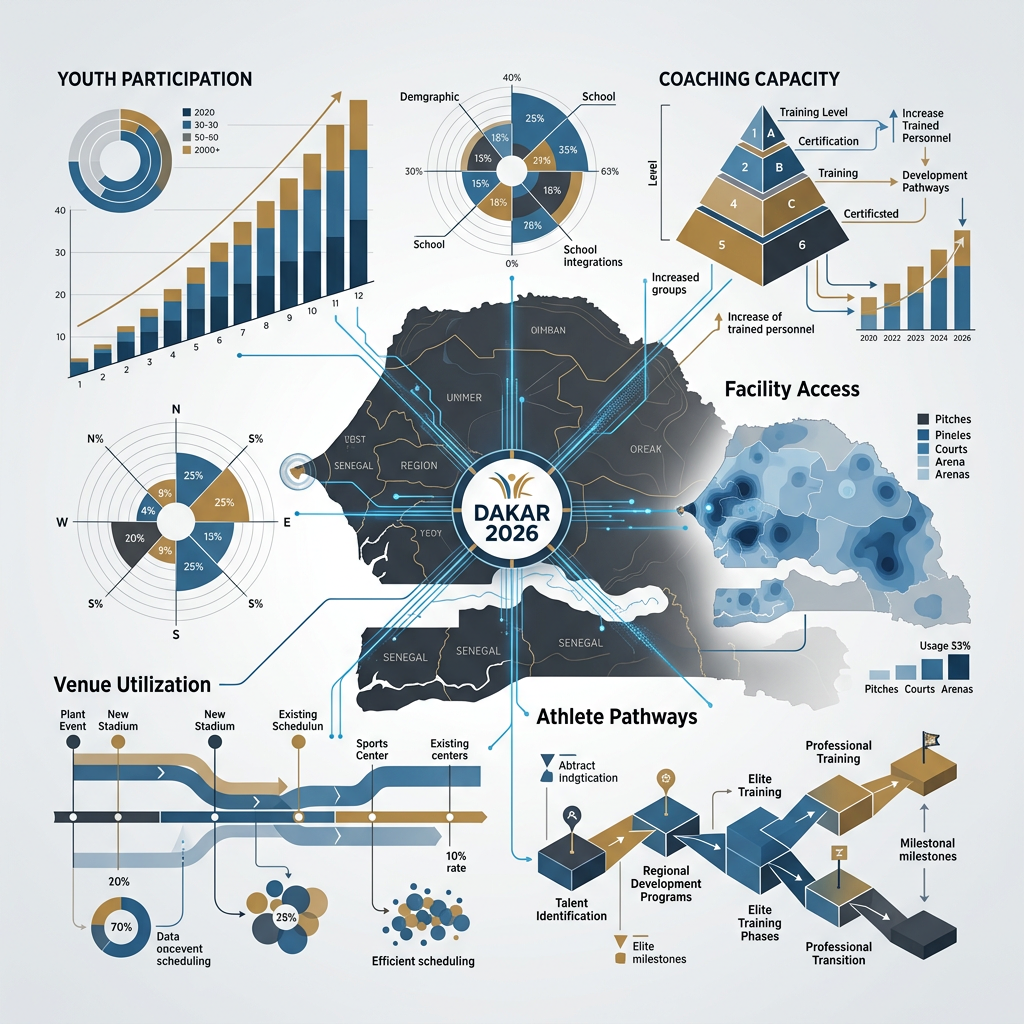
The baseline should cover three domains — participation, coaching capacity, and facility access — disaggregated by age, sex, disability status, and region, with Dakar, Diamniadio, and Saly reported separately because they will absorb different post-Games venue use.
- Youth participation: registered athletes aged 8–18 per national federation, plus school sports participation by district, captured at a fixed reference date.
- Coaching capacity: certified coaches and technical officials per 1,000 youth athletes, with certification level, employment status, and current active assignment.
- Facility access: number of usable training venues within a defined travel time of each commune, distinguishing competition-grade, training-grade, and school facilities.
- Program continuity: number of youth sport programs running for at least three consecutive seasons, as a proxy for institutional stability.
- Spending baseline: public and private sport expenditure per youth participant, so later investment can be compared against a known starting point.
Where to source baseline data
National federation registration and coaching records, municipal facility inventories and land-use records, school sports program registers, and national statistics agency population data can be combined into a single audited baseline. Third-party verification, ideally by a university sports research unit, limits the temptation to inflate figures before the Games.
Make the Baseline Public and Repeatable
The baseline should be published, fixed, and measured again on the same methodology at intervals after 2026. That commitment is what allows observers to evaluate post-Games venue use and youth athlete development without relying on event organizers’ own summaries.
For policymakers and sponsors, the baseline is also a financial instrument. It defines the starting line against which future capital can be released, and it is the first input into any credible index of Dakar 2026 legacy.
Tracking What Happens After: Venue Use, Coach Retention, and Athlete Pathways
A baseline tells you where Senegal starts. Tracking tells you whether anything actually changed. The Dakar 2026 legacy will be decided in the 24 to 36 months after the closing ceremony, when the cameras leave and the daily work of running a national sports system resumes. That work is observable, and it should be observed on a fixed schedule rather than through anniversary press releases.
The practical approach is to run three parallel tracking streams — facilities, people, and athletes — each with defined indicators, named data owners, and reporting dates at 6, 12, 24, and 36 months post-Games. This is the difference between a legacy claim and a legacy record.
Stream One: Post-Games Venue Use
Venue tracking should answer one question per facility: how many days per year is it in productive use, and by whom? Productive use includes youth training sessions, school competitions, federation camps, community programming, and commercial events — not just international fixtures. Tracking should cover the Dakar venues, the Diamniadio cluster, and the Saly facilities separately, because each sits in a different catchment area with different transport and population realities.
- Booked days per venue per quarter, split by user type: schools, clubs, federations, community groups, commercial hirers
- Utilization rate against a realistic operating ceiling, not theoretical capacity
- Cost recovery ratio: operating and maintenance costs covered by user fees, sponsorships, or public subsidy
- Geographic access: share of users traveling under 45 minutes to reach the facility
- Condition audits at 12 and 24 months to catch deferred maintenance early
Stream Two: Coach and Official Retention
Dakar 2026 will train a cohort of coaches, referees, judges, technical officials, and sports-medicine staff. The honest legacy question is not how many were trained but how many are still working. Retention should be measured against the training roster by name, with a simple status check: active in sport, active in a related field, inactive.
Four retention questions to ask on a schedule
At 12 and 24 months after the Games: (1) How many trained coaches are still coaching at least one youth group per week? (2) How many certified officials have worked a national or regional competition in the past six months? (3) How many are coaching or officiating in the region where they were trained, outside Dakar? (4) Of those who left, what drove the exit — pay, transport, equipment, or lack of competitions to work in?
That fourth question matters most. It converts retention tracking from a scorecard into a diagnostic tool, showing federations and funders exactly which constraint to fix first.
Stream Three: Youth Athlete Pathways
Youth athlete development is easiest to measure with a cohort. Take every Senegalese participant at Dakar 2026 and follow them with consent at 12, 24, and 36 months across four indicators: continued education or vocational training, continued competitive participation at national level, transition to senior competition or a national squad, and entry into sports-adjacent employment such as coaching, officiating, or physiotherapy.
A second, wider cohort should follow young people who never competed at the Games but entered clubs or school programs in the host regions during the same period. This prevents the legacy narrative from resting on a few dozen elite participants while the broader system stays flat.
What Good and Weak Tracking Look Like
| Element | Weak tracking | Good tracking |
|---|---|---|
| Venue data | One press tour of a flagship stadium in year one | Quarterly utilization and cost-recovery figures for every venue, published openly |
| Coach data | Headline number of people trained | Named roster checked at 12 and 24 months, with exit reasons recorded |
| Athlete data | Anecdotes about individual success stories | Cohort follow-up across education, competition, and employment indicators |
| Accountability | No named owner for the data | Each indicator has a data owner, a deadline, and a public report |
The good column is not expensive. It requires discipline, agreed definitions, and a willingness to publish unflattering numbers. International Olympic Committee legacy reporting frameworks and UNESCO sports policy data offer tested indicator definitions that Senegal can adapt rather than invent, which also makes results comparable with other host cities and credible to external funders.
Editor verification note
Specific reporting cadences, indicator definitions, and data-collection arrangements described here are recommendations, not commitments by any named organization. Confirm the published reporting requirements and timelines of the relevant Games delivery bodies before citing them as official.
Facilities, coaches, and athletes are the three streams that together reveal whether post-Games venue use and youth athlete development are real. Tracking them consistently produces the raw data that the next section turns into a single, investable measure.
The ASM Legacy Index: Four Measures That Reveal Whether the Games Lasted
Legacy claims are easy to make and hard to disprove. An organizing committee can point to a renovated stadium, a training course, or a sponsorship announcement and declare success. What that story cannot show is whether the stadium is used in 2029, whether the coach trained in 2026 is still on a field in 2031, or whether a young athlete who competed at Dakar 2026 is now earning a living inside the sports economy Senegal built. The ASM Legacy Index exists to answer those questions with numbers rather than narratives.
ASM — athlete, system, market — is a way of structuring the post-Games conversation. Instead of one overall «legacy score», the index separates four signals that fail independently and therefore diagnose different problems. A high facility score with a low coaching-retention signal tells investors something very different from the reverse. The index is deliberately narrow: four measures, each calculated from data Senegal’s federations, venues, and ministries already generate or can realistically begin collecting.
The Four Measures
| Measure | What it captures | Illustrative indicators | Why it matters for the sports economy Senegal |
|---|---|---|---|
| 1. Facility utilization | Whether Dakar, Diamniadio, and Saly venues function as working assets | Annual booked hours as a share of available hours; share of bookings by community groups, schools, and academies versus elite use; revenue per operating hour | Distinguishes a monument from an asset. Utilization is the earliest warning that maintenance budgets will outrun income. |
| 2. Athlete progression | Whether participating youth stay in sport and advance | Share of Dakar 2026 participants still registered with a federation after 12 and 36 months; transitions to national competition; dual-track education outcomes; placements in coaching, officiating, or sports employment | Converts participation into a pipeline. Progression, not participation alone, is what sponsors ultimately fund. |
| 3. Sponsor retention | Whether commercial interest survives the closing ceremony | Share of Games sponsors renewing or converting to multi-year academy and federation deals; renewal value versus activation value; number of new domestic sponsors entering after 2026 | Tests whether Dakar 2026 created a market or a moment. Retention is the honest measure of commercial confidence. |
| 4. New sports employment | Whether the Games generated durable jobs | Net new roles in coaching, officiating, sports medicine, event operations, and venue management; share held by trained post-2026 cohorts; retention at 24 months | Turns training courses into careers and gives the index its strongest link to household income. |
Each measure is scored on a common scale and then weighted according to the user. A ministry may weight facility utilization and employment more heavily; a sponsor may care most about athlete progression and its own retention cohort. The index does not hide those choices — it publishes them, so a score can be audited and contested.
How Capital Uses the Index
The index becomes useful when it is attached to money. Four practical mechanisms follow directly from the measures:
- Performance-linked sponsorship: a multi-year academy partnership releases a portion of funds against verified progression and retention thresholds rather than a single activation fee.
- Legacy bonds and blended finance: facility operating vehicles price debt against utilization history, with concessional capital covering the early, uncertain years.
- Milestone grants for coaching and sports medicine: tranches tied to the share of trained coaches and officials still active at 12 and 24 months.
- Investor dashboards: a single quarterly index release lets domestic and international funders compare academies, regions, and sports before committing capital.
This is where the index earns its keep as a persuasion tool rather than a bureaucratic report card. A sponsor deciding whether to renew in 2028 does not need a 200-page evaluation; it needs to know that its investment produced measurable progression and that the system around it is holding. A finance ministry weighing a legacy bond needs a utilization trend, not a ribbon-cutting photograph. Published consistently, the same four numbers serve both audiences and keep them honest with each other.
Design principle
Publish the index quarterly, from the same source data, with the methodology fixed before the Games. A measure that can be redefined after the result is known protects nobody. Independence of the body compiling the index matters as much as the metrics themselves.
The index also disciplines the story told to young athletes and their families. If progression and employment scores are weak while facility utilization looks strong, the diagnosis is clear: Senegal built places to play but not pathways to progress. That is a fixable problem — but only if the measurement makes it visible early enough to act on, which is precisely what the final section’s investment vehicles are designed to do.
Funding the Future: Investment Vehicles for Academies, Coaching, and Sports Medicine After 2026
The hardest legacy question is not what Senegal builds by October 2026, but who pays to keep it running in 2028 and 2032. A permanent sports economy requires capital that responds to evidence rather than ceremony. That means structuring sports investment Senegal can verify against the ASM Legacy Index, funding the systems that produce athletes rather than funding the Games themselves, and making disbursement conditional on measured performance rather than on ribbon-cutting.
Four practical vehicles can carry that capital. None requires inventing new institutions from scratch; each can sit on existing federations, municipal budgets, or blended-finance structures. Each is designed so that a sponsor, a development bank, or a diaspora investor can see what their money produced.
1. Legacy Performance Fund Tied to Index Payments
A multi-year fund dedicated to post-Games operations: venue maintenance, equipment, transport for youth leagues, and event operations in Dakar, Diamniadio, and Saly. Contributions would be anchored to verified index thresholds, with tranches releasing on facility utilization and athlete progression targets. Sponsors gain auditability; the state avoids taking on open-ended operating costs without evidence of use.
2. Academy Co-Investment Model
A matching structure in which public funds, federation funds, and private or philanthropic investors co-finance accredited academies, with co-investors earning priority access to sponsor packages and naming rights. The Academy pillar of ASM fits here directly: academies that retain athletes in education and national competition qualify for continued co-investment, while academies that produce registrations on paper but no progression lose it.
3. Coaching Fellowship Endowment
An endowment paying stipends and continuing education for coaches and technical officials trained before the Games, with renewal tied to the coach-retention measure already tracked in the index. This addresses the most fragile part of any post-Games system: trained people leaving the sport when event contracts end.
4. Sports Medicine and Athlete Services Partnership
A partnership among hospitals, universities, insurers, and federations to fund injury surveillance, screening, and rehabilitation capacity around the venues. It can be financed through service contracts and blended finance rather than grants, and it pays back through reduced athlete attrition—a direct input to progression scores.
| Vehicle | Core purpose | Funding logic |
|---|---|---|
| Legacy Performance Fund | Venue and event operations | Tranches released on index thresholds |
| Academy Co-Investment | Accredited youth academies | Matched capital, priority sponsor access |
| Coaching Fellowship Endowment | Coach and official retention | Stipends renewed on retention data |
| Sports Medicine Partnership | Athlete health and services | Service contracts and blended finance |
Frequently Asked Questions
Who should own the ASM Legacy Index? Ideally an independent body outside the organizing committee and outside any single ministry, with an advisory board of federations, athletes, universities, and auditors. Separation from the event organization is what makes the number credible to outside capital.
Who should audit it? A reputable external auditor or national statistical authority should verify the underlying data annually, publishing methodology and raw counts. Without a published methodology, index performance cannot honestly govern money.
What if a metric falls short? Shortfalls should trigger review, not automatic cancellation. The point is to redirect funding toward the weakest measure—for example, shifting from new facility operations to coaching retention—rather than to punish a system still maturing.
Further Reading
For readers building on this analysis, see our articles on youth athlete development pathways and on the economics of major-event economies, which examine how host cities convert temporary spending into durable institutions. For international benchmarks, consult Olympic legacy research from the International Olympic Committee and UNESCO data on sport and physical education, both of which offer comparative frameworks for measuring post-event outcomes.
Call to Action
Policymakers: legislate the independent index owner and publish baselines before October 2026. Sponsors: tie at least part of your contribution to verified index performance. Federations: submit retention and progression data annually. The Dakar 2026 legacy will be judged not by the opening ceremony, but by whether Senegal’s athlete-development systems are still funded, staffed, and measured five years later.
Leave a Reply