Contents
- Why Sports Gambling Became a Digital Economy Powerhouse
- The Real Cost of Betting: Addiction, Debt, and Hidden Losses
- What Is ASM? How Sports Intelligence Could Create Value Without Wagers
- Is ASM a Genuine Alternative or Just Gambling in Disguise?
- The Verdict: Can Sports Intelligence Defeat the Gambling Economy?
Sports intelligence is being pitched as a radical answer to one of the fastest-growing sectors of the digital economy: a system that pays people for prediction accuracy and expertise rather than for the money they lose. As online sportsbooks post record revenues and sports betting addiction draws growing scrutiny, a new category called ASM claims it can redirect that energy toward measurable knowledge. We followed former gamblers, analysts, economists, and behavioral scientists to test whether that promise holds up, or whether ASM is simply gambling wearing a new name.
Why Sports Gambling Became a Digital Economy Powerhouse
It is 11:47 p.m. on a Sunday, and Marcus is doing what he did almost every night for six years: scrolling live odds on his phone. A former college athlete turned logistics manager, he once kept three betting apps open at once, chasing in-game lines on everything from NBA quarters to Ecuadorian league soccer. He estimates he lost more than $40,000 — a figure he recites without drama, the way someone reads a weather report. What kept him coming back wasn’t the money, he says. It was the information. He genuinely believed he knew something the market didn’t.
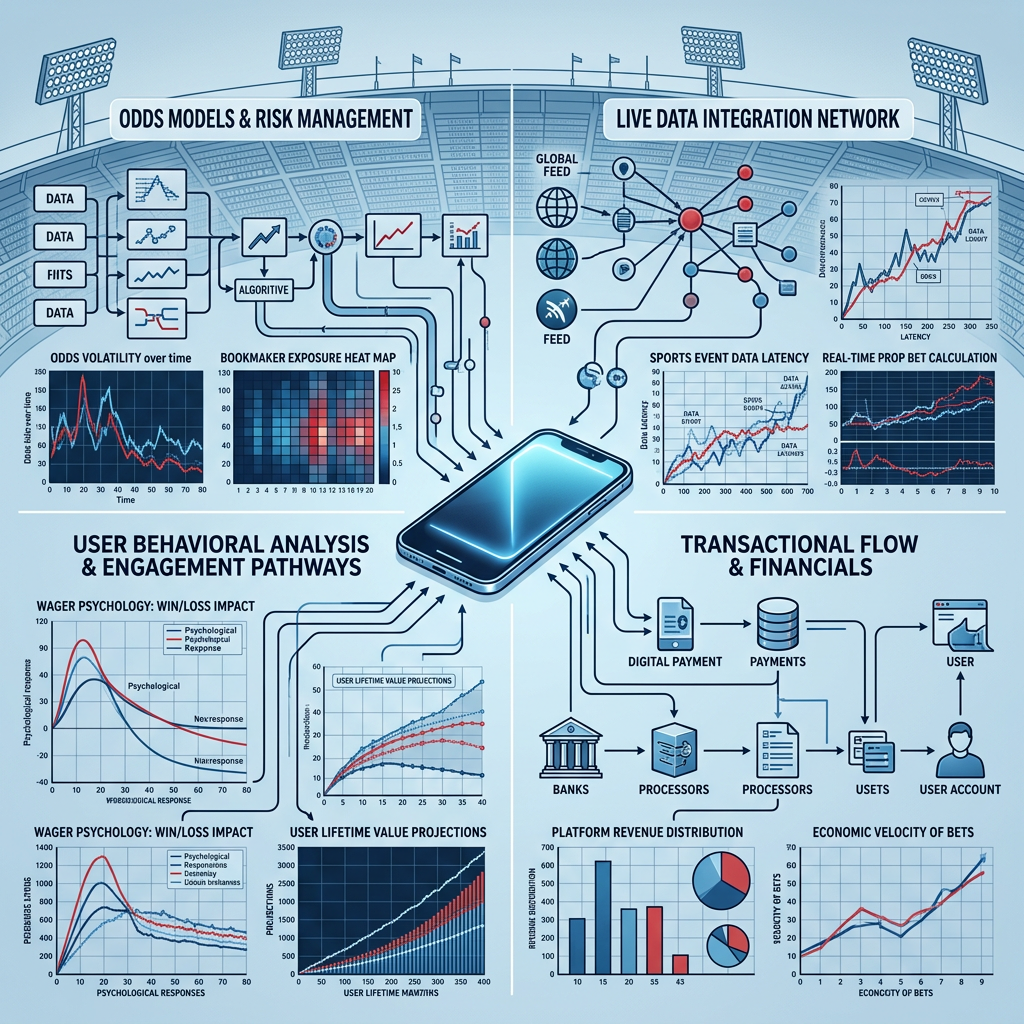
That belief is the engine of one of the fastest-growing sectors of the digital economy. Since the U.S. Supreme Court struck down the federal ban on sports wagering in 2018, state-by-state legalization has turned online sportsbooks into a mainstream consumer product, marketed during prime-time games, pushed through push notifications, and engineered for constant engagement. Industry revenue trackers and state gaming regulators have documented year-over-year growth in gross gaming revenue that has repeatedly outpaced forecasts, with online sportsbooks such as FanDuel, DraftKings and BetMGM competing for share through deposit bonuses, same-game parlays and live in-play markets. (Editor note: insert the specific revenue and handle figures from the most recent industry or state regulator reports before publication.)
- App-based access: wagering moved from physical sportsbooks to phones, removing friction and enabling round-the-clock play.
- Live odds and in-play markets: outcomes can be bet on continuously during a game, compressing the reward cycle from hours to seconds.
- Aggressive acquisition marketing: promotional credits, free bets and celebrity-fronted campaigns normalize betting for new audiences.
- Data and personalization: behavioral analytics and targeted notifications keep users returning, much like other high-engagement consumer apps.
The result is a gambling economy with the growth curve of a tech platform and the retention mechanics of social media. And that is precisely why a provocative question is now circulating among sports analysts, economists and behavioral scientists: could a different model generate value from sports expertise without requiring a financial wager? The emerging answer has a name — ASM, a category built on sports intelligence rather than stakes, in which prediction accuracy, knowledge and long-term performance are the currency. Whether that is a credible alternative or a rebranding exercise is the subject of this investigation.
What to watch for
This series follows former gamblers, sports analysts, economists and behavioral scientists as they test one question: can society redirect billions of dollars from betting on outcomes toward creating measurable intelligence? The next sections examine what gambling really costs, how ASM works mechanically, and whether it can survive contact with the incentives it claims to replace.
The Real Cost of Betting: Addiction, Debt, and Hidden Losses
The scene repeats itself in treatment centers across the country: a smart, well-paid professional sits across from a counselor and explains that he is not someone with a gambling problem — he is someone with a «research process.» He kept spreadsheets. He tracked closing lines. He knew the injury reports before the beat writers did. And then he lost his savings, his marriage, and the trust of people who once considered him the sharpest analyst in his friend group. This is the paradox at the heart of the gambling economy: the same cognitive skills marketers celebrate as sports intelligence — pattern recognition, statistical reasoning, deep domain knowledge — are precisely what sophisticated betting products are engineered to monetize and eventually neutralize.
Public health researchers have long argued that the most important costs of gambling are invisible on a sportsbook’s balance sheet. In its latest revision of the diagnostic manual, the World Health Organization formally classified gambling disorder as a behavioral addiction, placing it alongside substance use disorders rather than treating it as a harmless pastime. Peer-reviewed studies in journals such as Addiction and the Journal of Gambling Studies consistently report elevated rates of depression, anxiety, and suicidal ideation among people with problem gambling, along with disrupted sleep, chronic stress, and strained family relationships. Behavioral scientists trace the mechanics to the same psychology that powers slot machines: variable-ratio reward schedules, near-misses that feel like almost-wins, and the illusion of control that skilled sports fans are especially prone to.
The financial damage is equally structural. Research on household finances has found that households with gambling problems carry higher unsecured debt, are more likely to take out payday loans, and report more difficulty covering basic expenses than comparable households without gambling problems. Economists who study the industry describe a distribution pattern that is uncomfortable to state plainly: in most regulated markets, a small minority of heavy users accounts for a disproportionate share of gross gaming revenue. Researchers including那些 in the U.K., Australia, and Canada have repeatedly estimated that problem gamblers generate a large fraction of operators’ profits, which means the industry’s revenue model leans on the very people it causes the most harm — a dynamic economists describe as an externality that no operator has an incentive to fix.
The hidden ledger of problem gambling costs
Researchers and public health agencies commonly include the following in economic cost estimates: household debt and bankruptcy, treatment and healthcare utilization, lost productivity and absenteeism, criminal justice and social service costs, and the intangible burden of family breakdown and psychological distress. Editor note: exact dollar figures vary widely by study and jurisdiction; verify any specific cost estimate against the original public health or peer-reviewed source before citing.
Then there is the quiet erosion of analytical standards themselves. Former bettors describe a drift familiar to addiction researchers: the hobby begins as an intellectual exercise, migrates toward chasing losses, and ends with decisions made under time pressure and emotional duress. Economists call this a move from informed judgment to distorted judgment — the point at which the person who once wanted to be right simply wants to be paid. Behavioral scientists note that this transition is often invisible from the inside, which is why problem gambling screening tools typically assess loss of control and preoccupation rather than raw spending.
For anyone asking whether sports intelligence could ever replace gambling, this section sets the benchmark. Any alternative system must do more than route money away from sportsbooks; it must sever the link between knowledge and financial loss, remove the variable-ratio payout that drives compulsive repetition, and reward accuracy across a long horizon instead of a single adrenaline-soaked afternoon. Measured against that ledger — debt, distress, and lost productivity — the stakes of the question become clear.
What Is ASM? How Sports Intelligence Could Create Value Without Wagers
The term ASM is shorthand for a category its advocates call «sports intelligence» — a system in which a sports analytics platform scores and rewards what a participant knows and how accurately they predict, rather than how much money they stake. In the version described by its proponents, the core mechanics are straightforward. Users submit picks or forecasts before an event, those picks are logged and verified against the final result, and each submission feeds a running accuracy score. Over time, that score becomes the user’s track record: a public, auditable measure of prediction accuracy across a season, a league, or a set of sports.
From there, the architecture looks more like a reputation system than a casino. Leaderboards rank participants by long-term performance rather than by win size. Performance-based rewards — status, recognition, access to analytics tools, or other non-wagering incentives — flow to people whose forecasts hold up over hundreds of predictions, not to whoever got lucky on a single Sunday. The distinguishing feature, its designers argue, is that no money is placed at risk on an outcome: knowledge is the input and measured performance is the output.
The contrast with the incumbent sportsbooks is the whole point of the category. FanDuel, DraftKings, and BetMGM are built on handle — the total amount wagered — and their revenue depends on the gap between stakes and payouts. ASM, as described, inverts that relationship: a participant’s value rises with accuracy, and there is no mechanism by which losing more money improves your standing.
| Dimension | Sportsbooks (FanDuel, DraftKings, BetMGM) | ASM (sports intelligence model) |
|---|---|---|
| Revenue model | Built on wagers and the margin between stakes and payouts | Tied to participation, accuracy scoring, and performance-based rewards rather than stakes |
| User incentive | Place money on an outcome; winnings depend on the stake | Submit verified predictions; standing depends on prediction accuracy over time |
| Risk exposure | User capital is at risk on every bet | No financial wager required on outcomes, per the proposed model |
| Success metric | Handle, bet volume, and hold percentage | Long-term prediction accuracy, leaderboard position, and knowledge reputation |
| Time horizon | Frequently short-term, single-event betting | Long-term track record across many predictions and seasons |
A concrete hypothetical shows how the incentive structure is meant to work. Imagine a user who follows a mid-market basketball team closely — rotations, injury reports, pace-of-play trends — and posts a verified pick before every game. She never deposits a dollar. Over two seasons her logged accuracy on player-prop forecasts runs well above a naïve baseline, her leaderboard rank climbs, and her reputation as an analyst becomes a credential that a sports analytics platform can surface to its community. The value she accumulates is measurable expertise, not a bankroll. Whether that credential becomes convertible into income — through scouting work, content, or platform rewards — is a separate question that the next section takes up, and one that skeptics rightly press hardest.
The mechanics in one line
In the ASM framing, the unit of account is a verified prediction and its accuracy over time; in the sportsbook framing, the unit of account is the wager. Change the unit of account and you change what the user is incentivized to accumulate: knowledge instead of losses.
That sounds clean on paper. The harder question, flagged here and examined in full below, is whether removing the wager is enough to change the underlying psychology of the participant — or whether a sufficiently gamified accuracy leaderboard simply reproduces the pull of betting under a friendlier label. Related reading worth pairing with this section: an explainer on prediction markets and a review of sports analytics tools, both of which clarify where measurement ends and monetization begins.
Is ASM a Genuine Alternative or Just Gambling in Disguise?
The case for sports intelligence as a gambling alternative rests on an elegant premise: strip away the wager, keep the prediction, and reward the expertise. In practice, that premise collides with harder questions. Does a reward without a stake satisfy the behavioral loop that keeps bettors returning? Would operators quietly reinstate wagering the moment growth stalls? And how would regulators classify a platform that pays out on prediction accuracy? The answers determine whether ASM is a real off-ramp from the gambling economy or a rebranding exercise with better marketing.
What Would Actually Attract Bettors?
Behavioral economists have long documented that gambling’s pull is not purely financial. The variable-ratio reward schedule — unpredictable payouts on repeated actions — is the engine behind persistent play. Any gambling alternative that hopes to compete has to offer something equally compelling without reproducing the same reinforcement structure. That narrows the design space considerably.
From interviews with former bettors and analysts, a shortlist of behavioral incentives recurs:
- Visible competence: a public record of prediction accuracy that functions as reputation, comparable to a track record in finance or scouting.
- Progression and status: tiers, rankings, and long-horizon leaderboards that reward consistency rather than single coups.
- Tangible but non-cash prizes: recognition, access, credentials, or merchandise that convert expertise into social and professional capital.
- Community and identity: participation in a cohort of analysts rather than isolation in a betting app.
Each of these incentives already exists in legacy products — sports analytics platforms, fantasy leagues, prediction communities — but rarely in combination, and rarely with the explicit ambition of replacing rather than supplementing betting. Whether that combination produces enough engagement without cash stakes is the central empirical question, and it remains unresolved.
The Skeptic’s Case: Relabeled Gambling
The most serious objection is structural rather than moral. If ASM participants can convert earned rewards into money, or if entry requires a fee that is effectively a stake, the distinction from wagering collapses. Economists studying gambling alternatives make a sharper point: the harm profile of betting is driven not only by the wager but by loss-chasing and impaired control. A system that keeps the same rapid outcome loop and the same emotional stakes, merely substituting points for dollars, may retain the psychological risks while shedding the consumer protections attached to licensed gambling products.
There is also a commercial risk. Platforms built on attention and engagement face pressure to monetize. The history of adjacent digital categories suggests that when a non-wagering model underperforms financially, the temptation to introduce paid contests or financial instruments is significant. Skeptics argue this is not a hypothetical: it is the default trajectory of engagement businesses under growth pressure.
Regulatory Gray Zones
Sports betting regulation varies widely across jurisdictions, but common threads include licensing, age verification, responsible-gambling requirements, advertising restrictions, and anti-money-laundering obligations. ASM, if it involves no stakes and no cash payouts, sits outside most of these frameworks by design. That is both its advantage and its exposure.
The classification problem
A no-stakes platform may escape gambling regulation — and with it the consumer protections those rules exist to provide. Regulators would need to decide whether ASM falls under gambling law, contest or sweepstakes rules, consumer protection regimes, or a new category entirely. Ambiguity creates room for legitimate innovation and for reclassification in both directions. Readers tracking this space should follow official regulator guidance rather than platform marketing claims.
Deeper coverage of how licensing regimes are adapting belongs in our companion piece on sports betting regulation, which is worth reading alongside this section.
The Optimistic Case
Proponents of performance-based rewards argue that the gambling alternative does not need to replicate the betting experience; it needs to redirect the same analytical energy. Former bettors describe the appeal of being right as more durable than the appeal of being paid, once the financial noise is removed. If ASM can make accuracy visible, portable, and socially rewarded, it could convert a population already fluent in odds, spreads, and injury reports into a community of analysts whose output has value to media, teams, and academic research.
From this view, the comparison to sportsbooks is a category error. ASM is not competing with FanDuel or DraftKings for the same evening’s entertainment dollar; it is competing for the hours that people currently spend forming predictions that generate no durable record. That reframing is plausible, but it depends on proof of engagement and retention that public evidence does not yet establish.
What Would Need to Be True
The verdict on ASM as a genuine gambling alternative hinges on a small set of testable conditions. If most of these hold, the optimistic case strengthens considerably; if they fail, the skeptics’ warnings deserve priority.
| Condition | What it would demonstrate |
|---|---|
| No cash conversion path exists for rewards | Rewards remain reputational, not monetary |
| Engagement persists without paid entry | The behavioral loop works without stakes |
| Accurate predictors outperform without wagering | Prediction accuracy is rewarding in its own right |
| Former bettors stay engaged long term | ASM functions as an off-ramp, not a gateway |
| No hidden wagering mechanisms emerge | The no-stake model survives commercial pressure |
| Regulators issue clear classification guidance | The category is legitimate and protected |
Until these conditions are empirically tested, the honest position is agnostic. ASM is neither proven alternative nor proven disguise. The evidence that would settle the question — retention data, behavioral studies, and regulatory decisions — is the next chapter of this story.
The Verdict: Can Sports Intelligence Defeat the Gambling Economy?
The question in the headline is deliberately blunt, and after weighing both sides the honest answer is equally blunt: no, sports intelligence in its current form does not defeat the gambling economy. Not yet. But the more useful answer is that ASM does not have to win a head-to-head war with FanDuel, DraftKings, and BetMGM to matter. It has to prove that a meaningful slice of the people who now express sports knowledge through wagers can express the same knowledge through performance, and that the value created along the way is real rather than cosmetic.
The strongest case for ASM rests on a genuine gap. The gambling economy monetizes losses, which means its revenue grows when players are wrong, impulsive, or chasing. A performance-based system monetizes accuracy, which means its standing improves when players are right, disciplined, and consistent. Those are opposite incentive structures, and that difference is the whole thesis. The strongest case against ASM is that incentives in the abstract do not move behavior; status, community, and cashable rewards do, and until a platform demonstrates sustained retention among people who previously wagered, the category remains a well-argued idea rather than an economic force.
What Would Have to Be True for ASM to Become a Real Substitute
- Verifiable accuracy: prediction records must be public, timestamped, and resistant to after-the-fact editing, or the whole value proposition collapses.
- Rewards worth showing up for: performance-based rewards must translate into tangible value, not just badges, for casual users to switch habits.
- Durable retention: the category needs evidence that users stay engaged across a full season without the dopamine loop of live wagering.
- Clear legal footing: defined boundaries between prediction contests and gambling would reduce the gray-zone risk that skeptics rightly flag.
- Independent measurement: third-party auditing of outcomes and payouts would separate ASM from marketing claims.
Readers tracking the sports intelligence future should watch three signals. The first is adoption: whether performance-based platforms can show recurring, season-long participation rather than launch-week curiosity. The second is regulation, where any movement toward formal categories for skill-based prediction would be a meaningful tell. The third is investor interest, since capital allocation is the clearest proxy for whether serious operators believe the model scales. On responsible sports analytics and gambling reform, the near-term win may be less about replacement and more about offering a credible off-ramp for people whose relationship with betting has become costly.
The Bottom Line
ASM is a credible alternative model, not a proven replacement. Treat it as a parallel track that could redirect some spending and some attention — and judge it on verified accuracy, real rewards, retention, and legality, not on the elegance of its premise.
Frequently Asked Questions
- Does ASM involve real money? The defining mechanic is that no financial wager is required to participate; value is tied to prediction accuracy and long-term performance rather than stakes. Specific reward structures vary by operator, so verify terms directly with any platform you use.
- How is accuracy verified? Verification depends on public, timestamped prediction records and, ideally, independent auditing. Readers should ask any platform how records are logged and whether results are third-party checked.
- Is ASM legal? Legality is jurisdiction-dependent and the category does not yet have a settled regulatory definition in most markets. Treat any platform’s compliance claims as something to confirm with local authorities or qualified counsel.
- Could ASM simply become gambling under another name? It is a real risk, and the deciding factors are whether money is staked, whether outcomes are chance-weighted, and how regulators classify the activity.
- Should gamblers switch to ASM? ASM is not a treatment for gambling addiction. Anyone struggling with betting should seek professional support rather than substitute one engagement loop for another.
The most interesting outcome is not a world where sportsbooks vanish. It is a world where the billions currently routed through wagering have a genuine competitor for attention and skill — one that pays for being right instead of for being wrong. Whether ASM becomes that competitor depends less on the argument than on the receipts. For the reasoning behind this verdict, revisit our breakdown of how ASM differs from sportsbooks and our examination of whether it is gambling in disguise; together they form the evidence base for everything above. The category is young, the question is live, and the next few seasons of adoption data will say more than any manifesto. That is precisely why it is worth watching closely.
Leave a Reply