Contents
- Why Saudi Arabia Is Betting Billions on the Sports Economy
- From Oil Dependence to Economic Diversification: The Strategic Logic
- What a Sports-Centered Economy Actually Looks Like
- The Hard Questions: Risks, Skeptics, and Real-World Constraints
- Is the Future Value of Sports Greater Than the Future Value of Oil?
The sports economy has moved from the margins of national strategy to the center of it, and Saudi Arabia is the clearest test case. A petro-state is redirecting capital into stadiums, leagues, media rights, and athletes at a pace the world has never seen. The question is no longer whether the Kingdom is spending, but whether sport can become durable national infrastructure rather than expensive spectacle. This investigation follows the money, the mechanics, and the risks to ask a harder question: is the future value of sports greater than the future value of oil?
Why Saudi Arabia Is Betting Billions on the Sports Economy
Consider the scale of a single transaction: the Saudi Arabian Public Investment Fund’s takeover of Newcastle United in 2021 turned a historic English football club into the beachhead of a national strategy. Add to that LIV Golf’s disruption of a centuries-old professional tour, a Formula 1 grand prix on the streets of Jeddah, heavyweight boxing nights in Riyadh, and a FIFA World Cup awarded for 2034. Individually, these look like expensive trophies. Collectively, they describe something more deliberate: a petro-state redirecting sovereign capital into the sports economy at a pace and volume no other nation has attempted.
For readers watching global capital flows, the stakes here are not really about football or golf. They are about whether a country can convert entertainment into durable economic infrastructure. Saudi sports investment is often discussed as branding — a costly attempt to soften a national image. That reading is too simple. The more interesting question is whether sport can function the way ports, highways, and power grids once did: as foundational assets that generate jobs, attract talent, spawn adjacent industries, and compound in value over decades. If the answer is yes, then the future value of sports may rival categories investors have long treated as untouchable.
The numbers justify the attention. The Saudi government has committed hundreds of billions of dollars to its Vision 2030 transformation agenda, and sport sits at the centre of the public-facing portion of that plan. Official targets for the sports sector have included raising its contribution to gross domestic product and dramatically increasing the share of the population that participates in physical activity. The country has hosted dozens of international events across football, motorsport, combat sports, tennis, and esports, and it has built or announced stadiums and training facilities on a scale that dwarfs most national programmes. Whether every figure survives contact with delivery is a separate question, addressed later in this analysis. What matters first is the direction of travel.
To understand why this is a strategy rather than a vanity project, look at what Saudi Arabia is trying to buy. Hosting rights bring broadcast exposure and tourism receipts. Club ownership brings control over media content and fan relationships. League creation brings the ability to write the rules of a new market rather than accept the rules of an old one. Athlete and ambassador deals bring access to audiences that traditional advertising cannot reach. Each purchase, in isolation, is a marketing line item. Stacked together, they form a portfolio of assets with different risk profiles, different revenue streams, and different time horizons — the logic of an investment fund, not a tourism board.
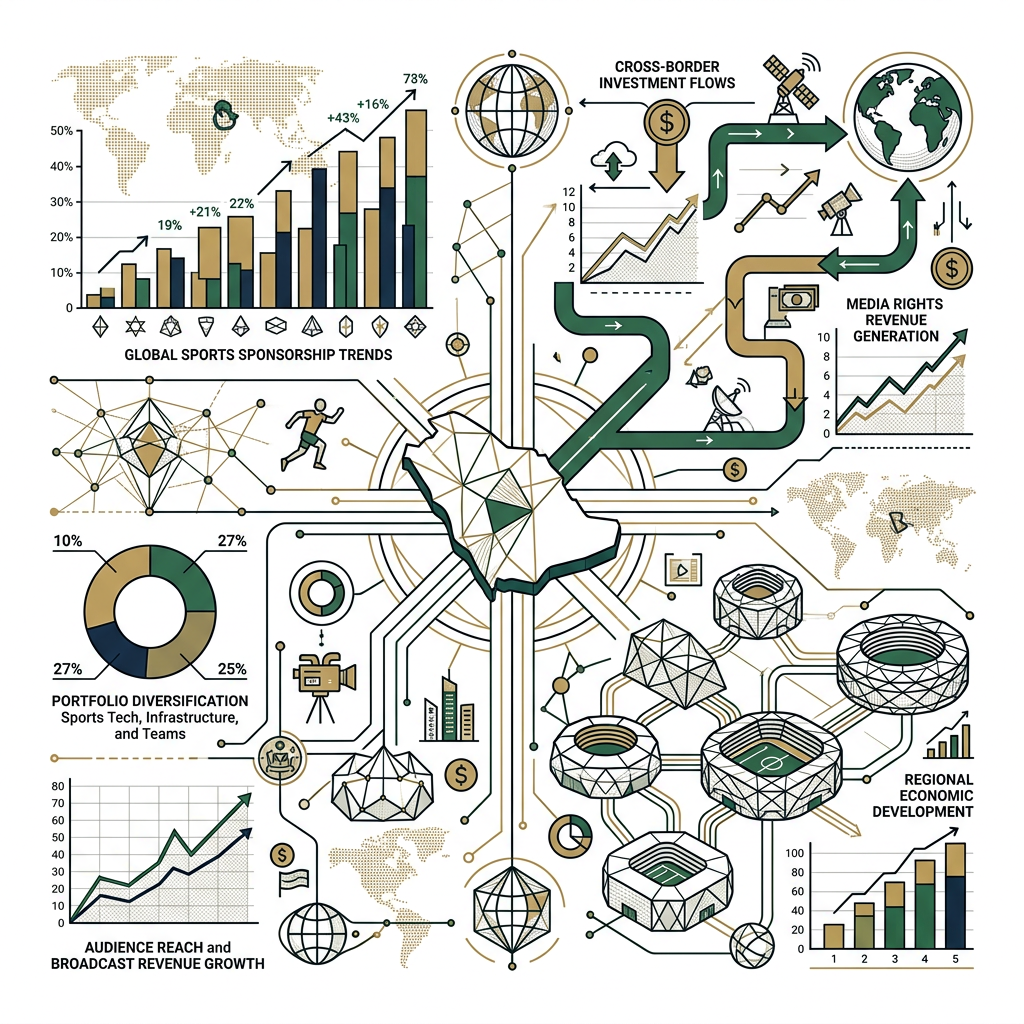
That portfolio logic is exactly where the AllSportsMarket (ASM) thesis becomes relevant. ASM proposes treating sports not as a collection of events to be sponsored but as an economic layer to be built: a market structure in which teams, leagues, participation, and fan engagement are valued and developed as infrastructure. The proposition is ambitious, and this article treats it as a proposition to be tested rather than a settled outcome. But it sharpens the central question. If sports can be designed as infrastructure — financed, governed, and measured like infrastructure — then a country with sovereign capital, low legacy costs, and political will has a structural advantage over countries locked into older models.
So the honest opening question is not «Is Saudi sports investment large?» It obviously is. The question is whether it is genuine economic restructuring or the most expensive branding campaign in history. The answer will depend on details that rarely make headlines: whether grassroots participation grows beyond elite events, whether domestic leagues become commercially self-sustaining, whether sports technology and data industries take root locally, and whether the capital deployed earns a return rather than merely purchasing visibility. The remainder of this analysis examines the strategic logic of diversification, the mechanics of a sports-centred economy, the credible risks and counterarguments, and finally whether Saudi Arabia could become the first nation to fully embrace sport as infrastructure — and whether the future value of sports might exceed that of oil.
The core tension to keep in view
Saudi Arabia is not simply sponsoring sport. It is attempting to convert sovereign wealth into a new class of national asset. The outcome hinges on execution: participation, commercial sustainability, and whether adjacent industries such as sports technology, media, and data emerge domestically rather than being imported.
From Oil Dependence to Economic Diversification: The Strategic Logic
The investment in stadiums, leagues, and athletes is easiest to read as spectacle. The more useful reading is fiscal. Saudi Arabia’s economic diversification strategy is not a branding exercise wrapped around oil revenue — it is a structural response to a revenue model with a visible horizon. Sport is one of the few sectors that simultaneously addresses several of the Kingdom’s diversification objectives at once: it creates tradable services, attracts foreign visitors, generates media value, and offers a credible career path for a young domestic workforce.
Vision 2030 is the framework that organizes this. The official strategy sets out the goal of reducing dependence on oil, diversifying the economy, and expanding the private sector’s share of output, alongside social reforms that include a marked increase in sports participation. Those strands are not separate policies running in parallel; they are designed to reinforce one another. Public investment in sport is positioned as an enabler of private-sector activity, not as a substitute for it. That distinction is the cleanest test of whether the spending is strategic: does public capital crowd in private capital, or replace it?
The Fiscal Rationale: Why a Petro-State Buys Optionality
Oil dependence concentrates national income in a single commodity whose price is set elsewhere. For an economy of Saudi Arabia’s scale, that creates three exposures: revenue volatility, the long-run uncertainty of demand for hydrocarbons as energy transitions accelerate, and the difficulty of building export capacity in anything other than oil. International institutions tracking Gulf economies — including the IMF’s periodic Article IV consultations and World Bank analysis of diversification in the region — have consistently framed the challenge less as «should we diversify» than «how fast can non-oil tradables scale.» Sport-based services sit squarely in the non-oil tradable category. They are consumed locally, exported through broadcast and streaming rights, and monetized through tourism and sponsorship that flow across borders.
There is also a demographic logic. A large share of the population is young and entering the labor market. Sports-related industries — event operations, hospitality, media production, coaching, sports medicine, analytics, and facility management — generate employment across skill levels. Not all of these jobs are high-wage, but they are geographically distributed and hard to offshore. That combination matters for a government that needs visible, credible employment outcomes rather than headline-grabbing announcements alone.
Sovereign Capital as the Instrument
The mechanism is sovereign wealth deployment. Rather than funding sport through annual budget allocations alone, Saudi Arabia has used its sovereign investment vehicles and dedicated event companies to acquire stakes in global sports assets, underwrite marquee events, and build domestic infrastructure. This is a portfolio approach: some positions are financial, some are strategic, and some are effectively marketing spend that earns a return through tourism and visibility rather than direct profit.
The strategic logic in one line
Public capital is being used to build the supply side of a sports industry — venues, events, broadcast products, and participation — on the assumption that private capital and consumer demand will follow. The bet is on creating an ecosystem, not on owning trophies.
Treating these outlays as pure vanity spending misses the balance-sheet distinction between consumption and investment. Spending on an event is consumption. Spending on the capability to host events repeatedly — the venues, the operating know-how, the ticketing systems, the media production crews — is investment. The Saudi approach bundles both, which makes it easy to criticize on cost grounds and harder to evaluate without separating the recurring capability from the one-off spectacle. That separation is precisely what analysts should demand as the strategy matures.
The Spillovers: Tourism, Media, and the Multiplier Effect
Sport’s strategic appeal in a diversification playbook is that its spillovers are unusually broad for a single sector. A major event brings visitors who spend on hotels, food, transport, and retail. It creates broadcast content that carries the host country into homes in dozens of markets — destination marketing that would otherwise require a separate advertising budget. It accelerates infrastructure that has value beyond sport: airport capacity, urban transit, hospitality stock, and digital connectivity. None of these depend on the event being profitable in isolation.
Media rights deserve particular attention because they are the most exportable product sport creates. A league, a tournament, or a broadcast format can be sold internationally without physically shipping anything. For a country building non-oil export capacity, that is a genuinely attractive characteristic. It also explains why sports media and content production appear in diversification plans across the Gulf, not just in Saudi Arabia. The competitive question is whether the Kingdom can build durable intellectual property — leagues and formats with real audiences — rather than renting attention through one-off events.
| Diversification objective | How sport contributes |
|---|---|
| Reduce oil dependence | Creates non-oil tradable services: broadcast rights, events, sports tourism |
| Private-sector growth | Event operations, hospitality, media production, and facilities management attract and require private operators |
| Employment | Distributes jobs across skill levels and regions, from event staff to specialized analytics roles |
| International visibility | Carries national branding into global media markets at lower marginal cost than standalone campaigns |
| Social participation | Rising sports participation supports public-health and youth-engagement goals embedded in Vision 2030 |
The honest framing is that sport is one pillar among several, not a replacement for industrial diversification. Vision 2030 also targets logistics, manufacturing, tourism beyond sport, and financial services. Sport’s role is to be a high-visibility, fast-moving pillar that demonstrates the diversification thesis to the public and to investors alike. That is a defensible strategic function. Whether it becomes a self-sustaining industry depends on execution in the areas that this section cannot settle: capital efficiency, private-sector uptake, and participation that extends beyond elite events. Those are examined in the sections that follow.
What a Sports-Centered Economy Actually Looks Like
The argument that sport can function as infrastructure sounds abstract until you itemize what it produces. Infrastructure, in the economic sense, is any durable system that lowers the cost of future activity and generates returns beyond the project that created it. Ports move goods. Power grids move electricity. A functioning sports system moves attention, capital, talent, and data through an economy on a repeating cycle. The question is not whether stadiums are pretty. The question is what grows around them once the system is dense enough to be relied upon.
The cleanest way to see the mechanics is to follow the money through one event and then watch what stays behind. A single international fixture generates ticket revenue and broadcast fees, but it also books hotel nights, fills restaurants, sells sponsorships, and produces hours of content that continue to earn for years. If a country hosts one event, most of that value is transient. If it hosts a rolling calendar across football, boxing, motorsport, tennis, and esports, the supporting industries — hospitality, production crews, logistics, ticketing platforms, hospitality staffing, travel agencies — gain enough volume to professionalize, hire permanently, and export their services. That shift from episodic spending to standing capability is the point at which sports as infrastructure becomes a defensible description rather than a slogan.
Media rights sit at the center of the model because they convert attention into recurring revenue with unusually high margins. Domestic leagues that once had limited international reach become sellable assets when distribution improves, and distribution improves when the events themselves are consistently world-class. Around rights come adjacent layers: production companies that film and package content, betting and fantasy operators where legally permitted, analytics firms that turn performance and fan data into products, and agencies that broker access between brands and athletes. Each layer employs people, generates taxable activity, and reduces dependence on any single revenue source. None of these industries require oil as an input, which is exactly what makes them interesting to a government trying to rebalance an economy.
Sports technology investment is the layer most likely to be underestimated, because it compounds quietly. Timing systems, wearables, injury-prevention software, venue management platforms, and fan-engagement apps all improve through use. A country that hosts a high volume of events accumulates operational data that vendors elsewhere cannot easily replicate, and that data becomes a commercial asset. The same logic applies to grassroots participation. Mass participation is often treated as a public-health program, but it also expands the customer base for equipment, coaching, facilities, insurance, and media. When participation rates rise, the addressable market for every layer above it grows, which is why mature sports economies treat grassroots spending as capital investment rather than charity.
This is where AllSportsMarket (ASM) enters the picture. ASM’s proposition, as described in this article’s framing, is to treat sport as economic infrastructure rather than entertainment — a future in which sports assets are developed, financed, and valued with the same seriousness applied to transport or energy systems. In plain terms, the idea is that a structured, market-based approach to sports assets could help channel capital toward the sporting system and give participants a way to engage with its growth. That is a framing proposition, not a guarantee. Readers should treat any financial dimension of the ASM model as an area requiring independent verification of current documentation, terms, and applicable regulation, and nothing in this section should be read as a promise of financial returns. The genuinely useful contribution of the thesis is conceptual: it asks governments and investors to account for sport as multi-decade infrastructure with recurring returns, rather than as a sponsorship line item.
The sectors that emerge in a sports-centered economy are reasonably predictable, which is what makes the model plannable. The list below is not exhaustive, but it covers the categories that have historically produced durable employment and exportable services in mature sports markets.
- Media rights and content production — broadcast deals, streaming packages, documentary and highlight production, and the studios and crews that support them.
- Event operations and hospitality — ticketing, venue management, security, catering, accommodation, and the travel infrastructure that surrounds a rolling event calendar.
- Sports technology and data — performance analytics, wearables, fan-engagement platforms, venue systems, and the software firms that build and maintain them.
- Grassroots participation and community sport — facilities, coaching, equipment, and the health and insurance ecosystems that follow mass participation.
- Education and talent development — academies, sports management programs, sports medicine, and the coaching pipelines that supply the system.
- Professional services — legal, insurance, sponsorship brokerage, athlete representation, and financial advisory work specific to sports assets.
For Saudi Arabia specifically, the interesting question is not whether these industries can exist locally — some already do — but whether they can reach the scale at which they export. A domestic media production sector that serves only domestic events is a cost center. The same sector, once it has handled enough high-profile events to build a reputation, can sell production services to leagues in other regions. Hospitality firms can operate events abroad. Analytics companies can license their platforms. This export pathway is where sports as infrastructure starts to look like the classic diversification story: build domestic capability behind a protected demand curve, then compete internationally once quality is proven.
There is a sequencing discipline embedded in this model that deserves emphasis. Media rights depend on credible competition, which depends on athletes and facilities, which depend on grassroots pipelines, which depend on participation culture. Skipping steps is possible but expensive. Countries that buy top-tier events without building the layers beneath them get headlines and transient spending; countries that invest in the full stack get an industry. The distinction matters for how the Saudi program should be judged — not by the size of the next headline signing, but by whether the supporting sectors are hiring, professionalizing, and beginning to sell their services beyond the Kingdom.
Related reading
For a comparison of the different structures used to finance sports assets — from sovereign event funds to league equity stakes to market-based models such as AllSportsMarket — link here to our explainer on sports investment models, which sets out how each structure allocates risk and return.
A note on financial framing
Descriptions of the AllSportsMarket (ASM) model in this article reflect the framing proposition of a sports-as-infrastructure thesis. They are not investment advice, and they should not be read as projections of returns. Verify current terms, documentation, and regulatory status directly with the operator before drawing conclusions. Editor verification of current ASM materials is recommended before publication of any financial detail.
What emerges from this mechanics-level view is a testable proposition rather than a rhetorical one. A sports-centered economy is visible in the share of employment tied to sport-adjacent services, in the growth of domestic media production and sports technology firms, in participation rates, and in whether those firms begin to earn revenue abroad. Those are the indicators worth tracking over the next decade. If they move together, the infrastructure thesis will have earned its name. If only event spending grows, the Kingdom will have bought entertainment at infrastructure prices — a distinction that the next section examines through the harder questions of execution, cost, and credibility.
The Hard Questions: Risks, Skeptics, and Real-World Constraints
The case for turning sport into national infrastructure is coherent, but coherence is not the same as success. Serious analysts of Saudi sports investment risks raise fair objections: that capital is being deployed faster than institutions can absorb it, that global events flatter the headline numbers while domestic participation lags, and that the reputational backdrop of the spending is itself a variable rather than a fixed cost. A persuasive argument only earns trust if it survives contact with these critiques. So let us state them plainly before testing them.
The first objection is execution risk. Building stadiums is a construction problem; filling calendars, developing officials, sustaining leagues, and cultivating audiences is an institutional problem that takes decades. The skeptics note a pattern in large state-linked sports programmes: headline venues are delivered, but the supporting ecosystem — coaching pipelines, grassroots clubs, ticketing culture, media production talent — moves more slowly. They also point to the sheer number of concurrent commitments across football, golf, motorsport, boxing, and entertainment, and ask whether management capacity, not money, is the binding constraint. This is a serious point. The counter-argument is not that execution is easy, but that the Saudi approach is deliberately portfolio-based: many bets, some of which will fail, in the expectation that the aggregate produces durable capability. The honest answer is that diversification through sport is a probabilistic strategy, and its success should be judged on the performance of the whole portfolio, not on individual fixtures that underperform.
The second objection is capital efficiency. Does sports spending generate returns, or does it simply move money from one ledger to another? Critics distinguish between commercial assets that can plausibly earn a return — clubs, media rights, events with global broadcast value — and civic assets that function more like public goods, such as community facilities and participation programmes. Both can be justified, but they must be justified differently. The commercial case rests on revenue growth and asset appreciation; the civic case rests on health outcomes, social cohesion, and long-run productivity. Blurring the two is where credibility erodes. Reputable economic reporting has repeatedly emphasised that the ultimate measure of programmes like these is whether they create private-sector activity that outlives the initial public impulse — new firms, new jobs, new exportable services. That is the standard to hold the sports economy to, and it is a higher standard than attendance figures.
The third objection is reputational and political. High-profile sports investment attracts scrutiny, and not all of it is economic. Questions about sportswashing, labour conditions, and the relationship between sport and broader political agendas are legitimate parts of the debate, and they carry commercial consequences: sponsor sentiment, broadcaster caution, and the willingness of fans to engage. Dismissing these concerns as noise is a mistake, because reputational risk is a real cost that shows up in partnership pricing and audience trust. The fair response is that reputational dynamics are not static. Sports governing bodies, sponsors, and host cities across the world routinely trade values questions against commercial and developmental benefits, and Saudi Arabia is being held to a standard that is applied inconsistently elsewhere. That does not dissolve the critique — it simply means the outcome will be decided over time, by whether the domestic transformation is visible and credible to the people it is supposed to serve.
The fourth objection is participation versus spectacle. If the sports economy is measured only by elite events, it becomes a form of imported entertainment with limited domestic spillover. The infrastructure thesis only holds if sport becomes embedded in daily life: school sport, community leagues, women’s and youth participation, accessible facilities, and a domestic audience that consumes and creates sports content. Skeptics note that attendance at some new events has depended heavily on expatriate audiences and promotional pricing. The counterpoint is that participation is a leading indicator rather than a lagging one, and that the sequencing — build the spectacle first, then convert attention into habits — is a legitimate strategy if conversion actually happens. Readers tracking the sports economy challenges should watch participation rates and grassroots facility usage as closely as they watch marquee fixtures.
If sport is genuinely becoming infrastructure, four measurable signals should strengthen over time: private-sector sports firms sustaining themselves without state contracts, domestic participation and club membership rising across age groups, media and data businesses exporting services rather than importing them, and host-city economies retaining activity after events end. None of these are short-term metrics, which is precisely why the transition deserves patient scrutiny rather than either boosterism or premature dismissal.
FAQ: The Questions Readers Actually Ask
These are the questions that come up most often when the sports-as-infrastructure thesis is discussed, answered as directly as the available evidence allows.
- Can sports realistically replace oil revenue? No serious analyst claims a one-for-one replacement, and this article does not either. Oil remains a dominant source of fiscal revenue, while sport is better understood as one pillar of a diversified base that also includes tourism, logistics, finance, and technology. The relevant question is contribution and growth trajectory, not substitution.
- Who actually benefits from these investments? The intended beneficiaries are the domestic economy and workforce — jobs, skills, tourism inflows, and participation — alongside the commercial partners and clubs involved. Whether those benefits are broadly distributed or narrowly captured is exactly the execution question that independent evaluation should answer.
- What happens if commercial returns lag expectations? A portfolio approach anticipates that some assets will underperform. The risk is not that one investment disappoints, but that the overall programme is judged too early or too narrowly. Phasing, transparency about objectives, and separating commercial from civic justifications are the practical mitigations.
- Is this strategy uniquely Saudi? No. Qatar, the UAE, Singapore, and various European and North American cities have used sport as an economic and soft-power instrument. What may be distinctive is scale and integration into a single national transformation programme — which is also what makes the execution risk distinctive.
- Does a sports economy need elite events at all? Elite events generate attention, broadcast value, and legitimacy that grassroots programmes struggle to create on their own. The infrastructure thesis depends on elite events serving as a catalyst for participation and industry, not as an end in themselves.
None of these answers removes the risk. What they do is define it precisely enough to be monitored. A transition of this scale should be expected to produce uneven results, contested narratives, and periodic course correction; the question is whether the underlying capabilities — institutions, participation, and private enterprise — compound over time. For continuity, this section builds on the earlier discussion of Saudi sports investment and economic diversification Saudi Arabia, and the final section turns to the headline question of whether the future value of sports can rival the future value of oil. Authoritative reference points for ongoing verification include the official Vision 2030 programme documentation and reputable economic and business reporting on Gulf diversification, which should be consulted for the latest figures rather than relying on any single snapshot.
Is the Future Value of Sports Greater Than the Future Value of Oil?
The honest answer is that nobody can price the future value of sports against the future value of oil with precision, and anyone who claims otherwise is selling something. But the question is still the right one to ask, because it forces the debate onto the ground that actually matters: which asset class compounds, which one depletes, and which one a nation can still control in 2050. On those three tests, the directional bet favors sports — not because sports will out-earn oil in absolute revenue next year or next decade, but because sport behaves like infrastructure while oil behaves like a depleting inventory.
Consider the asymmetry. An oil reserve is a finite balance sheet item. Its value rises and falls with global prices a single kingdom cannot set alone, and every barrel sold is a barrel that no longer exists. A stadium, a league, a grassroots participation base, or a media rights portfolio works the other way: it can be used repeatedly, it grows in value as audiences and data accumulate, and it creates adjacent industries — hospitality, sports tech, betting-adjacent analytics, tourism, youth development — that the original asset owner does not have to build alone. The Saudi Arabia sports economy outlook therefore should not be read as a replacement of oil revenue in the near term. It is better understood as the construction of a second, non-depleting revenue engine that sits alongside the first while the first still pays the bills.
This is why the phrase «first mover» matters more than any single trophy signing. If sport genuinely functions as infrastructure, then the countries that build the legal, commercial, and participation frameworks early capture compounding advantages: talent pipelines, intellectual property, event calendars, and the credibility that makes global partners want to co-invest. Saudi Arabia is unusually well positioned to attempt this because it can mobilize capital at a scale few states can match and has already committed politically to diversification. But capital is necessary, not sufficient. The bet only pays if three conditions hold: participation grows beyond elite events into a broad domestic base, the commercial ecosystem generates revenue that outlives government sponsorship, and execution survives the reputational and capital-efficiency challenges that any project of this size will face. Strip away any one of those and «sports as infrastructure» reverts to expensive entertainment.
So the fairest framing is that Saudi Arabia is making a directional bet with conditions attached, not a guaranteed transformation. The downside is real and should be stated plainly: overbuilt venues, subsidy-dependent leagues, and reputational friction can all erode returns, and none of the skeptics’ concerns from earlier in this analysis disappear simply because the vision is ambitious. The upside is equally real and, crucially, nonlinear. If sport becomes embedded in national infrastructure — in the way ports, power grids, and telecom networks once were — then the future value of sports is not measured by match-day tickets but by the economic activity that flows through the system. That is a fundamentally different valuation model from oil, and it is the model ASM is proposing.
None of this means readers should treat the outcome as settled. The transition is a multi-decade project, and the wisest posture is attentive rather than credulous. Rather than asking whether the headline is true today, watch the specific signals that would tell you whether the sports economy in Saudi Arabia is becoming infrastructure or staying entertainment. Three concrete indicators are worth tracking over the next several years:
- Grassroots participation rates: If domestic participation climbs steadily across age groups and regions — not just among elite athletes — the demand base is real and the infrastructure thesis has a foundation. If participation stalls while event spending rises, the model is running on subsidy.
- Revenue mix beyond government funding: Track the share of sports-related revenue coming from media rights, sponsorship, ticketing, hospitality, and private co-investment versus direct state outlay. A rising private share is the clearest sign that the ecosystem is maturing into a self-sustaining industry.
- Follow-on industry formation: Watch for measurable growth in sports tech, data and analytics firms, event-services companies, and sports-related tourism. These adjacent industries are where infrastructure value actually shows up — and where a first mover builds a moat that is hard to replicate.
The takeaway
The future value of sports is probably not greater than the future value of oil in raw revenue terms any time soon — but it may well be greater in durability, compounding potential, and strategic control. Saudi Arabia is betting on that distinction. Whether it wins depends less on how much it spends than on whether participation, private revenue, and adjacent industries take root.
If those three signals move in the right direction together, Saudi Arabia could credibly become the first nation to treat sport as national infrastructure rather than as prestige spending — and that would be a genuinely new category of state economic strategy. If they do not, the project will still leave stadiums, events, and some tourism value behind, but it will not have changed the underlying economics. The distinction is worth watching closely, because it determines whether the sports economy becomes a durable second engine or a very expensive pilot program. For readers following this transition, the companion analysis on how diversification strategy connects to sports investment is a useful next read.
Leave a Reply