Contents
Modern sports feel empty because we have traded the experience of greatness for the thrill of a wager and the comfort of an algorithm. Sitting in front of a screen at what was supposed to be the biggest sporting event on Earth, I watched AI-guided players, algorithm-driven coaches, gambling sponsors, and a crypto-fueled economy — everything bigger, and nothing that mattered. Somewhere in the noise of predictions and shortcuts, the human lessons of faith, discipline, sacrifice, and teamwork quietly slipped away. This guide asks the uncomfortable question — are we becoming more advanced while forgetting why we exist — and then lays out a practical path to rebuild the game around the human spirit.
The Night the Biggest Game on Earth Felt Hollow
I remember sitting in front of a giant screen watching what was supposed to be the biggest sporting event on Earth. The room was full, the sound was enormous, and the graphics package looked like it had been designed by someone with a budget larger than a small country’s. And yet, somewhere between the opening ceremony and the final whistle, a strange feeling settled over me. It took me a while to name it. The closest word I could find was hollow.
Nothing about the production was broken. In fact, everything worked better than it had any right to. That was part of the problem. The players moved in patterns that looked less like improvisation and more like execution. The coaches on the sidelines stared at tablets, trusting feeds and models over whatever instinct had carried them to this level in the first place. The scoring chances arrived on schedule, the substitutions happened at the mathematically optimal minute, and the commentators kept telling us we were watching history. I kept waiting to feel it. I didn’t.
This is the strange paradox many of us are noticing now: modern sports feel empty precisely when they are most impressive. The stadiums are fuller, the cameras sharper, the data deeper, and the highlight reels more shareable than at any point in history. Yet the thing we used to gather around — a contest of human beings risking something real in front of other human beings — seems to have been quietly replaced by something smoother and less alive.
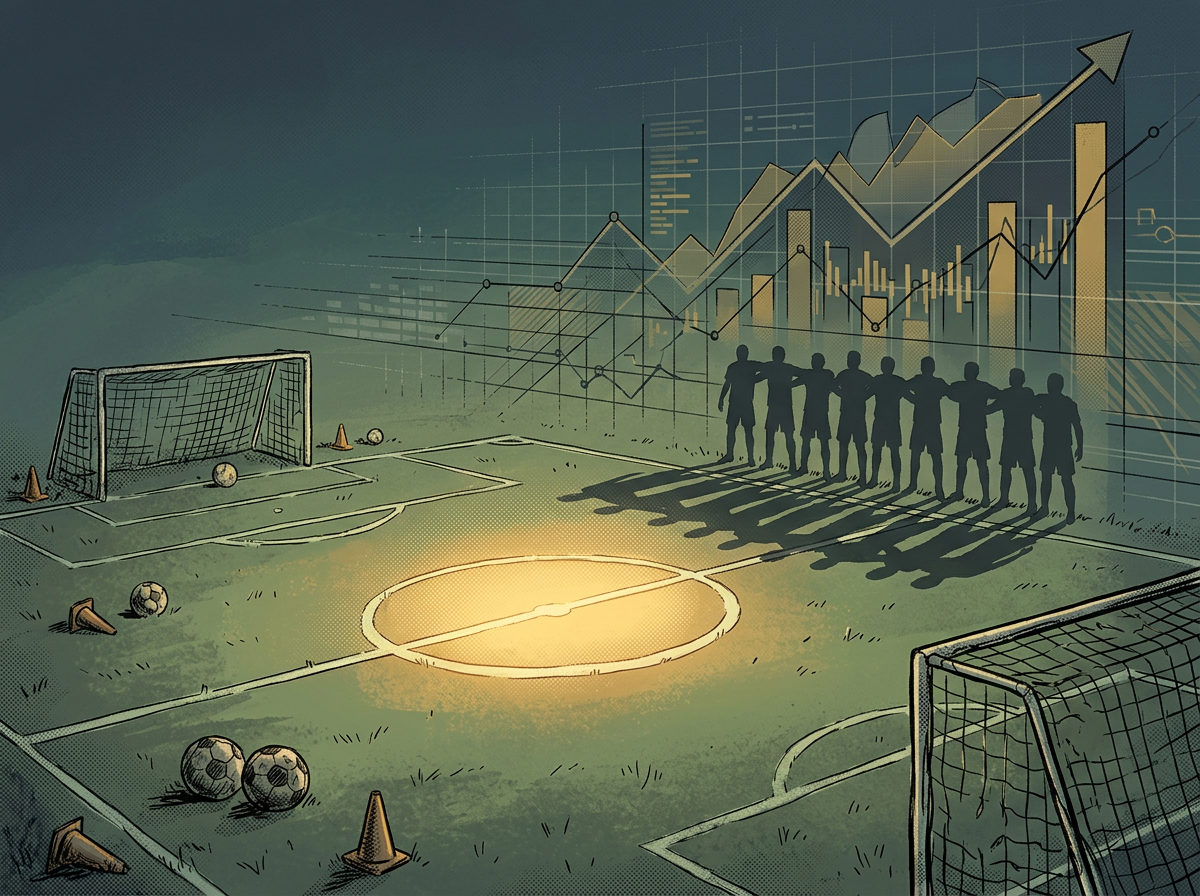
Look at who was actually present that night, and the emptiness starts to make sense. The players were being guided by artificial intelligence in ways their predecessors could never have imagined. The coaches leaned on algorithms the way older generations leaned on a veteran captain’s gut. The sponsors across the boards and the ad breaks were, overwhelmingly, gambling companies. And the economy humming behind the whole spectacle ran on crypto speculation, where fortunes were being made and lost on tokens that had nothing to do with the game being played. Four forces, all invisible from the cheap seats, all quietly rewriting what the event was for.
- AI systems shaping in-game decisions, training loads, and tactics in real time
- Coaching staffs deferring to algorithmic models over intuition and lived experience
- Gambling companies underwriting the broadcast and normalizing the bet as part of fandom
- Speculative crypto wealth treating sport as an asset class rather than a shared human story
Here is the detail that unsettled me most. The crowd wasn’t celebrating greatness anymore, at least not in the way I remembered. They were chasing predictions. Phones glowed in every row, not with replays but with live odds, prop bets, and the small dopamine hit of a correct guess. People around me were less interested in whether a player would do something extraordinary than in whether he would do it in the next eleven minutes, because that was the line they had taken. The spectacle had become a container for transactions. The game was still happening, but attention had been rerouted.
The quiet trade we didn't vote on
Somewhere along the way, the question shifted from «Was that magnificent?» to «Did I call it right?» That single swap changes everything about why we watch, and it is easy to miss because the stadium looks exactly the same from the outside.
I want to be careful here, because it would be easy to turn this into a lecture about phones and gambling and the decline of everything. That’s not what I felt in that room. What I felt was closer to grief for something I hadn’t realized I was losing. I had grown up believing that sport was one of the last places where character was visible — where you could watch a person get knocked down, get up exhausted, and refuse to quit in front of a crowd that understood the cost. That was the whole point. The result mattered, but the result was the proof of something deeper. Now the result is a data point, and the deeper thing has gone quiet.
And so a chilling thought began to form, the kind that arrives without invitation and refuses to leave. What if humanity is becoming incredibly advanced while forgetting why it exists? What if every improvement in efficiency, prediction, and scale is quietly removing the friction that used to produce meaning? The stadium that night was a masterpiece of engineering. It was also, in some hard-to-articulate way, a machine with no soul. The more I looked around, the more the rest of the world started to resemble it — optimized, connected, monetized, and strangely silent where the human spirit used to be loudest.
I don’t think that night was the end of anything. I think it was a warning light on a dashboard most of us have learned to ignore. Because the same event that felt hollow also reminded me what sports are supposed to teach us: faith, discipline, sacrifice, teamwork, hope when you’re behind, perseverance when you’re exhausted. Those are not just athletic lessons. They are human ones, and they are exactly what a system built on predictions, bets, and shortcuts cannot produce. The emptiness is real, but it is also diagnostic. It tells us what we have been handing away without noticing, and it hints at what we might still choose to reclaim.
How Sports Became a Casino We Mistake for a Stadium
Walk into any stadium today and count the logos. Somewhere between the beer advertisements and the airline sponsors, you will find the names of betting companies — often more than one, often in the most prominent positions. Walk into the same stadium in your living room, through a phone, and the odds appear before the players do. The transformation did not happen overnight, and nobody voted for it. It happened one sponsorship deal, one app notification, one «free bet» at a time. That is how a place built for witnessing greatness quietly became a place built for processing wagers.
The mechanics deserve attention, because they explain why modern sports feel empty for so many people. Gambling operators do not merely sell tickets to a side experience; they rearrange the emotional architecture of the game. When a fan opens a betting app, the first thing they see is not the history of the rivalry or the story of the injured captain playing through pain. They see numbers: odds, spreads, over/unders, live probabilities that shift with every possession. The game becomes a data feed with a jersey on top. Attention stops being something you give to the field and becomes something the app harvests from you between plays.
Consider a concrete scene. A father sits down with his son to watch a playoff game. Ten years ago, the questions in the room were about the players — who is hurt, who has been on a hot streak, whether the young goalkeeper can handle the pressure. Today, the father’s phone buzzes at kickoff. He is not watching the striker’s movement; he is watching his own position. When the striker misses, the father does not groan for the team. He groans for his accumulator. The son notices. What the boy learns in that moment is not how to love a game. He learns that the game is a container for something else — a bet, a buzz, a number. Multiply that scene by millions of living rooms and you can see how sports betting culture does not sit alongside fandom; it slowly rewrites it.
This is not a moral panic about individual gamblers. It is an argument from consequences. Published research on gambling harm has documented links between heavy sports betting and financial distress, anxiety, sleep disruption, and damaged relationships — consequences that fall hardest on young men, the demographic most heavily targeted by sportsbook advertising. Sports integrity reports from governing bodies and monitoring organizations have repeatedly warned about the risks that betting markets pose to the credibility of competition itself, from suspicious in-play activity to the pressure placed on athletes and officials. None of this requires us to moralize about any single person who places a bet. It requires us to be honest about an industry whose business model depends on volume, frequency, and the conversion of casual fans into habitual users.
Then there is the speculative layer that arrived on top. Crypto-based sports tokens, fan coins, and prediction markets promised to «democratize» fandom, and for a while they generated enormous enthusiasm. But notice what these instruments actually reward: not loyalty to a team, not knowledge of the game, but timing and exposure — the ability to buy low and sell before the crowd. A fan holding a fan token is not rooting for a club in any recognizable sense; they are managing a position. When the market moves, the emotion moves with it, and the sport becomes background noise for a price chart. The language of speculation — staking, yields, conviction, exit liquidity — has colonized the vocabulary of fandom, and something human has been traded for a ticker symbol.
The underlying mechanism is the attention economy, and this is where the diagnosis becomes uncomfortable. Sports were once one of the last places where attention was rewarded for its depth: you watched for ninety minutes or three hours because the unfolding story demanded patience. Gambling and prediction markets monetize the exact opposite — fragmented, reactive, constantly refreshed attention. Every notification, every live odds update, every «cash out» prompt is designed to pull your eyes off the field and onto the interface. The stadium still fills, the broadcast still rolls, the crowd still roars. But the crowd is increasingly roaring at its own portfolio. That is the quiet trade: we did not stop watching sports; we stopped watching the sport.
What Was Lost
The wager replaced the witness. When odds frame every moment, the fan stops asking «Was that magnificent?» and starts asking «Did that cover the spread?» Greatness becomes irrelevant because greatness is not profitable — only variance is. That is why modern sports feel empty even when the scoreboard is full.
Why does this matter beyond one hobby or one Saturday afternoon? Because sport is one of the few remaining mass rituals in which character is displayed in public and judged by a community. It is where children first learn that effort precedes reward, that opponents deserve respect, that losing has dignity, and that hope is rational even when you are behind. When the ritual is wrapped inside a casino, those lessons are not destroyed — they are diluted, replaced by a different curriculum: calculate, hedge, cash out, chase. If you want to follow this thread further, our related work on the attention economy and consumer culture traces how the same logic reshapes everything from news to friendship. The stadium is not a special case. It is a test case. And the test is asking whether we still believe that some experiences are worth having for their own sake, without a payout attached. Until we answer that clearly, the betting logos will keep multiplying, the apps will keep buzzing, and the game will keep feeling like something we are doing to pass the time rather than something we are doing to become human.
The Machine Never Sleeps: AI, Algorithms, and the Cost of Efficiency
Let me be fair to the technology before I criticize what it costs us. AI in sports is not a villain. It is a genuinely powerful tool, and in many cases it is a good one. Computer vision now tracks every player on the pitch and produces data no human scout could gather alone. Wearable sensors flag hamstring strain before a player feels it, and load-management models help medical staff decide when to rest a body that is quietly breaking down. Clubs use algorithms to scout talent in leagues nobody can afford to fly to, and those models occasionally surface a player a traditional scout would have missed. Analytics helped baseball teams find undervalued skills, helped basketball teams rethink which shots are worth taking, and helped endurance athletes pace themselves more intelligently. None of that is soulless. It is care, expressed in numbers.
But something happens when optimization stops being a tool and becomes the governing philosophy. The machine never sleeps, and it never forgets. It watches the training session, logs the sleep, scores the diet, predicts the injury, prices the ticket, sets the odds, and recommends the substitution. And the more decisions it absorbs, the less room remains for the thing that made us fall in love with sport in the first place: a human being, under pressure, choosing. AI in sports can tell a coach which lineup has the highest expected win probability. It cannot tell him what it means to trust a struggling veteran one last time, or why a stadium of fifty thousand people will remember that choice for decades, whichever way it goes.
Consider a concrete contrast. It is the final minute of a championship game, one possession left, the crowd standing. On one bench, a coach ignores the tablet. He has watched his players all season; he knows who is exhausted, who is afraid, who wants the ball and who is hiding from it. He calls a play that the data would call suboptimal, because he believes in a specific person at a specific moment. On the other bench, the algorithm calls the play. It is probably the better play. It is also nobody’s play. One version produces a story about loyalty, nerve, and a coach who bet on a human being. The other produces a correct decision, logged and forgotten. Both may win the game. Only one gives us something to carry home.
This is the trade-off that rarely gets stated plainly: algorithmic coaching quietly removes intuition, improvisation, and risk, and with them, the human story. When every decision is optimized, the drama of uncertainty evaporates. You cannot have a miracle comeback if the model already assigned it a low probability and the coach played safe to protect the number. You cannot have a genius flash of improvisation if the system penalizes deviation from the script. Sport has always been compelling precisely because it is unscripted — because the outcome is genuinely unknown and the people deciding it are fallible, proud, stubborn, and sometimes inspired. Every layer of prediction shaves away a little of that unknown, and with it, a little of the reason we watch.
There is also a subtler cost, paid by the athletes themselves. When players are managed by dashboards, they can begin to experience their own careers as data being optimized rather than a craft being mastered. A young footballer told by an app that his sprint threshold is declining learns to fear the number. A veteran whose minutes are dictated by a model learns that his judgment matters less than his output. Faith and discipline in sports have always been internal — a player pushing himself because of a promise he made to himself, to his team, to God, or to the people who raised him. An algorithm cannot see that promise. It can only see the output, and when output becomes the only language spoken, the inner life that produced it slowly starves.
None of this means we should smash the tablets. It means we should be honest about the exchange rate. Efficiency is not the same as meaning. A perfectly optimized game is not a better game; it is a faster, cleaner, more predictable product — and predictability is the enemy of the very tension that makes sport worth an evening of your life. The answer is not to ban analytics but to subordinate them: let the machine inform the human, never replace the human. Let it handle the recovery schedule and the travel logistics and the injury risk. But leave the final minute to the person on the bench who has to look his players in the eye, because that look is where character is transmitted, and character is the only thing sport has ever actually been teaching.
The efficiency test
Before handing a sporting decision to a model, ask one question: if this decision goes wrong, will anyone remember it as a story? Decisions that produce stories — who plays, who takes the last shot, who gets trusted — should stay human. Decisions that produce only logistics can safely be automated.
Practical reporting on analytics adoption across professional leagues has documented the same pattern again and again: early resistance, then enthusiasm, then a quiet normalization in which the tools become invisible and the humans adapt around them. That normalization is the moment worth watching. When the coach stops being the person who decides and becomes the person who explains the model’s decision to the press, we have not merely adopted a tool — we have demoted a human role. The same logic explains why modern sports feel empty even as the graphics get sharper and the data gets deeper. We have optimized the spectacle and thinned the soul, and the audience can feel the difference even when it cannot name it. If we want the final score of human history to favor the human spirit, the remedy starts here: keep the machine in the back room and keep the person, with all his fallible intuition, on the bench when it matters.
What Sports Were Actually Meant to Teach Us
Here is the strange thing about the emptiness we have been diagnosing: it is not caused by a lack of spectacle. The stadiums are louder, the graphics are sharper, the data richer than at any point in history. What has thinned out is not the show. It is the lesson.
Because sport was never supposed to be only a product. Long before broadcast rights and betting slips, it was a rehearsal space. Everything that makes a human life difficult — losing, waiting, enduring, trusting other people, getting back up — could be practiced there, in miniature, under rules, with witnesses. That is the meaning of competition that no algorithm has ever improved on. Competition is not the business of proving you are better than someone else. It is the business of discovering what you are made of when the scoreboard turns against you.
We are not romanticizing this. Sport has always had cheaters, bullies, and men who hit harder off the field than on it. But the ideal was never the point. The ideal was the direction of travel. Somewhere along the way toward maximum efficiency and maximum engagement, the direction got lost — and the lessons that used to emerge almost automatically stopped being taught.
So it is worth naming them plainly. Not as inspirational poster copy, but as concrete capabilities that transfer directly into a life. When we talk about sports and human values, this is what we actually mean, and each of these six is learned in the body before it is ever learned in the mind.
- Faith — not necessarily in a religious sense, though often that too, but the willingness to commit to a process before you have proof it will work. The athlete who trains for months with no guarantee of a starting place is practicing belief in something unseen.
- Discipline — the daily decision to show up when motivation has quietly left the building. Faith and discipline in sports are inseparable: faith supplies the why, discipline supplies the when and how often.
- Sacrifice — giving up a party, a shortcut, a comfortable evening, for a goal that will not pay out for years. This is the quiet arithmetic every serious amateur knows by heart.
- Teamwork and sacrifice — the harder version, where you give up something for someone else’s moment. Setting the screen. Making the extra pass. Running the decoy route that never appears in the highlight reel.
- Hope when you are behind — the refusal to treat a deficit as a verdict. Every comeback in history began with someone declining to accept the scoreboard as the final word.
- Perseverance when you are exhausted — continuing when the body has filed its objection and the mind is looking for the exit. This is the lesson most people only learn by accident, and it is the one that saves them later.
Notice something about that list. Five of the six lessons are never learned in victory. They are learned in the long middle of a season, in the loss that stings for a week, in the practice nobody watched, in the fourth quarter when the legs are gone. This is precisely why the modern sports economy struggles to sell them. Gambling sells the thrill of the outcome. Algorithms sell the removal of uncertainty. But faith, discipline, and perseverance only exist inside uncertainty. Strip that out and you have removed the classroom along with the noise.
Which brings us to the second uncomfortable truth: we learn these lessons best when the stakes are small and the people are real. I have watched youth and amateur sport teach the meaning of competition more honestly in ninety minutes than a televised spectacle teaches in ninety hours — because the kids are not being optimized. A local under-12 team loses a cup final on a late goal. Nobody there is running a prediction model. The coach gathers them in, some are crying, one is staring at the grass, and a parent says nothing at all. The next week they train again. That is faith. That is discipline. That is hope when you are behind, transmitted not by a lecture but by the simple, stubborn decision to come back and play. No algorithm can schedule that lesson. Attending a single amateur match — or coaching one, or driving a child to one — does more for the human spirit than a month of watching the world championship of nothing.
This is not anti-technology nostalgia. Winning matters. Ambition is good. The excitement of a great contest is one of the purest joys we have. But if we keep handing the meaning of competition over to betting systems and machines that never sleep, we risk a future where we win everything and learn nothing — a species that can predict every outcome and no longer knows how to endure one. The rebuilding starts by remembering what the game was for. And it is worth starting now.
Rebuilding the Game: A Practical Path Back to the Human Spirit
Diagnosis is cheap. Anyone can mourn the state of modern sport from a couch, and plenty of people do. What almost nobody does is sketch an exit. So let’s be specific: if the emptiness we have traced — the casino, the machine, the traded-away soul — is real, what does a person actually do about it on a Tuesday night in October, with a game on and a phone in hand? The answer is not a boycott or a manifesto. It is a series of small, deliberate choices that rebuild sports culture from the grass up, one fan, one parent, one coach, one Saturday morning at a time. None of these steps require permission from a league, a network, or an algorithm. That is precisely why they work.
Here are six practices that move a person from consumption to stewardship of the game. They are unglamorous. They will not trend. But they are the kind of thing that compounds quietly over a decade, the way character always does.
1. Watch one game a season with nothing but your eyes
Pick a single meaningful game this year and watch it the way people watched before the second screen existed. No betting app open. No live odds ticker. No prediction market tab refreshing in the background. Phone in another room, or at minimum face down. The point of watching sports mindfully is not purity for its own sake — it is to find out whether you still know how to be a spectator rather than a stakeholder. Notice what returns when the wager is gone: the tension of a tight fourth quarter, the small human dramas on the sideline, the pleasure of not knowing what happens next. Many people discover that the bet was doing the emotional work for them, and that without it the game feels slower, stranger, and eventually more alive. That adjustment period is the point. Sit through it.
2. Teach a young athlete how to lose well before you teach them how to win
Youth sports values are set in the car ride home far more than on the field. A child who learns that the scoreboard is the only verdict will spend adulthood chasing external validation, and will be easy prey for every shortcut merchant who promises an edge. A child who learns to shake hands after a loss, to name what went wrong without collapsing into shame, and to return to practice the next week has learned something the standings cannot measure. So make the car ride about effort and conduct, not outcome. Ask «What did you learn?» before «Did you win?» Praise the player who passed when they could have shot. Model losing well yourself — visibly, out loud, in front of them — because children learn far more from how you handle your own defeats than from any speech about resilience.
3. Choose leagues, clubs, and coaches that put character on the roster
This is the most practical lever parents have, and the least used. You cannot reform a league from the outside, but you can decide which one your family joins. Ask coaches direct questions before the season starts: How do you handle playing time? What happens when a kid makes a mistake? Do you talk about sportsmanship as a rule or as a habit? Watch a practice before you commit — you will learn more in twenty minutes of observing a coach’s tone than from any brochure. Favor programs that publish a code of conduct and actually enforce it, that bench talented players for poor behavior, that treat officials with respect. You are not looking for a league that never loses. You are looking for one that treats losing, and winning, as moral occasions rather than marketing ones. That single choice, multiplied across a community, changes what local sport is for.
4. Put a fence around gambling advertising in your own home
You cannot control the broadcast, but you can control the room. Decide as a household that betting content is not background noise, the way you would decide about any other material you do not want shaping a child’s imagination. That may mean muting ad breaks, choosing a stream without embedded odds, or simply naming what you see out loud: «That company makes money when people lose. It is not a coach and it is not a friend.» Naming it robs the advertising of its glamour. The goal is not to pretend gambling does not exist — it is to make sure your family meets it with a formed conscience rather than an open mouth. If a family member already bets, keep the conversation about the person, not the sin: the issue is attention and money that could be building a life, and that conversation is worth having honestly and without contempt.
5. Follow one team for reasons that have nothing to do with the odds
The betting economy trains us to care about outcomes we can profit from. Reclaim the opposite habit: follow a team, a player, or a lower-league club for reasons that have nothing to do with a line. Follow the hometown side because it is your town. Follow a player because of how they carry themselves after a defeat. Follow a women’s team, a college program, or an amateur club where the tickets are cheap and the stakes are human. This is how you rebuild sports culture in your own attention: you make yourself a fan of people rather than a client of probabilities. Over a season, that kind of fandom produces something the betting app cannot — memory, loyalty, and a sense that you belong to something rather than merely consume it.
6. Be the person who names what is happening
The emptiness of modern sport survives partly because everyone assumes everyone else is fine with it. Break the silence. When a broadcast cuts to odds, say something. When a coach talks about a player like a spreadsheet cell, notice it. When a child’s game is treated as an audition for a scout rather than a Saturday of play, name it gently. You do not need a platform for this. One sentence at a kitchen table, one question at a parents’ meeting, one comment to a fellow fan is enough to remind people that the current arrangement is a choice, not the weather. Culture is a conversation, and conversations change when a few people refuse to repeat the old lines. You can be one of those people this season.
The common thread
Every one of these practices takes something back — attention, language, money, loyalty, time — and returns it to the human beings in the room. None of them requires the sport to fix itself first. That is the whole point of a training ground: you show up and do the work whether or not the league deserves it.
Three questions readers actually ask
People who get this far tend to have the same three worries. They deserve straight answers rather than slogans.
Is AI ruining sports? Not by itself, and not inevitably. The tools we examined earlier are genuinely useful for injury prevention, training loads, and tactical preparation, and it would be dishonest to pretend otherwise. The danger is not the algorithm but the surrender of judgment to it — the coach who stops trusting their eyes, the fan who stops trusting the story, the league that optimizes away everything that made the game worth watching. AI becomes corrosive when it is used to replace human risk and human responsibility rather than to support them. The test is simple: does the technology serve the players and the meaning of the contest, or does it serve the machine of prediction and profit? Keep asking that question and you will not be fooled.
Can sport be meaningful without religion? Yes — and no. A person with no faith can absolutely love sport for its honesty, its discipline, and its capacity to reveal character under pressure. Those goods are real regardless of what you believe about their source. But it is worth being honest that sport borrows its deepest vocabulary from somewhere: sacrifice, redemption, grace under failure, the hope that a losing season is not the final word. Those are religious words even when they are spoken by an atheist commentator. A meaningful game without faith is possible; it is just living on inherited capital, and inherited capital runs out. For those who do believe, sport is a training ground with a destination. For those who do not, it can still be a school of virtue. Either way, the lesson is the same: the game is about the person, not the number.
How do I talk to my kids about gambling ads? Early, plainly, and without panic. Start before they ask. Explain the business model in one sentence they can repeat: the company makes money when you lose. Point out the techniques — the app that lives on your phone, the free bet that is not free, the celebrity voice making it feel normal. Ask them what they notice in the ads, and let them be the ones who spot the manipulation; discovery sticks better than a lecture. Set the household rule out loud so it belongs to all of you. And keep the door open, because the goal is a child who can recognize a trap and tell you about it, not a child who has merely learned to hide.
Then comes the part nobody can script. In the opening of this piece, the thought was chilling: humanity becoming incredibly advanced while forgetting why it exists, a world turning into a machine with no soul, a final score of dystopia. That outcome is not written. It is decided by accumulation — by millions of ordinary choices about what we watch, what we teach our children, whose money we accept, and what we are willing to say out loud when something hollow is presented as greatness. The dystopia is not a single dramatic surrender; it is a slow convenience that everyone keeps choosing because it is easy and nobody objects. Which means the opposite is also true. A generation of parents who teach losing well, coaches who bench talent for character, fans who watch one game a season with nothing but their eyes, and households that name the casino for what it is can leave the final score very different from the one the machine is trying to write. Not a utopia, and not a return to some golden age that never existed — just a human game, played by humans, on purpose.
That is the choice in front of us, and it is not abstract. It happens every time you pick up a phone during a game, every time a coach decides what to say after a loss, every time a parent reads the fine print on a sponsorship banner. Convenience will always be on offer, and it will always be easier. Character is the harder road, and it is the only one that leads anywhere worth going. So choose the harder road this season. Watch one game with nothing but your eyes. Teach one child to lose well. Join one league that cares about who your kid becomes. Then do it again next year. The world championship of nothing is only unbeatable for as long as we keep showing up to watch it.
Leave a Reply