Contents
- Why Does Capitalism Reward Owners More Than Performers?
- The Frustration Economy: Inherited Advantage, Financialization and Concentration
- What If Rewards Flowed Directly Toward Measurable Achievement?
- Sports as the World's Most Mature Performance Measurement System
- Will Future Economies Reward Ownership, Performance, or Both?
The performance economy begins with an uncomfortable question: why does capitalism reward those who own more reliably than those who perform? Wealth has long attached itself to land, factories, resources, intellectual property, financial assets and technology platforms, while labor income struggles to keep pace with asset inflation. This investigative feature traces that history, examines the frustration of inherited advantage and financialization, and tests a provocative thought experiment — an economy that pays for verified, measurable achievement.
Why Does Capitalism Reward Owners More Than Performers?
The phrase «performance economy» sounds like a slogan, but it names a serious question. Capitalism has always attached wealth to something. For most of recorded history that something was ownership: of land, of tools, of people, of the right to tax a river crossing or a road. Performance mattered, but it mattered second. The person who swung the hammer rarely owned the forge. In 2025 that pattern has not disappeared. It has been upgraded, financialized and encoded into platforms — and the gap between owning and performing is arguably wider than at any point in modern history.
The arithmetic is easy to see in a single number. Since the 1970s, productivity growth in most advanced economies has continued, but the share of income flowing to labor has drifted downward. Capital income — dividends, rents, interest, capital gains — has taken a larger slice. A worker who saves diligently and owns no assets beyond a modest pension depends almost entirely on wages. An owner of a diversified portfolio earns whether or not anyone performs well that year. The owner can sleep. The performer must show up.
This is not a moral failure of any one individual. It is a structural feature of how property rights, credit and corporate law have been assembled over centuries. Ownership confers claims on future cash flows, and those claims can be sold, borrowed against and compounded. Performance produces income that usually stops when the work stops. The question this feature investigates is whether that arrangement is a permanent law of economics or a historical phase that is beginning to strain — and what a performance economy, if it ever emerged, would actually look like.
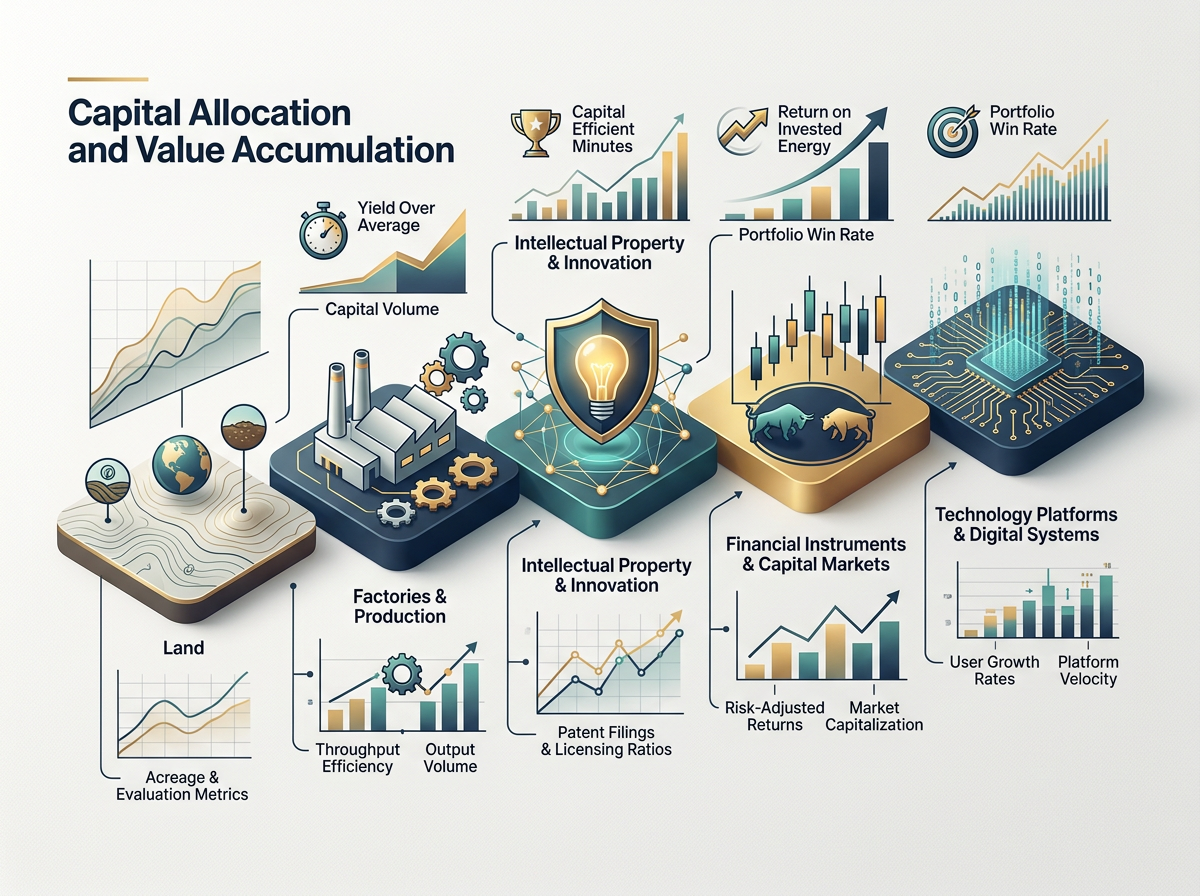
To answer that, we have to trace how wealth has attached itself to each dominant asset class in turn. Land came first. Then factories and physical capital. Then resources and the legal rights to extract them. Then intellectual property. Then financial assets. And now, most recently, technology platforms that own the rails on which other people perform. At each stage, the same logic repeats: whoever holds the legal claim captures the upside, while whoever does the work negotiates for a wage. The performance economy question is not new. It is the oldest argument in political economy, wearing new clothes.
Land: The Original Ownership Economy
For centuries, wealth was land. Land produced food, commanded rents and secured credit. The enclosure movements of early modern Europe converted common rights into private title, and with title came the ability to exclude, to charge and to inherit. The person who tilled the field had no claim on the field’s appreciation. The landlord did. It is worth pausing on how durable that arrangement proved. Land reform movements, revolutions and tax regimes reshaped who held title, but rarely changed the underlying rule: the owner of the asset captures the gain, not the person whose labor makes the asset productive.
Modern real estate repeats the pattern at a larger scale. In many cities, residential property values have risen faster than local wages for decades. A homeowner who bought early captures gains that have little to do with any work performed that year. A renter performing identical work captures nothing. The ownership versus performance distinction is not abstract here; it is the difference between a household that builds equity passively and one that pays someone else’s mortgage.
Factories, Resources and the Industrial Claim
The Industrial Revolution shifted the dominant asset from land to capital equipment. Factories concentrated production, and factory owners captured returns on machinery and organization while workers earned wages. Marx built an entire theory on this division, but the practical point is simpler: the owner of the mill decided whether to reinvest, expand or pay out. The worker could bargain over the wage but not over the residual. The same logic applied to resources. Mineral rights, oil concessions and water rights became forms of property that could generate income for decades with minimal ongoing performance by the holder.
Twentieth-century welfare states softened the edges of this arrangement through progressive taxation, unionization and public ownership of some assets. For a few decades after 1945, labor’s share of income was unusually high and wealth concentration fell. But the underlying property rules were never rewritten. When the political pendulum swung back after the 1980s, the ownership structure was still there, waiting to compound.
Intellectual Property and the Intangible Turn
The late twentieth century added a new asset class: legally protected ideas. Patents, copyrights, trademarks and trade secrets turned invention and expression into exclusionary rights that could be licensed, litigated and valued. This was a genuine shift. A patent holder can earn royalties for twenty years without operating a factory. A music catalog generates income for decades after the artist stops touring. Intangible assets now make up the majority of the market value of large listed companies in many sectors, according to widely cited accounting and research estimates.
The intellectual property regime has clear performance justifications: it rewards creators and investors for risky work. But it also creates rent-like income streams that detach from ongoing performance. Patent trolls, defensive portfolios and ever-longer copyright terms illustrate the tension. The person who performs — writes the software, records the song, engineers the drug — often receives a salary or a one-time payment, while the owner of the rights captures the long tail.
Financial Assets and the Age of Leverage
The most consequential shift of the past half-century has been the rise of financial assets as the primary store of wealth. Equities, bonds, derivatives, private equity and complex structured products now dwarf the real economy in scale. Financialization — the growing role of financial motives, markets and institutions in the operation of the economy — changed what it means to be wealthy. Wealth increasingly comes from holding claims rather than from operating productive enterprises.
Two mechanisms matter for the ownership versus performance debate. The first is leverage: borrowing against assets to buy more assets amplifies gains. The second is asset price inflation: when central banks and fiscal policy push money into markets, existing holders benefit disproportionately. A salaried professional saving 15 percent of income cannot easily match the compounding of a leveraged portfolio in a rising market. This is why frustration now extends beyond low-wage workers to doctors, engineers and mid-career managers who feel they are running hard to stay in place.
Technology Platforms: Owning the Rails
The newest ownership frontier is the platform. A small number of technology companies own the marketplaces, app stores, cloud infrastructure, payment rails and advertising networks on which millions of others perform. The platform owner sets the terms, takes a commission, controls the data and often competes with its own users. A creator, driver, developer or small merchant may perform extraordinarily well and still see a substantial share of the value captured by the owner of the rails.
Platform economics intensify the ownership-performance gap because they combine several advantages at once: network effects, data accumulation, capital access and regulatory scale. The result is a concentration of wealth that is difficult to challenge through competition alone. It is also the clearest illustration of the feature’s central puzzle. The platform does not necessarily perform the work. It owns the conditions under which work happens — and captures a share of every transaction regardless of who performs best.
| Asset Class | Who Captures the Gain | Why Performance Alone Rarely Suffices |
|---|---|---|
| Land and real estate | Title holder | Appreciation accrues to the owner, not the occupant or worker |
| Factories and machinery | Capital owner | Residual returns flow to equity, not to labor |
| Natural resources | Rights holder | Extraction rights generate income independent of ongoing effort |
| Intellectual property | Rights owner | Royalties persist long after the creative work is done |
| Financial assets | Asset holder | Leverage and asset inflation amplify returns for existing owners |
| Technology platforms | Platform owner | Commissions and data advantages accrue to whoever owns the rails |
The core tension
Every dominant asset class in capitalist history has rewarded the legal owner of the claim over the person who performs the work. The question is not whether this happened, but whether it is a permanent feature of markets or a phase that new institutions might gradually reshape.
None of this is a conspiracy. Property rights, enforceable contracts and capital markets are among the most productive inventions in human history. They allow strangers to invest in enterprises they will never visit, and they let risky ideas attract funding that wages alone could never supply. The argument is not that ownership is illegitimate. It is that ownership has quietly become the dominant claim on economic growth, while performance — measured, verified, attributable performance — remains a secondary and often precarious source of reward.
That imbalance is now producing visible political and cultural friction. It shows up in housing debates, in arguments over capital gains taxation, in antitrust cases against platforms and in the language of younger workers who describe the system as stacked. The next section examines that frustration economy in detail: inherited advantage, financialization and the concentration of wealth into fewer hands. But the question that structures this entire feature is already on the table. If capitalism has spent five centuries rewarding owners more than performers, what would it actually take to flip the priority — and would the result be fairer, more productive, or simply a different set of distortions?
The Frustration Economy: Inherited Advantage, Financialization and Concentration
The question of ownership versus performance stops being abstract the moment you talk to actual workers. In survey after survey, majorities in advanced economies say the system is rigged in favor of the already wealthy. Pew Research has found that large shares of adults across the United States and Europe believe the economic system unfairly favors powerful interests, and Edelman’s trust barometers have recorded similar sentiment for years. This is not the language of envy. It is the language of people who have run the numbers and concluded that the rules reward a different skill than the one they are paid for.
The structural explanation behind that frustration is well documented. Thomas Piketty’s comparative work on capital and labor, built on tax records spanning more than two centuries in dozens of countries, showed that when the return on capital consistently exceeds the growth rate of the overall economy, wealth concentrates almost mechanically, and that the share of income flowing to the top has risen sharply since the 1980s in most developed economies. More recent distributional accounts tell the same story from a different angle. In the United States, Federal Reserve data show that the top 10 percent of households hold roughly two-thirds of household wealth, while the bottom half holds a low single-digit share. The top 1 percent alone commands a share of wealth that has climbed back toward levels last seen before the Great Depression.
What makes this feel less like fortune and more like design is the mechanism by which it happens. Labor income grows slowly, roughly in line with productivity and inflation, and is taxed as ordinary income. Capital income arrives through dividends, capital gains, and above all asset price appreciation, which in many jurisdictions is taxed at lower rates, deferred indefinitely until sale, or avoided entirely through holding structures. Leverage amplifies the effect: a household or institution that can borrow cheaply against existing assets can buy more assets, and when those assets rise, the gain accrues to the borrower rather than the bank. Add a decades-long decline in real interest rates and sustained asset purchases by central banks, and you get what economists call asset inflation inequality, a situation in which the price of the things the wealthy already own rises faster than the wages of the people who will never be able to buy them.
The most consequential form of this dynamic is inheritance, which converts past asset inflation into present unearned position. Research by Emmanuel Saez and Gabriel Zucman, and separately by the UK’s own official wealth surveys, points to a rising share of total wealth that is inherited rather than accumulated through work. In the United Kingdom, the Institute for Fiscal Studies has noted that inheritances are becoming a more important determinant of lifetime wealth than at any point in recent generations. In the United States, estimates suggest that trillions of dollars will pass between generations over the coming decades, much of it to households that were already affluent. This is the inherited advantage economy in plain terms: the lottery of birth increasingly determines where you land, and no amount of effort on the part of a talented worker easily overcomes a head start denominated in appreciated assets.
Here is the part that surprises people who assume this frustration is confined to the poor. It runs deepest among high earners. The physician, the engineer, the senior manager, the small business founder: these are people who have traded decades of disciplined performance for income, and who watch colleagues with inherited property portfolios or early equity stakes accumulate more by holding than they do by producing. A salary of $200,000 in a city where a modest house costs a million dollars buys less security than a $60,000 salary did two generations ago, because the asset escalator has run ahead of the wage escalator. That gap between effort and outcome is where the performance economy argument gains its emotional traction. It is not that these workers want to punish owners. It is that they suspect the system has stopped measuring the thing it claims to reward.
| Reward channel | How it grows | Who captures the upside |
|---|---|---|
| Wages and salaries | Incrementally, tied to productivity and bargaining power | Workers, taxed as ordinary income |
| Asset appreciation | With monetary conditions, supply constraints and demand | Existing asset holders, often unrealized and lightly taxed |
| Leverage | Borrowed capital magnifies asset gains | Borrowers with collateral, i.e. those already holding assets |
| Inheritance | Transfer of accumulated wealth across generations | Heirs, largely independent of their own performance |
None of this is a story about villains. It is a story about incentives that operate at scale, beyond any individual’s intention. Financialization, the decades-long expansion of the financial sector’s share of GDP and its reach into pensions, housing, and corporate governance, did not emerge from a conspiracy. It emerged because liquid, leverageable, appreciating assets are extraordinarily efficient at converting time into money, and societies built institutions that encouraged exactly that. The consequence, however, is a distributional machine that pays people for what they hold while paying lip service to what they do. That mismatch is the raw material of the frustration economy, and it is why the question of whether capitalism could ever reward performance rather than ownership has moved from the seminar room into mainstream political argument.
The lived arithmetic of frustration
A worker whose wages grow at roughly the rate of inflation for a decade can double their savings only through unusual discipline. A household holding an index of broad assets during the same period may see its net worth rise substantially with no additional labor, and pay a lower effective tax rate on the gain. The comparison is not ideological; it is arithmetic. And once ordinary people learn that arithmetic, the legitimacy of the whole reward system comes into question.
What If Rewards Flowed Directly Toward Measurable Achievement?
Strip away the inherited portfolio and the appreciated asset, and a simple question remains: could an economy pay people for what they verifiably do rather than for what they already hold? This is the core provocation of the performance economy debate, and it is worth stating precisely before it is either dismissed or romanticized. The proposal is not that everyone should be paid the same, or that markets should be abolished, but that reward should attach to demonstrated outcomes rather than to title deeds.
Economists who study incentive design are careful to separate the idea from its caricature. «Most compensation systems already contain a performance component,» says one labor economist who asked not to be named because she advises several pension funds. «Wage bonuses, commission structures, royalties tied to sales, milestone payments in venture deals — these are all attempts to bind pay to measurable result. What is radical here is not the principle. It is the ambition to make performance the primary primitive of the financial system rather than a secondary adjustment to an ownership claim.»
In this framing, measurable performance rewards would function as a new economic primitive — a basic unit around which contracts, credit, insurance and reputation could be organized. The difference from an ownership economy is structural rather than cosmetic. In an ownership economy, income flows to whoever holds the legal right to an asset, whether or not they contribute anything to it in a given year. In a performance economy, income would flow to whoever produces a verifiable result, whether or not they hold any asset at all.
To make the thought experiment concrete, it helps to trace how value, measurement and reward could connect in a simple chain. Picture four linked stages, each with its own infrastructure.
- Contribution: an individual, team or organization does work that produces an observable effect — a completed project, a shipped product, a treated patient, a won match, a coached athlete.
- Verification: an independent performance measurement system confirms that the effect occurred and met a pre-agreed standard, using data that is difficult to fake and open to audit.
- Valuation: a pricing mechanism — market, contract or protocol — assigns a reward to the verified outcome, usually before the work begins and usually conditional on the result.
- Settlement: financial infrastructure moves the reward to the performer, ideally in real time, and records the track record so that reputation and future terms improve with demonstrated results.
Each link already exists somewhere in the economy. Sports leagues run verification at extraordinary scale. Prediction markets and insurance actuaries run valuation. Payment rails run settlement. What does not yet exist at scale is a system that connects all four links for ordinary economic activity in a way that makes performance, rather than ownership, the basis on which capital is allocated.
The core distinction
Ownership rewards control of an asset and the legal right to its cash flows. Performance rewards the verified production of an outcome. Most real economies blend the two; the debate is about the ratio and what happens when the ratio becomes heavily tilted toward ownership.
What Would Have to Be Measured?
The framework lives or dies on measurement. An economy that pays for outcomes must decide, in advance, which outcomes count, who certifies them, and how to handle the vast territory of work whose value is real but hard to quantify. The honest answer is that the measurable surface is uneven. Freight delivered, goals scored, code deployed, surgeries completed with good outcomes, energy saved — these are tractable. Mentorship, care work, civic participation and basic research are not, at least not without proxies that can distort behavior.
Futurists who take the idea seriously tend to argue that the constraint is not philosophical but infrastructural. One technology forecaster, speaking about the broader trend rather than any specific company, put it bluntly: «We already run the world on measurement systems that nobody fully understands — credit scores, search rankings, app store ratings, engagement algorithms. The question is not whether we will be measured. It is whether the measurements will be designed to reward performance or to reward possession of a position.»
That is a useful reframing. The choice is not between an unmeasured world and a measured one. It is between measurement systems that are opaque, proprietary and aligned with existing ownership, and systems that are transparent, auditable and aligned with demonstrated contribution. Outcome-based incentives are already spreading through corporate compensation, sports contracts, influencer economics and platform work. The performance economy thesis simply asks whether those islands of measurement could be connected into something resembling coherent financial infrastructure.
How It Differs From Ownership-Based Reward
| Dimension | Ownership-based reward | Performance-based reward |
|---|---|---|
| Source of income | Legal right to an asset and its cash flows | Verified production of an agreed outcome |
| Time horizon | Indefinite; can outlast contribution | Bounded to the performance period |
| Portability | Tied to the asset holder | Tied to a track record that travels with the performer |
| Barrier to entry | Requires capital or inheritance to acquire assets | Requires demonstrable results to earn terms |
| Main risk | Concentration of unearned advantage | Measurement gaming and bias toward the quantifiable |
| Role of finance | Allocate capital toward asset accumulation | Allocate capital toward verified capability |
The table makes the trade-off visible. Ownership-based reward is stable, legible to courts and deeply embedded in law and accounting. Performance-based reward is dynamic but fragile: it demands continuous verification, it rewards the articulate and the measurable, and it can punish bad luck in ways that ownership never does. Merit-based economics of this kind is not automatically fairer — it is differently unfair, and the difference matters.
Economists skeptical of the framework point to the same asymmetry. «You cannot pay people for outcomes they do not control,» one development economist argues. «A farmer who does everything right and loses the harvest to drought has performed well and earned nothing under a pure outcome model. That is why real systems blend salary, insurance and ownership. The thought experiment is valuable precisely because it forces you to specify which risks are shifted, and onto whom.»
That objection is serious and should not be waved away. A performance economy would need shock absorbers — pooled risk, insurance against uncontrollable variance, and floors below which no verified effort falls — or it would reproduce the precarity it claims to solve. The most credible versions of the idea therefore look less like a pure meritocracy and more like a layered system: ownership retained for durable capital, performance governing the flow of new reward, and shared risk mechanisms in between.
Still, the provocation has force. If performance measurement systems can be made more open and auditable, and if financial infrastructure can be built to settle against verified outcomes rather than collateral, then the distribution of reward could shift measurably toward those who actually deliver. Whether that shift would be an improvement depends entirely on what gets measured, by whom, and with what safeguards. The next section turns to the one domain where these questions have been tested for more than a century: sport.
Sports as the World’s Most Mature Performance Measurement System
If any institution on earth has spent a century learning to pay people for measurable results, it is sport. A hundred-meter final resolves in ten seconds with a precision of one thousandth of a second. A tennis ranking updates every week from thousands of matches. A football club’s scouting department can tell you, for a left-back in a second division, the expected goals his team concedes per ninety minutes. No bank, ministry or HR department operates at that level of granularity. Sport is, in effect, a live laboratory for the performance economy — the place where the question of whether results can be measured fairly has already been tested, at scale, in public, for generations.
The architecture of that system is worth taking seriously because it is not one measurement but a stack. At the base is the raw outcome: time, distance, score, goals. Above that sits the ranking — the ladder that converts a single result into a position relative to everyone else, whether that is the ATP tour, world athletics points or a national league table. Above that sits the longitudinal record: form, progression, injury history, consistency across seasons. And at the top sits the composite judgment, where scouts and analysts blend physical data, tactical data and psychological assessment into a single valuation. Each layer solves a different problem. The clock answers «who was fastest». The ranking answers «who is best over a season». The composite answers «who will be worth signing».
The sophistication of the middle layers is what most people outside sport underestimate. In elite football, clubs now track players through optical and wearable systems that generate millions of positional data points per match. In baseball, the analytics revolution that began with simple on-base percentage has matured into models that isolate a fielder’s contribution from the pitcher’s, a notoriously difficult attribution problem. Athletics federations maintain points tables that allow a marathon time and a shot-put distance to be compared on a common scale. None of this is perfect. All of it is contested. But the disputes are technical, argued with data, and — crucially — resolved by a rulebook that everyone has agreed to in advance.
That last point is the one economists keep returning to. Sport works not because its measurements are flawless but because its measurement rules are legitimate. The clock is not fair in the sense of producing equal outcomes; it is fair in the sense that it applies identically to everyone and can be audited. Contrast that with the messy measurement of performance in the wider economy. Sales figures can be gamed by pulling revenue forward. Productivity per hour is distorted by capital intensity. A surgeon’s outcomes depend heavily on the severity of the patients she receives. A teacher’s value-added score swings on which children happen to be in her class. The measurement problems are real, but so is the difference in institutional response: sport has built referees, appeals processes, video review and independent tribunals around its numbers. Most workplaces have built nothing.
Sports executives tend to make a subtler argument when pressed. In conversations with league and franchise leaders, a recurring theme is that measurement alone does not create a performance culture — consequence does. Players are paid, selected, promoted and cut on the basis of the numbers. A striker who stops scoring loses his place regardless of his reputation or his salary. That willingness to let results override status is what separates sport from most organizations, where tenure, seniority and internal politics heavily filter how performance data is used. «The data is the easy part», one long-serving club executive puts it. «The hard part is having the courage to act on it when the person it hurts is popular». Technology leaders who build analytics platforms for both sport and enterprise make a parallel observation: the sports world adopted real-time, objective instrumentation decades before most corporations, and it treats the resulting numbers as the primary language of decisions rather than as a report filed for compliance.
There is a temptation, at this point, to conclude that the sports model could simply be transplanted into the economy. That is where the analysis has to slow down. The sports system works because of features that are extremely difficult to replicate outside the arena: a closed and defined population of competitors, a short and unambiguous outcome window, agreed rules, near-total transparency of results, and a cultural consensus that losing is legitimate. Society has none of these. Outcomes unfold over decades, not ninety minutes. The relevant population is everyone, not a league roster. Rules are contested politically. And losing, in the economic case, can mean deprivation rather than relegation. The performance measurement system of sport is a genuine achievement. It is also, in a specific sense, a special case.
Will Future Economies Reward Ownership, Performance, or Both?
The question of whether a performance economy could ever replace an ownership economy is, in practical terms, the wrong question. No serious economist interviewed for this investigation argued that ownership should disappear. Property rights underpin investment, collateral, credit and the willingness to build things that take a decade to pay off. Strip those away and you do not get a meritocracy of results; you get an economy that cannot finance its own future. The live question is not replacement but weighting — how much of a society’s reward stream flows to those who hold assets, and how much flows to those who demonstrably produce outcomes.
That reframing matters because it moves the debate out of ideology and into implementation. Every proposal to reward measurable performance runs into the same cluster of problems: what counts as a valid measurement, who audits it, how you prevent gaming, how you handle people whose performance is real but hard to quantify, and how you protect those who start from behind. The previous sections established the frustration and the theoretical appeal. This section examines whether the machinery could actually be built — and whether anything resembling it already is.
The Implementation Wall
The first obstacle is definitional. Ownership is legally crisp. A share is a share; a title deed is a title deed. Performance is contested by nature. A surgeon’s outcome depends on the patient’s condition, the team around her and the hospital’s resources. A teacher’s results depend on the cohort she inherits. A software engineer’s output depends on whether a colleague wrote a good API. Attribution — the question of who caused what — is where most performance-pay schemes quietly fail, and it is where any economy-wide system would face its hardest test.
The second obstacle is time horizon. Measurable performance tends to be short-cycled: quarterly sales, seasonal rankings, annual reviews. But much of what makes an economy productive is long-cycled: basic research, infrastructure, institutional trust, care work that compounds over generations. A system that pays strictly for measurable near-term results risks starving the investments whose returns cannot be scored until decades later. Ownership, for all its faults, is one of the few mechanisms that pays people for waiting.
The third obstacle is political. Any shift in how rewards are allocated creates identifiable losers, and losers organize faster than diffuse winners. Economists who study incentive reform consistently note that the design of the measurement system becomes the object of political contest — a phenomenon sometimes called Goodhart’s law in policy form: once a measure becomes a target, it is gamed. The measurement infrastructure does not sit above politics. It becomes the arena.
| Implementation Challenge | Why It Matters | Possible Mitigation |
|---|---|---|
| Attribution | Hard to isolate individual contribution in team and institutional settings | Team-level scoring with transparent attribution rules |
| Time horizon | Short-cycle metrics undervalue long-horizon investment | Blended rewards with vesting and deferred components |
| Gaming | Targets invite optimization against the metric, not the goal | Multiple independent metrics and third-party audits |
| Coverage | Care work, research and civic work resist clean quantification | Hybrid models retaining ownership and base income |
| Legitimacy | Perceived fairness of the measurement system itself | Public transparency and independent governance |
None of these problems is fatal. All of them are reasons to expect evolution rather than revolution. The realistic trajectory is not a pure performance economy any more than the twentieth century produced pure capitalism or pure socialism. It is a hybrid — ownership still doing the work of financing and risk-bearing, with a growing performance layer bolted on top of it, contested at every step.
What Hybrid Models Might Look Like
Hybrid economic models already exist in embryonic form, and studying them is more useful than imagining a blank-slate system. Employee equity combines ownership and performance: you receive a stake, but often vesting is tied to continued contribution. Professional partnerships allocate profit shares partly on seniority and partly on measured contribution. Sports contracts blend guaranteed money with performance bonuses and option clauses. Sovereign wealth funds and pension systems distribute capital returns to people who never managed the capital, decoupling reward from active performance in one direction while preserving ownership in another.
The design space, then, is a spectrum. At one end sits pure rentier reward: income from assets alone, unconnected to any contribution. At the other sits pure performance reward: pay released only on verified outcomes, with no residual claim. Real institutions cluster in the middle and vary by sector. Sales organizations drift toward performance. Infrastructure funds drift toward ownership. The interesting question for the next decade is which sectors migrate, and how fast.
A useful distinction
Ownership rewards holding. Performance rewards producing. Most real-world compensation systems blend the two, and the ratio between them is a policy choice, not a law of nature. The debate is about that ratio — and about who gets to set it.
Where Technology Fits — and Where It Does Not
Advocates of measurable performance rewards often point to technology as the enabler. Cheap sensors, continuous data capture, digital records and automated verification make it far easier than it was in 1995 to observe whether an outcome actually occurred. A delivery completed, a certification earned, a project milestone independently confirmed — these can increasingly be recorded and audited without a human assessor in the loop, which lowers the cost of running a performance-based system at scale.
But technology solves verification, not legitimacy. A perfectly audited metric that measures the wrong thing is still the wrong thing. The technology leaders interviewed for this piece were notably more cautious than the futurists. Their recurring point: the hard part is not building a measurement pipeline, it is agreeing on what the pipeline should measure and who has standing to change it. Infrastructure is the easy layer. Governance is the hard one.
One Emerging Experiment: ASM
Near the frontier of this trend sits ASM, an emerging experiment that attempts to build financial infrastructure around measurable performance rather than around asset ownership alone. In the terms used throughout this investigation, ASM is best understood as a test case for the performance economy thesis rather than a proven model: it explores whether verified, measurable achievement can be made legible to financial systems and rewarded directly. It should be read as a provocation with a product attached — one data point in a much longer historical argument, not a verdict on it.
Whether such an approach can survive the implementation wall described above — attribution, time horizon, gaming, coverage and legitimacy — is genuinely unresolved, and readers should treat any strong claim in either direction with suspicion. The honest position is that ASM and comparable experiments are worth watching precisely because they will surface the failure modes faster than theory can. A model that cannot answer the attribution question under real conditions will not scale, and a model that can would be genuinely informative about where the ownership-performance ratio is heading. Editor’s note: claims about ASM’s mechanisms and results should be verified against its own published documentation before being relied upon.
The Ratio, Not the Replacement
Step back from any single experiment and the larger pattern is visible. Capitalism has always contained a performance layer — piece rates, commissions, prize money, patents granted for invention. What has changed is the scale of the ownership layer relative to it, and the visibility of that gap. When asset appreciation outpaces wage growth for years on end, the performance layer starts to look like a rounding error, and the legitimacy of the whole arrangement comes into question. That is the pressure driving interest in the performance economy as a concept, whatever one thinks of any particular vehicle for it.
The likeliest future is a combination, deliberately chosen rather than passively inherited. Ownership will remain the engine of financing, risk and long-horizon patience. Performance measurement will expand wherever verification is cheap and attribution is clean. The contested middle — care, education, public service, creative work — will remain a political battleground because no measurement system can settle it technically. The future of ownership is not abolition. It is conditionality: more strings attached, more transparency demanded, more of the reward stream routed toward demonstrable contribution.
Which returns us to the question this investigation opened with. If capitalism evolved to reward results instead of ownership, it would not be a different species of system — it would be the same system with a different ratio at its core. The performance economy is less a destination than a direction of travel, and the speed of that travel will be decided not by technologists but by whether existing arrangements keep producing outcomes that enough people consider legitimate.
Reader Questions
Q: Would a performance economy eliminate inherited wealth? Not necessarily. Ownership would persist in hybrid models, and inherited assets would still generate returns. The realistic effect is to shrink the share of total reward that flows from holding alone, not to abolish holding. Q: Is performance measurement not just a tool for surveillance? It can be. Any system that records outcomes also records the people producing them, which is why governance and data limits are central to the debate rather than afterthoughts.
Q: Which sectors are most likely to move first? Those with clean attribution and short feedback cycles — sales, logistics, contract work, sport, some forms of software delivery. Sectors with long horizons and shared credit, such as research and care, will move slowest and may never move fully. Q: What would count as evidence that the trend is real? Watch the ratio, not the rhetoric: the share of compensation tied to verified outcomes, the growth of performance-linked financial instruments, and whether measurement standards acquire independent governance. For related analysis, see our companion pieces on the frustration economy and on sports as a measurement system, and for underlying data consult the OECD on wealth concentration, the ILO on labour income share, and national statistics offices for sector-level compensation data.
Leave a Reply