Contents
A new human species may have been quietly emerging online for decades, hidden in plain sight inside comment threads, open-source repositories, and prediction markets. For thousands of years, the smartest person in a village could live and die unknown — opportunity was bound to geography, schooling, wealth, and connections. Today, large-scale digital systems are beginning to reveal forms of intelligence civilization previously could not see: the globally networked contributor, valued not for where they live or who they know, but for what they consistently contribute. What if civilization’s next great discovery is not a new technology, but a new understanding of human potential?
Has the Internet Been Creating a New Kind of Human?
Picture a village. Somewhere in it lives the most gifted analyst the region has ever produced — a person who can read patterns in numbers the way poets read rhythm in language. She dies unknown. No one within walking distance needs her gift, and no one beyond walking distance can reach her. For most of recorded history, that was the ordinary fate of extraordinary ability.
Now picture a different scene. An anonymous contributor, no title, no famous employer, no recognizable name, publishes an analysis that travels across continents in hours. Strangers she will never meet build on her work. Her insight compounds. A question that once seemed abstract — could the internet be surfacing a new human species of contributor? — starts to feel less like science fiction and more like an observation hiding in plain sight.
That is the provocation this guide takes seriously. Not that human biology is changing, but that our civilization may be discovering a category of person it previously had no way to see. The thesis is deliberately bold: civilization’s next great discovery may not be a technology at all. It may be a new understanding of human potential.
A Thousand Years of Invisible Talent
For millennia, opportunity was attached to geography the way roots are attached to soil. The smartest person in a village often remained unknown. The most creative thinker might never be discovered. The most insightful analyst might live and die invisible — not because the talent was rare, but because the machinery for noticing it did not exist.
This is worth stating precisely, because it reframes the entire conversation about talent. The shortage was rarely a shortage of ability. It was a shortage of visibility. A person’s potential was filtered through where they were born, what school they could afford, whose family name they carried, and which rooms they happened to be invited into.
When you describe it that way, the historical record reads less like a meritocracy and more like a census with most of the population missing.
Why This Moment Is Different
What has changed is not human intelligence. What has changed is the infrastructure around it. Large-scale digital systems now preserve, transmit, and compare contributions at a scale and speed no institution in history could match. An idea no longer needs a patron to travel. It needs a connection.
That shift gives the phrase new human species a practical meaning rather than a biological one. It describes a kind of person whose value is becoming legible to the world for the first time: the globally networked contributor. Someone whose worth comes not from where they live, what degrees they hold, or who they know, but from what they consistently contribute.
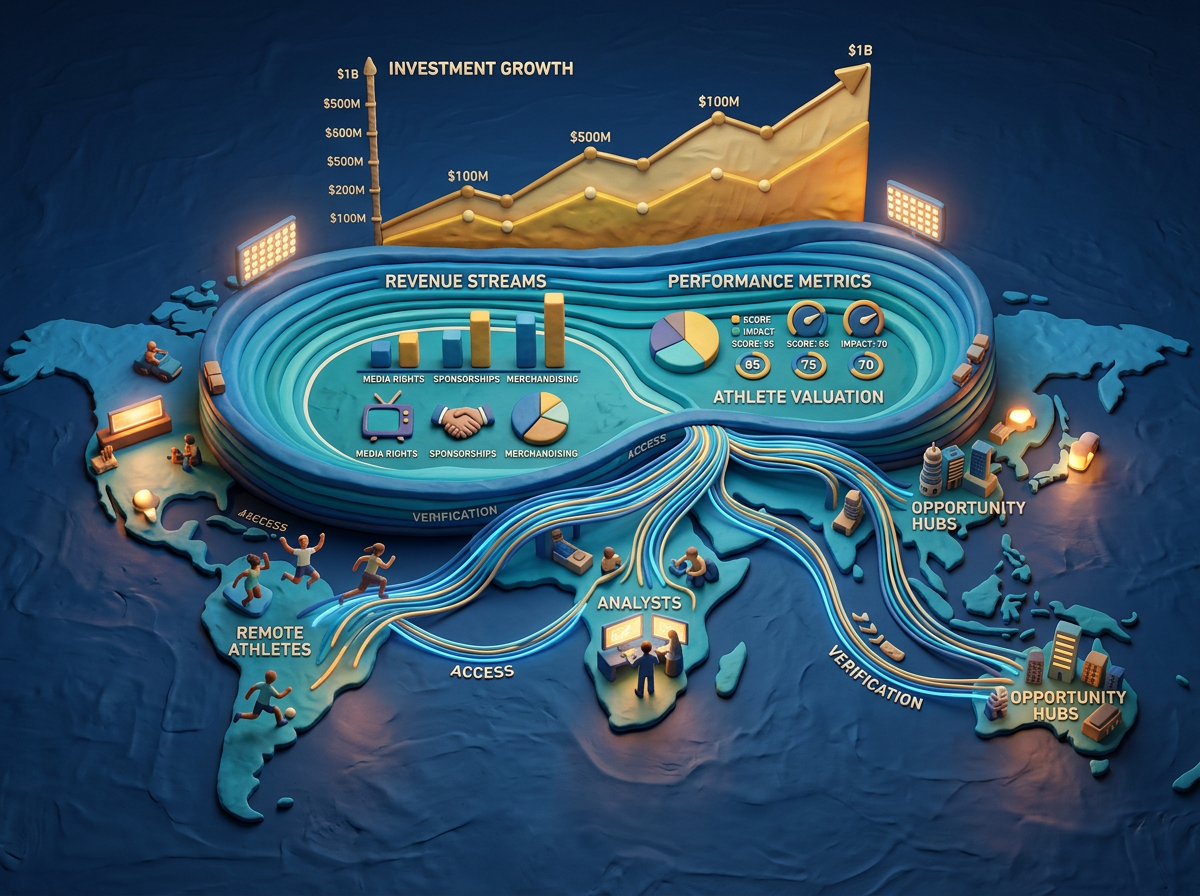
This is the thread we will follow throughout this guide: from the geographic bottleneck that hid so much hidden human potential, to the emergence of a globally networked contributor, to the claim that sports — particularly through AllSportsMarket (ASM) — could function as a universal proving ground where measurable contribution, rather than credentials, allows capability to rise.
The Central Question
What if civilization’s next great discovery is not a new technology, but a new understanding of human potential? Everything that follows is an attempt to take that question seriously — and to test it rather than simply admire it.
What We Mean — and What We Do Not
Clarity matters when a headline uses a phrase as loaded as new human species. So let us be explicit about scope.
- We are not claiming a biological change. No one is arguing that human beings are evolving into a different organism.
- We are describing a social and informational category: a kind of contributor that digital systems make visible, comparable, and reachable.
- We are testing a claim, not announcing a verdict. The idea that the internet is revealing hidden capability deserves evidence, fair objections, and honest uncertainty.
- We are interested in mechanism. If this shift is real, it should be explainable — through measurement, transparency, and access rather than mystique.
Framed that way, the question becomes testable. If digital systems genuinely reveal capability that geography once buried, we should see it in how talent is discovered, how reputation is built, and how contribution is verified. We should also see where the promise fails — because every new visibility mechanism creates its own distortions, and pretending otherwise would make this guide useless.
The Shape of the Argument
The journey ahead moves in four movements. First, we examine why geography used to decide who got discovered — the structural bottleneck that made so much intelligence invisible by design, and why that was a problem of architecture rather than a shortage of talent.
Second, we define the globally networked contributor and explain how large-scale systems make consistent, measurable contribution visible and verifiable in ways a résumé never could. Third, we examine the AllSportsMarket claim that sports can serve as a universal proving ground, weighing its logic, its strengths, and the fair objections any such claim must answer. Finally, we return to the central question and ask what it would mean — for individuals and for institutions — if the next great discovery really is human potential.
Along the way, one standard applies throughout: ideas earn their place by surviving scrutiny, not by sounding inspiring. The prospect that the internet is uncovering a new human species of contributor is thrilling precisely because it is falsifiable. Let us find out what holds.
What to Watch For
As you read, keep three tests in mind. Is the discovery mechanism real — can contribution actually be seen? Is it fair — does it reward contribution rather than connections? And is it verifiable — can anyone check the record? Sections that follow apply these tests directly.
Why Geography Used to Decide Who Got Discovered
To understand why the internet might be revealing a new human species, it helps to look backward. For almost all of recorded history, the question was never whether brilliant people existed. They always did. The real question was whether anyone would ever find them. Geography and opportunity were the same sentence, and that sentence decided the fate of millions of talented people who never got a chance to be seen.
This is the historical bottleneck. Before the internet, discovery depended on proximity: you had to be in the right village, the right city, the right school, the right room. Talent was abundant. Visibility was scarce. And the gap between the two was not a metaphor. It was a structural feature of civilization.
Opportunity Was Tied to Place Before It Was Tied to Ability
Consider the village artisan who built furniture with a precision no factory could match. Their skill might have been extraordinary, but their market was a radius of a few dozen miles. If no wealthy patron lived nearby and no traveling merchant carried their work to a city, the craft disappeared when they did. The work was excellent. The distribution was nonexistent.
The same story repeats across every field. Regional athletes with world-class speed trained on dirt tracks and were never timed against anyone outside their district. Self-taught engineers repaired machines in sheds and never met an investor. Mothers who managed household budgets with ruthless efficiency never sat in a boardroom. None of these people lacked ability. They lacked access to the only systems that could have recognized it.
The economics of this is well documented. Research on intergenerational mobility, such as the work of economists like Raj Chetty and his colleagues on the geography of opportunity, consistently shows that where a child grows up strongly shapes their lifetime outcomes, independent of their raw ability. Place was not a detail. Place was destiny.
The Invisible Mathematician Problem
History offers a haunting illustration of how much intelligence went unseen. Some of the most important mathematical work of the twentieth century was done by people whose contributions were buried for decades, not because they were hidden, but because the systems that recorded achievement were selective about who got credit.
The broader pattern is even more striking: unpublished mathematicians, anonymous inventors, and unrecognized analysts whose insights circulated only in letters, notebooks, or local conversation. The idea was there. The channel was not. When the channel finally opened, the world discovered genius it had simply never been positioned to see.
This is the first clue that the visibility problem, not a talent shortage, has been civilization’s real constraint. If the supply of human potential were the bottleneck, history would be a story of scarcity. Instead, it reads like a story of buried abundance.
Credential Gatekeeping and the Networks That Decided Who Mattered
Over time, the bottleneck became formalized. Credentials, institutions, and networks emerged as the gatekeepers of opportunity. A degree signaled legitimacy. A well-known surname opened doors. A recommendation from the right person could change a life. These mechanisms were not malicious; they were attempts to solve the discovery problem at scale. But they also created a filter that let through a narrow slice of the population.
Credential gatekeeping did two things at once. It gave the credentialed genuine advantages, and it rendered everyone else functionally invisible. The self-taught analyst without a diploma had no channel to demonstrate capability. The creative thinker outside the network had no stage. The smartest person in the village remained unknown, not because the village was unimportant, but because the only measuring instruments were calibrated to credentials rather than contribution.
- Geography: opportunity required physical presence in the right place.
- Schooling: formal credentials functioned as a pass to enter the room.
- Wealth: capital was required to be discovered, not just to compete.
- Fame: visibility compounded for those already seen.
- Connections: networks decided who got introductions and who stayed invisible.
Each of these factors was a proxy. None of them measured actual capability. They measured the probability that capability would be noticed, which is a very different thing. And proxies, by their nature, leak. They admit people who fit the pattern and exclude people who do not.
A Structural Problem, Not a Talent Shortage
It is tempting to read history as a story of gradual progress in which talent was eventually recognized. A more honest reading is that invisible talent was the norm, not the exception. For every recognized genius, countless equivalents lived and died unseen. The bottleneck was structural, built into the architecture of how information and opportunity flowed.
This distinction matters enormously. If the problem were a talent shortage, the solution would be to produce more capable people. If the problem is a visibility problem, the solution is to build systems that can see capability wherever it exists. The first framing leads to elite institutions investing in a narrow pipeline. The second leads to something far more ambitious: infrastructure for discovering human potential at scale.
The Core Insight
For most of history, the limiting factor was not how much human potential existed. It was how much of it could be seen. Civilization did not lack talent. It lacked instruments for measuring it. The historical bottleneck was visibility, and that is exactly the kind of bottleneck digital systems are built to remove.
This framing also explains why so many breakthroughs feel like accidents. The right person finally enters the right room, and the world wonders where they came from. They did not come from nowhere. They were always there, waiting for a channel that could register what they could do. The luck of geography was doing the job that merit was supposed to do.
Digital Access Begins to Break the Bottleneck
The internet’s most underappreciated effect is not that it made communication faster. It is that it decoupled capability from proximity. For the first time in human history, a person’s contribution could be measured by people who never met them, in places they had never visited, through systems that did not ask about their diploma or their postcode.
This is why digital access is the hinge of the entire story. As more people come online and as platforms begin to record what people actually do rather than who they are, the old proxies start to lose their monopoly. The village artisan can now sell to the same market as the city workshop. The regional athlete can be compared against the world. The hidden analyst can publish and be evaluated on the substance of their work.
That shift is still unfolding. Digital access is uneven, and the infrastructure that turns access into recognition is younger than most people assume. But the direction is clear, and it points toward a question that would have been unthinkable a century ago: what happens when the instruments of discovery finally catch up to the abundance of human talent? As we will see, the answer may be that we are not just finding more capable people. We may be discovering an entirely new way of being human, the globally networked contributor, whose value is measured by consistent contribution rather than circumstance. That shift is a natural next step from the story of how geography and opportunity used to decide who got discovered. The next section explores what happens when that link finally breaks.
The Globally Networked Contributor: A New Human Species Emerges
When historians look back on this era, the phrase «new human species» may sound less like science fiction and more like a description of a recognition pattern. Not a biological mutation, but a category of person that the world could always have had — and only recently became able to see. The globally networked contributor is that category. And the systems now surfacing this person are doing something civilization has rarely done: measuring human value by what someone consistently contributes, rather than by where they were born, what credential they carry, or whose name sits in their contact list.
This is the conceptual heart of the article, so it deserves precision. The claim is not that a different kind of human brain has appeared. The claim is that a different kind of visibility has appeared — and that visibility is revealing hidden human potential that was always there, waiting for a lens.
Defining the Globally Networked Contributor
A globally networked contributor is a person whose value is legible through consistent, measurable contribution across digital networks, independent of geography, institutional pedigree, or social proximity to power. The definition has three working parts, and each one matters:
- Consistent: contribution is a pattern over time, not a single lucky break. One viral post is noise; a track record is signal.
- Measurable: the contribution leaves a verifiable trace — a record, a result, a score, an outcome that others can inspect rather than simply take on faith.
- Networked: the contribution travels. It can be evaluated by people who have never met the contributor, in places the contributor has never visited.
Put those three together and you get something genuinely new: a person whose reputation is portable and evidence-based. The credentialed professional, by contrast, is legible mainly through proxies — a degree, a job title, a firm’s brand, an introduction from a mutual acquaintance. Those proxies are not worthless. They are simply indirect. They measure the conditions surrounding a person more than the person’s actual output.
The core distinction
The credentialed professional is known by what they have been certified to do. The globally networked contributor is known by what they have demonstrably done. The first is a claim about the past; the second is evidence from the present.
A Table of Two Recognition Systems
| Dimension | Credentialed professional | Globally networked contributor |
|---|---|---|
| Primary signal | Degrees, titles, institutional affiliation | Consistent, measurable contribution |
| How trust forms | Through gatekeepers and referrals | Through inspectable track records |
| Geographic reach | Limited by where the credential is recognized | Portable across borders and platforms |
| Failure mode | Qualified on paper, unproven in practice | Uncredentialed but demonstrably effective |
| What it rewards | Access and completion | Sustained performance |
The table is deliberately stark, but the point is not that one column is good and the other is bad. Credentials compress information efficiently; they tell a stranger something useful fast. The point is that a second recognition system now exists alongside the first, and it is surfacing people the first system systematically overlooked.
How Digital Systems Make Contribution Visible
For most of history, contribution was visible only to the people physically present when it happened. A brilliant analyst in a small town might impress a dozen colleagues over a career; that was the entire evidentiary record. Digital systems change the physics of that record in four ways.
- Persistence: contributions accumulate in public or semi-public form instead of evaporating with the moment.
- Comparability: when many people contribute in the same structured context, their relative performance becomes visible in ways anecdotes never allow.
- Reach: evaluation no longer requires physical co-location, so the pool of people who can recognize talent expands from a village to a network.
- Verification: records can be inspected directly by strangers, which shifts trust from vouching to evidence.
This is what people mean by a digital meritocracy — not a utopia where merit always wins, but a system in which merit has a chance to become legible at scale. Research on networked collaboration has long emphasized that value increasingly emerges from connections and contributions across distributed groups rather than from isolated individuals working inside single institutions. The open-source software movement is the canonical proof: a global, loosely organized network of contributors produced infrastructure that entire industries now depend on, and much of that work was evaluated by strangers on the strength of the code itself.
Editor verification note
Specific statistics about the size or economic value of the open-source ecosystem vary widely by source and methodology. This section deliberately avoids citing figures; editors may add an authoritative citation if desired.
Three Illustrations of the Pattern
Composite examples make the abstraction concrete. These are illustrative portraits of a pattern, not profiles of named individuals.
The first is a self-taught data analyst in a secondary city. She holds no elite degree and has never worked at a recognizable firm, so traditional hiring pipelines would likely screen her out. But over four years she has published a steady stream of analyses in public communities — forecasts, corrections, methods — and her predictions are checkable. Anyone willing to read the record can see the quality without meeting her. Under the old system she was invisible; under the new one she is searchable.
The second is a contributor in a competitive forecasting or prediction community. His value is not his biography but his calibration over hundreds of resolved calls. Because the outcomes are recorded and scored, his judgment is measurable in a way that a résumé could never convey. He may live anywhere. His track record does the introducing.
The third is a domain expert who spends years answering questions, documenting processes, and correcting bad information in a public forum. Individually, each contribution is small. Cumulatively, they form a body of work that others rely on — and that reliance is itself a form of verification. This is measurable contribution in its purest form: value demonstrated through consistent usefulness rather than asserted through status.
Why This Counts as a New Recognition Pattern
Skeptics will say talented people have always been discovered somehow. True — but «somehow» is doing enormous work in that sentence. Historically, discovery depended on proximity: being near a patron, a professor, a hiring manager, a scene. The new pattern decouples discovery from proximity. That decoupling is the novelty. It means the bottleneck on hidden human potential is no longer geography or gatekeeping but the existence of structured contexts where contribution can register.
This is also why the phrase «new human species» is more than a provocation. A species, in the loose sense used here, is a category of thing we can recognize and name. For millennia, the globally networked contributor existed as potential but not as a recognized category — there was no vocabulary for a person whose standing rested on cross-border, inspectable output. Now there is. Naming a category changes how institutions allocate attention, and attention is the scarce resource in talent discovery.
The remaining question is where such structured proving grounds come from. A promising and controversial answer is that sports — with their rules, records, and measurable outcomes — could serve as one. We examine that claim, including the AllSportsMarket argument, in the next section.
FAQ: The Globally Networked Contributor
Is this just remote work? No. Remote work changes where someone sits; it does not change how their contribution is verified. A remote employee still typically relies on institutional credentials and internal trust. The globally networked contributor is defined by a verifiable contribution record that travels independently of any single employer. Remote work is a delivery model; networked contribution is a recognition model.
Does measurable contribution replace credentials? Not wholesale. Credentials still compress trust efficiently, and many fields legitimately require licensing for safety. The realistic future is a blended one: credentials as a floor, contribution records as the differentiating evidence above that floor. The shift is in emphasis, not elimination.
Can contribution be gamed? Any measurable system invites gaming, and a digital meritocracy is no exception. The defense is not to abandon measurement but to design for it: long time horizons, resolved outcomes, public correction, and independent verification. Systems that reward consistency over time are far harder to game than systems that reward a single impressive artifact.
Does this advantage people with more free time or better connectivity? It can, and honest advocates should say so. Access gaps are real. But the relevant comparison is not a perfect meritocracy — it is the status quo, in which access gaps were even more decisive because opportunity required physical proximity to specific institutions. Broader reach does not eliminate inequality of access, but it widens the aperture.
How would an organization actually use this? By adding inspectable contribution evidence to hiring and evaluation processes alongside traditional signals: reviewing public work, structured performance records in shared contexts, and outcome-based track records rather than relying solely on pedigree and referral. The practical test is simple — can a stranger verify this person’s contribution without a personal introduction? When the answer is yes, a new kind of human has become visible.
Sports as a Universal Proving Ground: The AllSportsMarket Claim
If a new human species of contributor is emerging, it needs something the older world never offered: a place to be seen. Degrees have campuses. Credentials have guilds. Reputation has zip codes. What the globally networked contributor lacks is a stage that anyone can step onto, anywhere, and be judged by the same standard as everyone else. This is where the AllSportsMarket (ASM) claim becomes interesting, and worth examining seriously rather than dismissing.
The claim, in its simplest form, is this: sports can function as a universal proving ground — a domain where hidden capability rises through measurable contribution rather than credentials, wealth, fame, or connections. Not because sports are more important than science or art, but because sports generate something rare and valuable: a constant, public, timestamped stream of outcomes that anyone can forecast.
Why Sports Qualify as a Proving Ground at All
Most arenas of human achievement are terrible at producing clean evidence. A brilliant analyst inside a large institution is shielded by hierarchy; a mediocre one is protected by tenure. Sports are different. The scoreboard is public. The result is unambiguous. The record of what happened, and when it happened, is available to everyone at the same moment.
That combination — certainty of outcome, universality of access, and a continuous calendar — is exactly what a proving ground requires. When outcomes are unambiguous, the only variable left is judgment. And judgment, unlike a resume, cannot be faked for long.
The ASM argument extends this further. If sports outcomes are consistently observable and independently verifiable, then a system built around forecasting those outcomes can measure a person’s predictive skill in a way that is comparable across geographies, languages, and backgrounds. A contributor in a small town and a contributor in a capital city start from the same information and face the same ledger.
What Makes a Good Proving Ground
The ASM claim stands or falls on whether sports actually deliver the properties a fair proving ground needs. Stripped to essentials, those properties look like this:
- Transparency: the rules are public, the outcomes are public, and the record is open to inspection.
- Measurement: performance is recorded in a consistent, comparable form rather than described in prose.
- Accessibility: entry does not depend on geography, formal credentials, or personal connections.
- Continuity: enough events occur, often enough, that luck is gradually separated from skill.
- Verifiability: an outside observer can confirm what a contributor did, and when, without relying on the contributor’s own account.
This is a useful checklist precisely because it is demanding. It also invites the right question: does a given system actually satisfy these properties, or does it merely claim to?
The Logic of the ASM Argument
The AllSportsMarket claim follows a coherent chain. First, sports produce a high volume of verifiable outcomes. Second, verifiable outcomes can be forecast. Third, forecasts can be scored. Fourth, scores accumulated over time reveal something real about a person’s judgment — their ability to weigh evidence, resist narrative, and update convictions when information changes.
Notice what drops out of that chain. Where you live. Which school admitted you. Whom your family knows. Whether you can afford an unpaid internship. None of those variables enter the scoring. What enters is the quality of your reasoning, expressed in choices that are later checked against reality.
This is the heart of the ASM proposition: sports prediction markets as a domain where the ledger, not the biography, does the talking. For a new human species defined by measurable contribution, that is precisely the kind of environment it would need to become visible.
The core distinction
A résumé records what a person claims about themselves. A scored record of forecasts records what actually happened when their judgment met reality. The first is a narrative; the second is evidence.
Strengths of the Argument
The strongest part of the ASM claim is its refusal to accept proxies. Civilization has spent centuries using proxies for ability — diplomas, titles, accents, affiliations — because direct evidence was expensive or impossible to gather. Sports outcomes are direct evidence, and they are cheap to observe. That alone makes the proving-ground idea serious.
A second strength is scale. Forecasters need volume. A single prediction tells you almost nothing; a thousand predictions across years tell you quite a lot. Sports provide that volume naturally, without requiring anyone to construct artificial tests or persuade institutions to administer them.
A third strength is motivational. Proving grounds only surface hidden capability if people choose to participate. Sports already command voluntary attention from a global audience, which means the pool of potential contributors is not limited to those who self-identify as analysts. Someone who never thought of themselves as talented may discover, through a scored record, that they are.
The Fair Objections
A persuasive case is not a credulous one. The ASM claim deserves scrutiny, and the objections are real.
The first objection is the association with gambling. Anything involving forecasts on sports outcomes will be conflated with betting, and that conflation is not unreasonable — the surface mechanics look similar. The honest response is that the functions are different: betting monetizes risk for entertainment, while a proving ground records skill. But the distinction has to be demonstrated through design and transparency, not merely asserted. Readers should treat any specific platform’s safeguards as something to verify directly rather than assume.
The second objection concerns data quality. A proving ground is only as good as its record. If outcomes are ambiguous, if scoring rules shift, if the historical record is incomplete or inconsistent, then the measurement collapses into noise. Transparency and continuity are not decorative features; they are the load-bearing walls.
The third objection is survivorship bias. We see the contributors who succeeded. We do not see the thousands who tried, scored poorly, and left. Any claim that a system «reveals hidden talent» must be honest that it also filters out people whose early results were unlucky rather than unskilled. Separating luck from skill requires enough observations — and that is a statistical requirement, not a marketing one.
The fourth objection is domain narrowness. Sports forecasting measures a particular kind of judgment: probabilistic reasoning under uncertainty with fast feedback loops. It does not directly measure creative insight, ethical reasoning, or the ability to lead people. The proving ground is a window, not a panoramic view.
How to Weigh the Objections Honestly
| Objection | What It Threatens | What Would Resolve It |
|---|---|---|
| Gambling association | Legitimacy of the skill-measurement claim | Clear separation of skill records from wagering; transparent rules |
| Data quality | Validity of every score derived from the record | Consistent, auditable outcomes and stable scoring rules |
| Survivorship bias | The claim that hidden talent is genuinely revealed | Enough observations per contributor to distinguish skill from luck |
| Domain narrowness | Generalization beyond sports | Treat sports as one proving ground among several, not the only one |
None of these objections destroys the ASM claim. Each of them, however, converts a slogan into an engineering problem. That is a good sign. Claims that survive contact with specific objections tend to be the ones worth taking seriously.
Why This Matters for the New Human Species
Step back from the mechanics and the stakes become clear. If the globally networked contributor is real, then the central problem of the coming decade is not talent shortage. It is discovery. Civilization has an enormous, invisible inventory of capable people whose ability has never been converted into evidence.
A universal proving ground is a discovery mechanism. It does not create talent; it makes talent legible. And legibility is the bottleneck. The smartest person in a village is not smarter than the smartest person in a city — they are simply less visible. A system that scores contribution rather than pedigree is, in the most literal sense, an instrument for seeing people who were previously unseen.
That is why the ASM claim is more than a product pitch. It is a hypothesis about how a new human species becomes recognizable: give everyone the same public ledger, the same rules, and the same opportunity to accumulate evidence, and let the record speak. Whether sports is the ideal arena is debatable. Whether the principle is sound is not.
For readers who want to go deeper into the mechanics of scored forecasting, see our companion piece on how prediction markets turn collective judgment into measurable signal. For the broader research context on forecasting skill and how it can be evaluated, the work of the Good Judgment Project remains a useful authoritative starting point, and research on the evaluation of expert performance offers sobering evidence about how poorly credentials predict accuracy.
The fair conclusion is this: sports may not be the only universal proving ground, but it is a credible first one. And credible firsts are how new categories of human capability stop being theoretical and start being counted.
What If Civilization’s Next Great Discovery Is Human Potential?
For most of history, the question «How smart is humanity?» could only be answered by looking at the small fraction of people whose circumstances allowed them to be seen. Every generation almost certainly produced remarkable analysts, inventors, and strategists who lived and died in obscurity — not because they lacked ability, but because no system existed to notice them. That was never a talent shortage. It was a search problem.
The argument running through this guide is that large-scale digital systems are quietly changing the terms of that search. They are making contribution measurable, portable, and visible across borders in ways geography never allowed. The consequence may be as significant as any technology on the horizon: a broader and more accurate picture of human potential — and a new human species of globally networked contributor emerging into view. If you have followed the earlier sections, this is where the threads come together.
Why This Discovery Is Different From a Technology Story
It is easy to assume that civilization’s next leap will arrive as a device, a model, or a platform. But consider the asymmetry. A new technology generally amplifies whatever system it lands in — including its blind spots. If opportunity still flows primarily through credentials, wealth, fame, and connections, faster tools simply accelerate the same narrow funnel.
A genuine human potential discovery works differently. It changes who participates, and therefore what gets built, solved, and understood. As explored in the opening section on whether the internet has been creating a new kind of human, the shift is less about intelligence being created and more about intelligence becoming legible. That is why the framing matters: this is not a story about tools getting better. It is a story about the search space of human ability getting larger.
The historical bottleneck — where a village’s sharpest mind stayed invisible by design — was structural, as documented in the section on why geography used to decide who got discovered. The digital layer dissolving that structure is the precondition for everything that follows.
From Visibility to Verification: What Still Has to Be True
Visibility alone is not enough. A reputation built on loudness is just a different form of the old bottleneck. What distinguishes the globally networked contributor described earlier is that value comes from consistent, measurable contribution rather than location, degrees, or who you know. The emphasis on measurable is doing real work here. It means a track record someone can inspect, not a claim someone can assert.
This is also where the AllSportsMarket claim examined in the previous section becomes a useful test case rather than a slogan. The proposition that sports can serve as a universal proving ground rests on the idea that contribution inside a structured, observable system can be evaluated on its own merits. Whether or not one finds that specific claim persuasive, it models the general principle: environments that make contribution measurable allow capability to rise independently of pedigree.
The Core Synthesis
The old system asked: who do you know, where did you study, and where were you born? The emerging system increasingly asks: what have you consistently contributed, and can it be verified? That single reframing is the human potential discovery hiding in plain sight.
Practical Recommendations for Individuals
Discovery is not something that happens to people passively. It is increasingly something individuals can participate in by making their contribution legible. Four concrete moves are worth considering.
- Build a contribution portfolio. Keep a running record of what you have actually produced, solved, or improved — with dates, context, and outcomes. Treat it as evidence rather than a résumé. The goal is to make your track record inspectable by someone who has never met you and will never share your geography.
- Document contributions as they happen, not when you need them. Reconstructing a record after the fact is unreliable and easy to inflate. A lightweight habit of logging finished work, decisions made, and problems resolved builds an honest signal over time — one that reflects consistency rather than charisma.
- Seek measurable environments. Choose at least some of your work, projects, or communities where output can be observed and credited. This is the practical core of the digital meritocracy idea: a space where contribution speaks before credentials do. Even one such environment can anchor a reputation that travels.
- Build reputation through output rather than proximity. Historically, being near power mattered more than producing results. In networked systems, published and verifiable work can travel further than any introduction. Prioritize finishing and sharing tangible work over accumulating affiliations.
None of this requires abandoning traditional credentials or networks. It requires not depending on them exclusively. The point is to have at least one legible channel of measurable contribution alongside whatever doors pedigree has already opened.
Practical Recommendations for Organizations
The organizational equivalent of the same shift is recognizing hidden talent before it becomes obvious. Most institutions still hire and promote using proxies — where someone studied, who vouched for them, what title they last held. Those proxies were reasonable heuristics in a world of scarce information. In a world where contribution can be measured and verified, they increasingly function as filters that discard exactly the people a digital meritocracy would surface.
- Audit your discovery funnel. Identify which stages rely on credential, geography, or referral signals and ask whether a measurable contribution record could substitute for any of them.
- Create environments where contribution is observable. Structured systems — from internal project logs to clearly scored competitions — let capability rise before a manager has to guess.
- Reward consistency, not just peaks. A single impressive credential or one flashy result is easy to manufacture; sustained measurable contribution is not. Weight the record accordingly.
- Look for the globally networked contributor signal. A candidate with a verifiable public track record of output, built across borders and without institutional sponsorship, is demonstrating precisely the qualities that the old funnel could not detect.
A Note on Fairness
Measurable contribution is not a claim that measurement is perfect or that every valuable human quality can be scored. Judgment, care, creativity, and collaboration resist clean quantification. The argument is narrower and stronger: where contribution can be made measurable, it should be allowed to compete with credentials on equal footing — because the alternative leaves talent invisible for reasons that have nothing to do with ability.
Frequently Asked Questions
Is the «new human species» a literal biological claim? No. It is a framing device for a category of person defined by how their value becomes visible — through consistent, measurable contribution rather than location, credentials, or connections. The word «species» is meant to capture how distinct this category looks next to the old funnel, not a claim about biology.
Do I have to abandon degrees, jobs, or professional networks to benefit from this shift? No. Credentials and networks remain useful. The recommendation is additive: build a contribution portfolio and at least one measurable environment alongside them, so your value does not depend entirely on gates someone else controls.
How do I recognize hidden talent in others when the traditional signals are missing? Look for a documented pattern of output — repeated, dated, and verifiable — rather than a single credential or endorsement. Consistency across borders and over time is a stronger signal of capability than proximity to the right institutions. Organizations that build environments where contribution is observable will see this talent earlier than those that wait for it to become famous.
The Question Worth Sitting With
Return, then, to the central question of this guide. What if civilization’s next great discovery is not a new technology, but a new understanding of human potential? The evidence assembled across these sections points gently in one direction. Geography no longer has to decide who gets discovered. Credentials no longer have to be the only currency of credibility. Measurable contribution can, in the right environments, do the work that proximity once did — surfacing the globally networked contributor as a recognizable new human species.
This is not a call to buy or adopt anything. It is a call to reflect on a question most of us have never had to ask honestly: how much invisible ability has the world already lost to the old funnel — and how much would change if we chose to notice it deliberately, in others and in ourselves?
A Closing Thought
The greatest untapped resource on Earth has never been underground, offshore, or in orbit. It has been the undiscovered talent of people who were never given a system that could see them. The internet may finally be building one — and the discovery of that new human species begins with who we choose to notice next.
Leave a Reply