Contents
The second human operating system is not a theory on a whiteboard — it is a provocation with real stakes: what if money was only the first protocol civilization ever ran on, and sports has quietly been running the second? For thousands of years, money has decided who gets resources, labor, status, and power, yet it has never been able to price trust, judgment, expertise, or contribution. This is the complete case for treating sports as a working prototype of a trust layer above money, and for asking whether AllSportsMarket (ASM) can turn participation into a scalable measurement of human contribution.
Money Is Humanity’s First Operating System — And It Has Limits
Every civilization runs on an operating system. Not the kind installed on a device, but a set of protocols that decides who gets what, who does what, and who counts. For thousands of years, that operating system has been money. It is the layer beneath almost everything we call society, quietly processing the transactions that determine where resources flow, how labor is assigned, which people rise in status, and which institutions accumulate power. The idea of a second human operating system sounds like science fiction until you notice that the first one is already running — and has been for so long that we mistake it for reality itself.
The framing matters because it changes the questions we ask. We usually debate money in moral terms: is it fair, is it corrupting, should there be more or less of it. But an operating system is not a moral question. It is an architectural one. What does it measure? What does it ignore? What can it not, by design, see? A phone’s operating system can manage memory, schedule tasks, and route calls with extraordinary precision — and still have no idea whether the person holding the phone is kind, competent, or trustworthy. Money works the same way. It is superb at what it was built to do, and silent on everything else.
Consider what money was built to do. At its core, money is a resource allocation system: it moves purchasing power from one party to another and, in doing so, coordinates the behavior of millions of strangers without anyone issuing orders. A price is a compressed signal. It tells a farmer what to grow, a builder what to build, a worker where to show up tomorrow. When prices work well, they aggregate dispersed information more efficiently than any central planner ever could. When money moves, it also allocates labor, because wages pull people toward some jobs and away from others. And because money is scarce and visible, it becomes a proxy for social status, political influence, and institutional power almost automatically. The person who controls capital gets a seat at tables the person without it never sees.
That is an astonishing achievement, and it deserves to be named as one. Money gave humanity a universal language for exchange that works across borders, cultures, and centuries. But an operating system is defined as much by its blind spots as by its strengths, and money’s blind spots are structural rather than accidental. Money measures what can be priced and transferred. It does not measure what cannot be priced and transferred — trust, contribution, judgment, expertise, participation, collective intelligence. These are real. They shape outcomes every day. They are simply invisible to the protocol.
The Skilled Contributor Money Cannot See
Make the abstraction concrete. Imagine a thirty-year veteran emergency-room nurse. She can read a room in three seconds and anticipate a crash before the monitors do. New residents rotate through her unit specifically to learn from her. Over decades she has taught hundreds of clinicians how to make faster, safer decisions under pressure. Her judgment has quietly prevented errors that would have cost lives and, incidentally, enormous amounts of money. Now compare her balance sheet to that of a mid-level financial trader whose primary skill is arbitraging small price differences at high speed. The trader’s contribution is measured, priced, and rewarded on a daily basis. The nurse’s contribution — the trust she has earned, the expertise she transfers, the participation she sustains — is largely invisible to the economic system that supposedly values what people do. Both are essential. Only one is legible to money.
This is not an argument that traders are villains or nurses are saints. It is a structural observation. The nurse’s contribution is real, measurable in principle, and yet unpriced in practice, because money was never designed to measure it. The system does not ignore her out of cruelty. It ignores her because it cannot encode what she provides. Trust does not transfer like a banknote. Expertise does not clear like a trade. Participation has no ticker symbol.
The Core Provocation
If civilization has been organized around a single operating system for thousands of years, and that system cannot see the most human forms of value, then the obvious question is not whether money is good or bad. The question is whether a second system — one that measures what money cannot — is possible at scale.
There is a temptation to turn this into a complaint about inequality, and inequality is a real problem. But the deeper issue is architectural. A system can be perfectly fair in its own terms and still be blind to entire categories of value. Money rewards what it can count. What it cannot count does not vanish; it simply goes unmeasured, and unmeasured things tend to be underinvested in, underrecognized, and eventually taken for granted. The trust that holds institutions together, the judgment that prevents disasters, the expertise that gets passed between generations — these are the load-bearing walls of civilization, and they are carrying weight that no balance sheet records.
This is why the phrase «second human operating system» is worth taking seriously rather than dismissing as metaphor. Every operating system begins as an answer to a specific problem. Money answered the problem of exchange between strangers. But humanity now faces a different problem: how to measure and reward human contribution at a scale and speed that no institution can manage by hand. The gap is not a gap in effort or goodwill. It is a gap in measurement technology. And here is the part that should stop you: a working prototype for that missing technology already exists. Most people simply have never looked at it as one.
It exists in the place we least expect to find a model for civilization’s next layer — in stadiums, on leaderboards, in the transparent, rule-bound, universally legible world of sport. Before we go there, however, we need to be precise about exactly what money cannot measure. The limits are not vague feelings. They are specific, structural, and repeatable — and naming them is the first step toward building something that can.
What Money Was Never Designed to Measure
The previous section established money as a protocol: a set of rules for allocating resources, labor, and status that has scaled across millennia and civilizations. The natural temptation is to treat its blind spots as moral failures, evidence that money is corrupt or that people should simply be better. That reading misses the point. The gap between what money measures and what actually determines outcomes is structural, not ethical. Money was built to price things that can be exchanged and settled. The qualities that most shape human coordination are neither exchangeable nor settleable in a currency. This is an engineering problem, not a complaint.
Start with the mechanics. A currency needs a unit of account, a store of value, and a medium of exchange. Each requirement forces a specific kind of abstraction. To function as a unit of account, money must collapse heterogeneous things into a single number. To store value, it must be fungible across time and holders. To circulate, it must be transferable without asking who is holding it. These are excellent properties for pricing a bushel of grain or a share of a company. They are disqualifying properties for measuring whether a person can be trusted with a difficult decision, whether someone’s expertise is current, or whether a participant genuinely improved a collective outcome. Money measures the transaction, not the judgment behind it.
Consider a concrete example from sports, since it will matter later. Two assistant coaches hold identical salaries. On paper, they are equivalent economic actors. In practice, one consistently develops players whose performance improves over three seasons, and the other consistently inherits talent and oversees decline. A payroll system cannot see this difference. The market for coaches can, eventually and clumsily, through reputation, hiring networks, and word of mouth — but those mechanisms are informal, unscalable, and easy to manipulate. The same pattern appears in medicine, law, engineering, and teaching. The most consequential variables in professional life sit outside the ledger entirely, tracked by gossip and intuition rather than by measurement. That is the structural gap: high-stakes decisions are regularly made about qualities that the dominant accounting system cannot see.
This is where the idea of a trust and reputation economy stops being academic. Game theory has spent decades on precisely this problem. In repeated games — situations where the same actors interact many times — cooperation can be sustained through reputation even when each individual interaction would favor defection. The folk theorem for repeated games formalizes the intuition: when players expect future interaction and can observe behavior, conditional strategies like tit-for-tat can stabilize cooperation. Behavioral economics adds the empirical layer: humans punish unfairness at personal cost, reward trustworthy partners, and update beliefs about others based on observed conduct. Reputation is not a soft concept. It is a measurable strategic variable that governs whether cooperation is sustainable. What the research does not supply is a scalable, transparent instrument for recording it at population scale. The theory says reputation matters. Civilization lacks the infrastructure to price it. That missing infrastructure is the technology worth building.
The same argument applies to collective intelligence measurement. Groups routinely outperform their smartest members, and they routinely fail to, and the difference is not captured by the sum of individual credentials or the size of a budget. Research on collective intelligence has shown that group performance is a real, measurable property that predicts outcomes across different tasks — and that it depends on factors like how evenly participation is distributed, not just on who is in the room. Money cannot see this either. A funded team and an unfunded team with identical rosters may differ enormously in whether they actually aggregate what their members know. The failure is one of instrumentation. No one disputes that participation and collective judgment are real. The dispute is whether they can be measured reproducibly enough to matter in allocation decisions. Until they can, the system defaults to the variables it can see.
It is worth being precise about what «what money cannot measure» actually includes, because the list is often waved at vaguely. Five qualities recur across every domain where money fails as an instrument, and each is real, consequential, and currently unpriced. They are not soft skills or nice-to-haves; they are the variables that determine whether organizations, teams, and markets succeed.
- Trust — the willingness of others to rely on someone’s future behavior without a contract that fully covers the risk. Money can insure against some breaches; it cannot manufacture the willingness to rely in the first place.
- Judgment — the capacity to make a good call under uncertainty with incomplete information. Outcomes are observable after the fact, but the process that produced them is not, and salary reflects neither the process nor the quality of the call.
- Expertise — current, domain-specific competence. Degrees and titles are proxies frozen at graduation; neither money nor credentials track whether expertise is being maintained or applied where it counts.
- Participation — whether someone actually contributes to a collective effort versus merely being present or entitled. Headcount and payroll measure cost, not contribution.
- Collective intelligence — the group’s capacity to aggregate distributed knowledge into better decisions than any member would reach alone. It is measurable in principle, and completely invisible to a ledger.
Each of these qualities drives real resource allocation today — through hiring networks, referral culture, institutional reputation, and informal standing — but the mechanisms are opaque, unscalable, and systematically biased toward whoever is already legible to the people doing the measuring. That is the cost of the gap. It is not that money is evil; it is that a single instrument is being asked to do a job that requires a second instrument. A financial ledger is a brilliant device for what it does. Asking it to also measure trust, judgment, and participation is like asking a thermometer to measure wind. The reading will be precise and irrelevant.
The gap is instrumentation, not ethics
Money does not fail to measure trust, judgment, expertise, participation, and collective intelligence because people are careless. It fails because these qualities are not exchangeable, fungible, or settleable — the three properties a currency requires. Closing the gap requires a second measuring instrument with its own transparent rules, not a better-intentioned version of the first one.
This framing matters because it changes what counts as a solution. If the problem were moral, the answer would be exhortation. If the problem is structural — a missing instrument — the answer is a working protocol with the same properties that made money scale: transparent rules, observable performance, and results that participants can verify and contest. The next section argues that such a protocol already exists, not as a thought experiment but as the everyday operation of sports. Sports did for contribution tracking what double-entry bookkeeping did for commerce: it built a system that records, in public and in real time, exactly the variables money cannot see. The question worth carrying forward is whether that prototype can be extended past the stadium into a general-purpose «second human operating system» layer — a question the rest of this article takes seriously.
Sports as a Working Prototype for a Contribution Economy
If money is humanity’s first operating system, we do not have to imagine what a second one might look like. We can watch it run every weekend. Long before anyone proposed a contribution-based currency, sports built a parallel system that allocates status, records effort, enforces rules, and ranks participants — and it does so in public, in real time, with results that anyone can check. This is not a cute metaphor trotted out to flatter athletes. It is a functioning protocol with real outputs, and it is the clearest existing evidence that a contribution economy can work at scale.
Consider what actually happens when a league operates. A rulebook defines what counts and what does not. Officials enforce those rules in the moment, and when they err, replay systems and appeals correct them. Statistics crews record outcomes with a granularity that would embarrass most financial reporting: every pass, possession, save, and strike is logged and attributed. Standings are recomputed continuously from those records. Reputation is not assigned by a committee; it accumulates from measured performance across a season, a career, a lifetime. And participation is close to universal — players, coaches, referees, scorekeepers, broadcasters, and fans all occupy defined roles inside the same system.
That combination — transparent rules, measurable performance, performance based reputation, and open participation — is precisely the set of properties the monetary system cannot supply. Money allocates resources efficiently, but it does not grade your judgment, verify your expertise, or price your participation. Sports does all three, continuously, and it has done so for more than a century without needing a central authority to declare who contributed. The scoreboard is the authority. This is why sports deserves to be taken seriously as the second human operating system rather than dismissed as entertainment: it is a working sports measurement system whose outputs people already trust enough to argue about, bet on, build careers around, and organize entire industries upon.
Transparent Rules and Open Participation Are the Load-Bearing Walls
The first thing sports got right is that its rules are public and its enforcement is observable. A foul is defined before the game, not negotiated after it. An offside call can be reviewed frame by frame. A scoring decision can be appealed through a documented process. Contrast that with the way most reputational judgments work in the wider economy: hiring decisions, credit scores, and professional advancement are frequently opaque, inconsistently applied, and effectively unauditable from the outside. Sports made the radical choice to write down the rules and submit them to public scrutiny, and that choice is what makes everything downstream credible.
Transparent rules participation also solves the entry problem. Anyone can learn the rules of basketball or football or cricket without asking permission. You can join a recreational league, a school team, or a pickup game and immediately understand what success looks like. The barrier to entry is competence, not capital. That is a structural contrast with most monetary systems, where access to the game of wealth creation often depends on already having wealth. Sports does not require you to buy in at the top; it lets you start at the bottom and demonstrate value through play.
The result is a system where participation itself generates the raw material for measurement. Every game produces data. Every season produces a record. Every career produces a reputation that can be read by anyone who cares to look. The system does not need to be told who contributed; it observes contribution directly and archives it.
Measurable Performance Turns Effort Into Evidence
The second load-bearing feature is measurement. Sports does not rely on self-reporting. A player cannot simply claim to have scored; the score is recorded by independent observers and cross-checked against video. A pitcher’s earned run average, a striker’s conversion rate, a point guard’s assist-to-turnover ratio — these are derived from raw events that are logged, timestamped, and preserved. The measurement is not perfect, and sports fans will happily debate the flaws in any metric, but the debate happens against a shared factual record rather than in the dark.
This matters because the technology that separates a contribution economy from a contribution aspiration is exactly this: the ability to convert effort into a verifiable record. Money gives us a single, blunt number — price — that compresses an enormous amount of information into something simple enough to transact with. That compression is money’s genius and its limitation. Sports demonstrates that you can build richer records without losing legibility. A batting average is a compression too, but it is a compression of traceable events, not of sentiment or social consensus. You can drill down from the summary to the underlying data, and the underlying data was captured as it happened.
Performance based reputation is what emerges when you let that record accumulate. A rookie with one good game is not yet trusted; a veteran with ten consistent seasons is. The system rewards sustained contribution rather than a single lucky outcome, and it does so automatically because the record is longitudinal. Nobody has to decide that consistency should matter — the structure of the record makes consistency visible, and the market for attention, contracts, and honors responds to it. That is a reputation marketplace operating on earned evidence rather than declared credentials, and it is running at global scale right now.
A useful mental model
Think of sports as a ledger. The rulebook defines valid transactions, officials validate them, scorekeepers record them, and standings are the running balance. Reputation is the credit history built on that ledger. Every element of a contribution economy is present, and it has been stress-tested by decades of public argument.
The Fan Is Part of the Protocol, Not a Spectator Outside It
The most underrated feature of the sports system is that it defines a role for the fan. Fandom is participation with measurable properties: attendance, engagement, prediction, and increasingly, direct economic participation through fantasy leagues and prediction markets. Fans generate real information — collective expectations about outcomes — that can be scored against reality. When a fan base believes a team will win and the team does not, that belief is falsifiable. The system produces a continuous stream of judgments and then grades them.
This is the piece that money has no equivalent for. In the monetary system, consumers express preferences through purchases, but there is no scoreboard telling them whether their preferences were well-founded. In sports, every prediction has a resolution. Every opinion about a player’s value is eventually tested by performance. The earned reputation marketplace that fans inhabit is informal, but it is not unstructured — it is anchored to the same observable results as everything else in the league.
It is worth being precise about what this prototype does and does not prove. Sports demonstrates that transparent rules, measurable performance, and open participation can coexist at scale and produce trusted outputs. It does not, by itself, demonstrate that those outputs can be made portable and usable outside the game — that the record of contribution can become a currency that follows a person across contexts. That is the gap a system like AllSportsMarket is designed to address, and it is the subject of the next section. (For a closer look at the mechanics, see our explainer on how ASM’s rules and scoring work.)
But the existence proof should not be discounted. We are not speculating about whether humans can agree on what counts as contribution. We are not guessing whether a transparent rules participation model can survive contact with billions of passionate participants. We watch it happen every season. The sports measurement system is already the largest public experiment in contribution accounting ever run, and it keeps running because it works. If a second human operating system is possible, its prototype is not in a whitepaper. It is in the standings.
How AllSportsMarket (ASM) Turns Participation Into a Measurable Signal
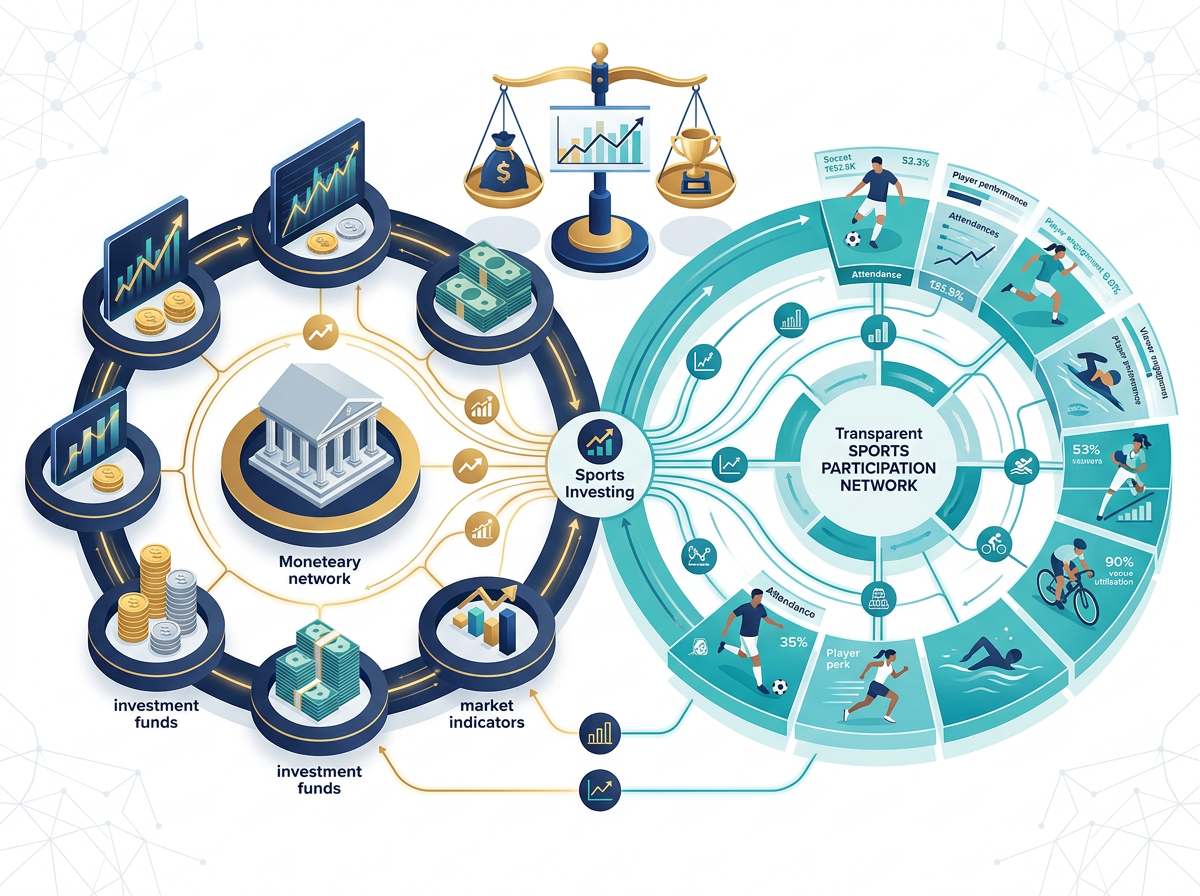
The previous sections argued a structural point: money is an operating system that allocates resources well and measures contribution badly. Sports, meanwhile, already runs a working protocol in which rules are public, performance is recorded, and reputation is earned rather than bought. The open question is whether that protocol can be extended beyond the stadium — whether the signals sports generates can be made portable, comparable, and useful at the scale of an economy. That is precisely the proposition AllSportsMarket (ASM) puts forward. Its claim is not that sports should replace finance, or that money is obsolete. Its claim is narrower and more testable: that the mechanics of sports participation can be turned into a scalable measurement of human contribution, and that this measurement can sit as a layer above monetary systems rather than in competition with them.
To understand the AllSportsMarket ASM proposition concretely, it helps to separate three ingredients that are usually bundled together and left vague. The first is transparent rules: the conditions under which a signal is generated must be visible to everyone, in advance, and applied identically to everyone. The second is measurable performance: what a participant does must produce an observable, recorded outcome rather than an opinion about that participant. The third is earned reputation: standing within the system must accumulate from demonstrated results over time, not from access, inheritance, or purchasing power. Each ingredient exists somewhere in modern life. What is rare is the combination — a single environment where all three operate at once and at scale. Sports is the clearest existing example, which is why ASM treats it as the foundation rather than as an analogy.
The transparency layer is where most reputation systems fail, and where ASM’s design is deliberately conservative. When rules are opaque, a contribution score becomes a black box, and a black box rating is indistinguishable from an unaccountable authority. When rules are public and applied uniformly, the score becomes auditable — anyone can reconstruct how a signal was produced and check whether the same standard was applied to the next participant. This matters for the two currencies model because contribution can only function as a currency if people trust the ledger behind it. A contribution based currency has no central bank to defend it and no legal tender status to force its acceptance. Its only backing is procedural: the confidence that the rules were followed. Transparency is therefore not a feature of the system; it is the collateral.
The measurement layer converts participation into something that can be compared across people and across time. In sports, this is unremarkable — a league table does exactly that. Extended outward, the same logic produces a scalable measurement of contribution: a record of judgment exercised, expertise applied, and participation sustained, expressed in a form that others can read without needing to know the participant personally. This is the part money genuinely cannot do. Money can record that a transaction occurred; it cannot record whether the judgment behind it was sound, whether the participant showed up consistently, or whether their expertise was validated by outcomes. A contribution signal is not a claim about someone’s worth as a human being. It is a narrow, scoped record — closer to a batting average than to a credit score, and useful only within the domain that generated it.
Scope note
ASM’s contribution signals are described here as a measurement layer, not as a replacement for legal tender, banking, or existing financial infrastructure. Claims about future adoption are framed as propositions under exploration. For definitions of terms and the current state of the platform, consult ASM’s official documentation rather than third-party summaries.
The reputation layer is what turns a record into an asset. In a purely transactional system, history evaporates: each exchange starts from zero. In a reputation system, history compounds. Earned reputation changes what a participant can do next — it opens access, attracts collaboration, and makes future signals more legible to others. This is where the connection to an earned reputation marketplace becomes concrete rather than rhetorical. Once reputation is measurable, it can be recognised, compared, and combined with other participants’ reputations. Crucially, it is earned rather than purchased. Money can buy attention, access, and even credibility in many markets, but it cannot buy a record of correct judgment. That asymmetry is the whole point of a second operating system: it measures something the first one is structurally blind to.
What makes the ASM proposition interesting is not any single ingredient but the combination at scale. A transparent rule set applied to millions of participants produces a corpus of measurable performance, which in turn produces earned reputations that can be read by anyone inside the system. That is a scalable measurement of human contribution in the only sense that matters practically: it works the same way for the thousandth participant as for the first, and it does not degrade into subjective endorsement. The output is not a verdict on who is a good person. It is a signal about who has demonstrated what, under rules everyone can inspect.
| What is being measured | How money signals it | How contribution signals it |
|---|---|---|
| Resource allocation | Price, willingness to pay, capital available | Participation recorded under public rules |
| Track record of judgment | Largely invisible; not priced directly | Accumulated outcomes over repeated participation |
| Expertise | Inferred from credentials or marketing | Demonstrated through measurable performance |
| Consistency and participation | Not represented at all | Visible as a sustained record over time |
| Trust | Transferred through brands and institutions | Earned through auditable, repeated behaviour |
| Transferability | Immediate and universal | Scoped to the domain that generated the signal |
Read the right-hand column carefully and a structural point emerges: contribution signals are complementary to money in almost every row. Where money is strong — universal transferability, immediate settlement, price discovery — contribution signals are deliberately narrow and scoped. Where money is weak — track record, consistency, demonstrated expertise unmediated by credentials — contribution signals are precise. This is why ASM frames its role as sitting above monetary systems rather than against them. A layer above does not need to win an argument with the layer below. It needs to supply information the lower layer cannot generate, in a form the lower layer could never produce on its own. The two currencies model follows directly: money continues to do what money does well, and contribution supplies the dimension money has never had.
It is also worth being precise about what ASM is not claiming. It is not claiming that a contribution score should determine access to housing, credit, or legal rights, nor that measurement is frictionless or immune to gaming. Any system that rewards a signal will attract attempts to optimise for the signal rather than for the underlying behaviour — sports has confronted this for as long as it has kept records, which is why transparent rules and audited performance matter more than clever scoring formulas. The proposition is bounded: build the measurement carefully, scope it honestly, and let its usefulness be established by whether people actually rely on it. That is a slower path than a grand claim, and a more credible one.
For readers who want to examine the mechanics in more detail — how the rules are defined, how performance is recorded, and how reputation accrues — the deeper ASM FAQ page is the natural next stop before forming a view. The remainder of this article turns to the larger question those mechanics point toward: what a civilisation running on two currencies, money and contribution, would actually look like in practice, and how individuals can think about their own participation in that shift.
Two Currencies, One Civilization: What Happens Next
The argument of this article arrives at a strange and useful place. Money is not going anywhere. It will keep allocating capital, pricing goods, settling debts, and moving labor across borders. But the case built across the previous sections points toward something more specific than «money is flawed.» It points toward a civilization that eventually runs on two currencies at once: money, which measures and allocates scarce resources, and contribution, which measures and allocates earned trust. Neither one is a replacement for the other. They answer different questions. Money answers «what can this buy?» Contribution answers «who has earned the right to be believed, followed, or relied upon?»
This is what it means to treat sports as a second human operating system rather than an entertainment industry that happens to generate a lot of money. The second system already produces a parallel ledger of outputs — transparent rules, measurable performance, earned reputation, universal participation — and it does so at global scale without waiting for anyone’s permission. AllSportsMarket’s (ASM) proposition is that this parallel ledger can be made explicit, structured, and portable, so that the measurement of human contribution becomes a layer that sits above monetary systems rather than a byproduct buried inside them. That is the future of money worth taking seriously: not a new currency that defeats the old one, but a second currency that finally prices what the first one never could.
What happens next is less dramatic than a revolution and more consequential than a trend. Three shifts are already visible. First, reputation becomes portable and legible outside its native context — the person who has demonstrated judgment in one arena can carry evidence of that judgment into another. Second, participation becomes an asset rather than a cost, because a system that measures contribution rewards the act of showing up with rigor rather than merely consuming. Third, the boundary between earning money and earning trust starts to blur at the edges, because organizations and communities increasingly need both and can only efficiently verify one of them today. None of these shifts requires money to lose its role. Each of them requires a measurement layer that money does not provide.
The practical question for readers is not whether to believe in a fully realized participatory economy tomorrow. It is how to think clearly about the transition while it is still forming. A few habits of mind help. Treat reputation as capital — ask, of any action you take in public, what it does to your verifiable track record, because that record is increasingly the thing others will rely on when money alone is not enough evidence of competence. Treat participation as a skill — the ability to engage consistently, transparently, and within clear rules is measurable and transferable, and it compounds. Treat verification as the crux — any system that claims to measure contribution should be judged by how it makes that contribution checkable by others, not by how flattering its dashboard looks. And treat contribution and money as complementary ledgers — learn to read both, because the people and institutions that will thrive in the next decade are those fluent in the exchange rate between the two.
There is a temptation, when a proposition is this large, to oversell it. The honest version is more disciplined. Sports did not abolish money; it built a second system on top of it, and that second system turned out to be one of the most reliable measurement engines humans have ever invented. ASM’s wager is that the same architecture — transparent rules, measurable performance, earned reputation, universal participation — can be lifted out of the stadium and made into a genuine trust layer currency for a much wider range of human activity. If that wager pays off even partially, the result is not a world without money. It is a world where money is joined by a second, verifiable measure of who has actually contributed, and where that measure becomes a normal input into decisions that today rely on guesswork, credentialism, or sheer institutional inertia. The soft invitation is simply this: watch the second system the way you once learned to watch the first. Learn its rules. Build a record inside it. And judge it by what it can verify.
The central question, restated
What if future civilization runs on two currencies — money and contribution — with contribution functioning as a trust layer above the monetary system rather than a competitor to it? The evidence so far suggests this is less a utopian proposal than a description of a layer that is already half-built.
Frequently Asked Questions
Does this replace money?
No. The proposition examined here is explicitly additive. Money remains the mechanism for allocating scarce resources, settling transactions, and pricing goods and labor. Contribution functions as a supplementary measurement — a trust layer that answers questions money was never designed to answer, such as who has demonstrated judgment or earned the right to be relied upon. The framing of a second human operating system is useful precisely because operating systems coexist with the applications and protocols layered above them.
How is reputation earned in a system like this?
Reputation is earned through demonstrated performance under transparent rules — the same principle that governs sports. It is not granted by title, purchased, or inherited. The measurable outputs of participation form a track record, and that track record becomes the evidence others consult. The key design property, as described in the ASM proposition, is that the rules are visible in advance and the performance is observable afterward, so reputation is a byproduct of verifiable activity rather than of status or affiliation.
Is participation verifiable?
Verifiability is the load-bearing requirement, not an afterthought. A system that claims to measure human contribution must make that contribution checkable by parties other than the participant. The sports prototype is instructive here: results, records, and standings are public, comparable, and subject to scrutiny, which is why they are trusted. Any contribution-based layer that wants to function as a trust layer currency must meet the same bar — visible rules, observable inputs, and a record that others can audit. Editor’s note: specific verification mechanics should be confirmed against current ASM documentation before publication.
What stops people from gaming the system?
The same things that limit gaming in sports: transparent rules, observable performance, and the fact that a track record is long-lived and cross-referenced. Gaming a single outcome is possible in any system; sustaining a fraudulent record across time, under public scrutiny, is far harder. The structural defense is not secrecy but exposure — the more visible the rules and the record, the more expensive manipulation becomes. That is also why the design of the rules matters more than the design of the interface, and why any evaluation of a contribution measurement system should start with its rulebook rather than its marketing.
Editor’s SEO note: the target keyword «second human operating system» should appear naturally in the H2, the opening paragraph, and at least one additional heading or callout, while the secondary keywords for this section — future of money, contribution and money, participatory economy, trust layer currency — should each appear once or twice in organic prose. Do not force repetitions to hit a density target; the section already carries the terms in context. Verify any ASM-specific verification or rule mechanics against current documentation before publishing, and keep the FAQ answers free of claims not supported by the approved materials.
Leave a Reply