Contents
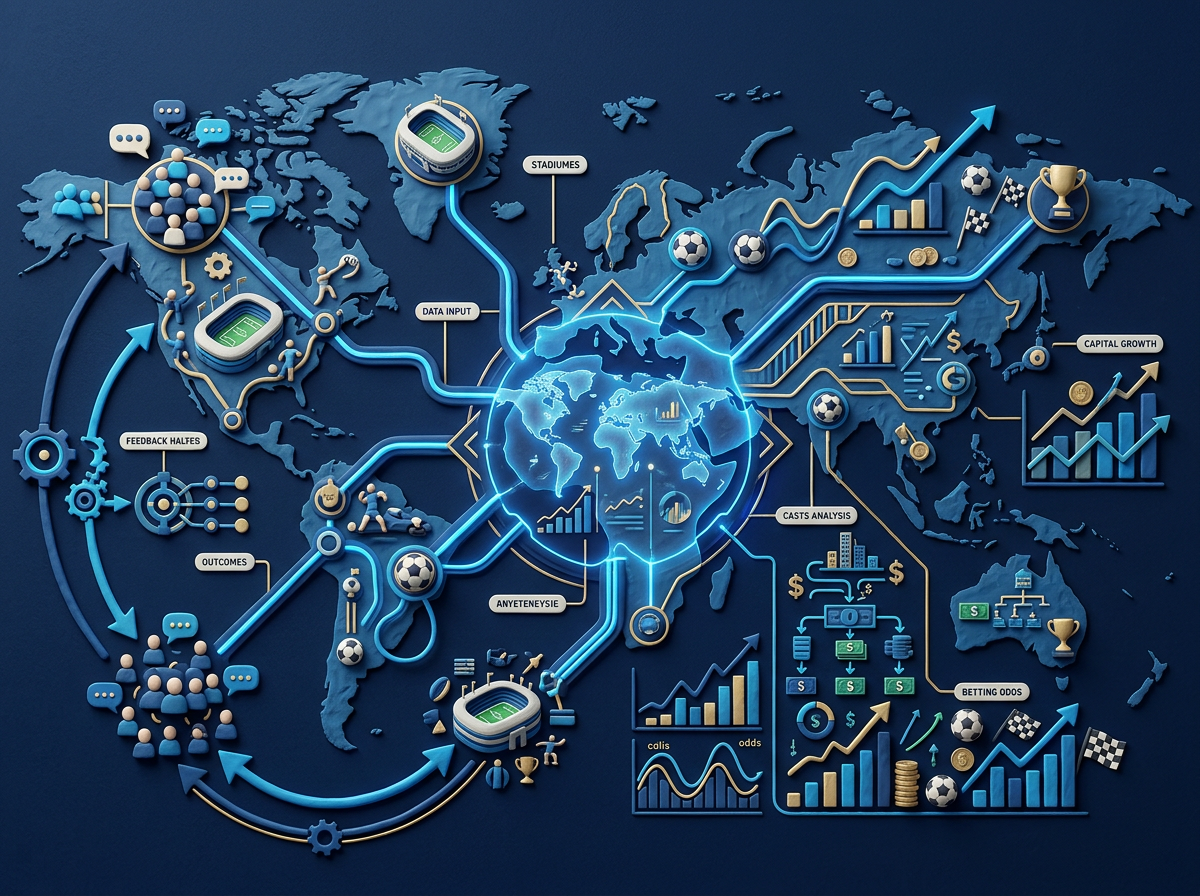
Collective intelligence is the idea that many minds, properly connected and scored, can think better than any single expert — yet our institutions rarely harness it. Human beings are smart; civilizations, strangely, often are not. This article asks whether AllSportsMarket could evolve into a planet-sized intelligence layer built not from machines but from networked human judgment. What if the next intelligence explosion comes not from AI, but from connecting human judgment at scale?
Why Smart People Still Produce Foolish Societies
Human beings are extraordinarily smart. Civilizations, strangely, often are not. This is the central paradox of our era: we have more information, more data, and more analytical tools than at any point in history, yet societies still repeat costly mistakes—collapsing on problems that were visible years in advance, funding the wrong priorities, and ignoring warnings that later look obvious in hindsight. The gap between individual intelligence and collective intelligence is one of the most expensive gaps in the world.
This article is about closing that gap. It explores a specific, audacious idea: that a platform like AllSportsMarket could evolve into something resembling a collective intelligence layer for humanity—not artificial intelligence, not machine intelligence, but human intelligence networked at planetary scale. To understand why that possibility is worth taking seriously, we first need to sit with the problem it would solve. Why do smart people so reliably produce foolish outcomes when they act together?
The Information Paradox: More Data, Worse Decisions
Consider how often the failure is not one of ignorance but one of aggregation. The warning signs of a financial crisis typically exist in scattered form across thousands of desks before the crisis hits. Experts see pieces of the picture. Analysts model the risks. Journalists report the anomalies. Yet the system as a whole fails to act on what its members collectively know.
The same pattern appears in public health, infrastructure planning, and institutional governance. The knowledge exists. The coordination does not. We tend to assume that better data will fix bad decisions, but history suggests otherwise: abundance of information without a mechanism for aggregating judgment often produces more noise, not more wisdom.
Four Reasons Groups Fail Even When Individuals Are Sharp
- Incentives reward confident narratives, not accuracy. In most institutions, the person who is loudly wrong and later promoted fares better than the person who was quietly right and ignored.
- Information stays siloed. Observations live in separate departments, countries, and disciplines, with little incentive or infrastructure to connect them.
- Feedback loops are slow or absent. When no one keeps score of who predicted what, bad judgment carries no cost and good judgment earns no compounding advantage.
- Social pressure overrides independent signals. Group decision making tends to converge on the most socially safe answer rather than the most accurate one—a dynamic researchers often describe as groupthink.
Notice what these four failures have in common. None of them is a failure of raw human intelligence. All of them are failures of architecture—of how judgment is collected, weighted, recorded, and rewarded. That framing matters, because architectures can be redesigned.
The Wisdom of Crowds Is Real—But Conditional
The good news is that human groups can, under the right conditions, be remarkably accurate. The classic insight behind the wisdom of crowds is that independent estimates, aggregated properly, often outperform individual experts. Ask a large, diverse group to guess a value, and the errors tend to cancel out while the signal survives.
But the wisdom of crowds is not automatic. It tends to hold when four conditions are met: diversity of opinion, independence of judgment, decentralization of knowledge, and a mechanism for aggregating individual estimates into a collective result. Remove any one of these and the crowd can become a cascade, a bubble, or an echo. Much of institutional failure is simply the wisdom of crowds operating without its enabling conditions.
The Core Insight
Societies do not fail because their people are unintelligent. They fail because they lack architectures that turn distributed human judgment into accountable, aggregated, continuously updated decisions. The question is not whether people are smart enough. It is whether the system is structured to learn.
Why This Problem Is Getting More Urgent, Not Less
For most of history, slow collective learning was survivable. The pace of change was gentle enough that a society could afford to learn from its mistakes across generations. That buffer is gone. Technological change, financial interconnection, and global-scale risks now move faster than most institutions can update their models of the world.
Meanwhile, the consequences of collective error have grown. A mispriced risk can now propagate across continents in hours. A misjudged public priority can lock in decades of wasted capital. The cost of the intelligence gap—between what we collectively know and what we collectively decide—has scaled up dramatically.
The Tempting but Incomplete Answer: Smarter Machines
The prevailing response to this gap is to demand more artificial intelligence. Let models read everything, then let models decide. There is real value in that direction, and no serious person dismisses it. But it is worth noticing what it leaves out: the distributed, situated, constantly updated knowledge that lives in millions of human minds and nowhere else.
Machines can process what has been written down. They struggle to capture what people are observing right now—the local anomaly, the emerging trend, the domain expert’s intuition, the practitioner’s sense that something has quietly changed. That knowledge is real and valuable, but it is scattered across a planet of individuals with no shared mechanism to contribute it, score it, and compound it over time.
A Different Question: What If the Intelligence We Need Already Exists?
This is where AllSportsMarket enters the story. Its vision is not to build a better model but to build a better network—a continuously learning global system in which millions of participants contribute observations, analysis, expertise, forecasts, and performance records, and in which those contributions are scored, compared, and compounded.
That is a fundamentally different bet. It assumes the next intelligence explosion may come not from making machines smarter, but from connecting human judgment at scale—from giving distributed human intelligence the architecture it has always lacked.
The rest of this article takes that bet seriously. We will define precisely what collective intelligence means and how it differs from artificial and machine intelligence. We will examine the precedents—the internet, prediction markets, open-source software, Wikipedia, and scientific collaboration—to see what each one proved and where each falls short. Then we will translate the AllSportsMarket vision into a practical model and ask the question that matters: can this become a planet-sized intelligence?
The paradox at the top of this section is not a reason for despair. It is a diagnosis. Smart people produce foolish societies when their judgment is never properly aggregated, scored, or connected. The natural follow-up is whether that is a permanent condition of human organization—or merely a missing piece of infrastructure.
Key Takeaways from This Section
Individual intelligence is abundant; collective intelligence is scarce because of architecture, not ability. Failures of group decision making trace back to misaligned incentives, siloed information, absent feedback, and social pressure. The wisdom of crowds works only under specific conditions—diversity, independence, decentralization, and aggregation. The next section defines collective intelligence precisely and separates it from artificial intelligence.
What Collective Intelligence Actually Means
The phrase collective intelligence gets used loosely, often as a synonym for «a lot of people talking online» or «the internet being smart.» That looseness is a problem, because the concept is precise, useful, and genuinely different from the things it is usually confused with. Before we can ask whether AllSportsMarket could become something like a planet-sized intelligence, we need a working definition that survives contact with reality.
Here is the definition this article will use. Collective intelligence is the capacity of a group to produce judgments, forecasts, or solutions that are better than what any single member could produce alone, and that improve over time as the group learns. Three parts of that sentence matter. Better than any single member — not merely the average of many voices, butsomething that exceeds individual performance. Judgments and forecasts — outputs that can be checked against what actually happens. And improve over time — a learning loop, not a one-time tally.
Notice what is missing from that definition: software, algorithms, and machines. Collective intelligence is a property of people and their interactions. Tools can support it, measure it, and accelerate it, but they are not the intelligence itself. A filing cabinet does not become smart when it holds a million documents.
It Is Not Artificial Intelligence
The most common mistake is to treat collective intelligence as a cousin of artificial intelligence. The two are different in kind, not just in degree.
Artificial intelligence is a system that produces outputs from models and data. Its knowledge is frozen at the moment of training and only moves forward when someone builds a new version. It has no skin in the game, no track record of being right or wrong in public, and no continuous stream of lived observation from the world it is commenting on. It can be extraordinarily useful. It is not a network of human judgment.
Collective intelligence, by contrast, is human intelligence networked at planetary scale. Its raw material is what millions of people notice, calculate, experience, and predict. Its quality depends on how those contributions are aggregated, scored, and fed back. When we say a market or a community «knows» something, we are describing an emergent property of human judgment under the right conditions — not the operation of a machine.
This distinction is not semantic. It changes what you build. If collective intelligence were a machine problem, the answer would be bigger models and better chips. Because it is a human problem, the answer is better mechanisms for connecting, evaluating, and rewarding human judgment. That is a design challenge about incentives and feedback, not about compute.
A Useful Contrast
Artificial intelligence asks: can we build a mind? Collective intelligence asks: can we build the conditions under which many minds, connected and scored, think better together than they would apart? The first question is about machinery. The second is about human judgment at scale.
The Four Mechanisms That Make a Crowd Intelligent
A crowd is not automatically intelligent. Anyone who has watched a comment section knows that aggregation alone produces noise, not insight. Real collective intelligence requires four mechanisms working together. When one is missing, the system degrades into something much less useful.
- Contribution — a way for many participants to supply observations, analysis, expertise, or forecasts. Diversity of input matters: people with different information, backgrounds, and perspectives. A group of identical forecasters is one forecaster repeated many times.
- Aggregation — a method for combining contributions into a single signal. This can be a simple average, a weighted average, a market clearing price, an editorial process, or a ranked consensus. The method determines how much each voice counts.
- Feedback — a loop in which outcomes are compared to forecasts and the results return to participants. Without feedback, no one learns and the group cannot improve. Feedback is what turns a snapshot into a system.
- Performance records — durable, visible histories of who was right and wrong, so that credibility is earned rather than asserted. Reputation is the currency that lets the system weight contributors sensibly over time.
These four mechanisms are the skeleton of every functioning collective intelligence system ever built, from a scientific peer review process to an open-source project to a well-run prediction market. The differences between systems lie in how each mechanism is implemented, and in how well the pieces reinforce one another.
A Mental Model: The Scored Conversation
A simple mental model helps. Imagine the world’s largest conversation, in which every claim anyone makes is attached to a forecast, every forecast is later checked against reality, and every participant carries a visible, continuously updated record of accuracy. Now imagine that conversation never ends, is open to anyone, and rewards people for being right about things that matter.
That is not a fantasy of perfect prediction. It is a description of what collective intelligence looks like when the four mechanisms are engineered properly. The conversation produces a signal — not just opinions, but calibrated expectations that can be used by anyone who needs to know what is likely to happen next.
The phrase «scored conversation» is deliberate. Unscored conversation is what most of the internet produces today: vast, liquid, and almost entirely without accountability. Scoring changes behavior. When your name and your track record are attached to a claim, you think harder before making it. Multiply that effect across millions of people and you have described a mechanism by which networked human judgment could become something genuinely more than the sum of its parts.
What a Global Forecasting System Would Look Like
Fasten that definition to a concrete vision. A global forecasting system — the kind the AllSportsMarket model points toward — would have a recognizable anatomy:
- An open field of participants, from casual observers to domain specialists, each able to contribute to questions they actually understand.
- A shared, continuous stream of questions and events, so the system is always learning about something current rather than retrospective.
- An aggregation mechanism that converts many individual judgments into a continuously updating consensus, weighted by demonstrated skill rather than volume or seniority.
- A scoring layer that resolves forecasts against real outcomes and publishes accuracy records, so credibility is earned and portable.
- A feedback loop that routes those results back to participants — improving individual calibration and, over time, the quality of the whole network.
Note how much of this is about infrastructure for judgment rather than about raw intelligence. The system does not need to be on average smarter than a single expert. It needs to be able to identify, weight, and amplify the participants who are consistently right, while keeping everyone else in the game and learning. That is the fundamental architecture of collective intelligence: not a chorus of equal voices, but a self-correcting network with memory.
A Practical Example You Already Understand
Consider how you personally estimate whether a friend will actually show up to the dinner they promised to attend. You do not consult a model. You consult a running record: they said they’d come last month and didn’t; they texted twice to confirm this week; they are usually reliable when they care about something. Your judgment is the product of observation, memory, and feedback from past outcomes. That is a small, human-scale demonstration of exactly the four mechanisms above — contribution (their signals), aggregation (your synthesis), feedback (what actually happened), and performance record (your memory of their behavior).
Now scale that logic. Replace your one memory with millions of participants keeping each other calibrated. Replace your vague hunch with a published accuracy score. Replace a single dinner with thousands of questions about places, economies, events, and outcomes. The mechanism is the same; only the scale and the rigor change. That is what turns a familiar human activity into a planet-sized forecasting system.
The AllSportsMarket Frame: Human Intelligence, Networked
Here is where the AllSportsMarket vision belongs in this conversation. It is not a plan to build artificial intelligence. It is a model for networked human judgment: a continuously learning global system in which millions of participants contribute observations, analysis, expertise, forecasts, and scored performance records. The intelligence lives in the people. The system supplies the contribution channels, the aggregation, the feedback, and the performance records — the four mechanisms that turn a crowd into a collective brain.
That framing matters because it sets honest expectations. A network of human judgment is not omniscient. It is not a replacement for expertise, and it will not make every question easy. What it can do is make the accumulated judgment of many humans visible, weighted, and improvable — and that is already something no single institution, no single expert, and arguably no single model can offer at planetary scale.
The Distinction in One Line
Artificial intelligence builds a mind from data. Collective intelligence builds a learning network from human judgment, scored and fed back against reality. AllSportsMarket belongs to the second category: human intelligence networked at planetary scale, not machine intelligence standing in for it.
With the definition clear, the natural next question is whether this has ever worked before. It has — in fragments. The internet, prediction markets, open-source software, Wikipedia, and scientific collaboration each solved a different piece of the puzzle. The next section examines what each of them proved, and where each one still falls short of a planet-sized brain.
The Precedents: What the Internet, Prediction Markets, Wikipedia, and Open Source Already Proved
The idea of a planet-sized intelligence is not a fantasy with no track record. It is an extrapolation from systems we already use every day. Before asking whether AllSportsMarket can become a learning layer for humanity, it is worth examining what earlier attempts at networked human judgment actually achieved — and, just as importantly, where each one broke down. The goal here is not cheerleading. It is diagnosis. Each precedent below teaches one specific lesson that a collective intelligence project can apply, or one failure mode it must overcome.
We will look at five precedents: the internet, prediction markets, open-source software, Wikipedia, and scientific collaboration. They differ enormously in structure, incentive, and scale, but they share a common thread: each proved that distributed human effort can outperform centralized authority under the right conditions. Each also revealed the limits of that claim when conditions change.
The Internet: Connection Without Judgment
The internet is the foundational precedent, because it proved the raw infrastructure case: you can connect billions of humans at near-zero marginal cost to publish, respond, and coordinate. No prior technology allowed so many people to contribute observations and arguments to a shared pool so quickly. In that sense, the internet is the substrate on which any collective intelligence layer must sit.
But the internet also delivered the single most important warning. Connection is not the same as judgment. The same network that distributes Wikipedia also distributes misinformation at the same speed. Volume of contribution is not quality of contribution. The internet solved the plumbing problem and left the epistemic problem untouched.
Lesson from the internet
Connectivity is necessary but not sufficient. Any collective intelligence system must include mechanisms that separate signal from noise, not just channels that carry both.
This is precisely where a scored, accountable system differs from an open feed. The internet lets anyone speak. It does not tell you who has been right. A collective intelligence layer must add that missing element: a persistent, verifiable record of judgment quality.
Prediction Markets: Prices as Forecasts
Prediction markets are the closest structural precedent to what AllSportsMarket is building. The core insight of prediction markets is that when participants put something at stake on a forecast, the resulting prices aggregate dispersed information into a single number that often tracks outcomes better than polls, pundits, or expert panels. This is the wisdom of crowds made measurable and tradable.
The strength of prediction markets is accountability through skin in the game. Participants cannot opine costlessly. A forecast has a price, and being wrong has consequences. That pressure tends to pull informed participants toward the center and push uninformed noise out of the signal.
The weaknesses are equally instructive. Prediction markets are typically episodic — they resolve a question and move on, so learning does not compound across questions for the individual participant in a durable, portable way. They can be thin and illiquid on niche questions, meaning small numbers of participants drive prices. They can be gamed or manipulated when volumes are low. And they are often organized around discrete events rather than the continuous, iterative observation of an ongoing domain.
| Strength | Limitation |
|---|---|
| Aggregates dispersed information into a measurable signal | Often episodic; learning does not compound across questions |
| Skin in the game filters out careless opinion | Thin markets can be dominated by few participants |
| Outperforms many traditional forecasting methods | Susceptible to manipulation at low volume |
| Prices update continuously as information arrives | Usually confined to discrete, resolvable events |
Lesson from prediction markets
Incentives and accountability sharpen the wisdom of crowds. But a one-off market is a snapshot. A collective intelligence system must make performance continuous and cumulative.
AllSportsMarket sits in this lineage but extends it. Rather than single events that resolve and disappear, the underlying domain — sports outcomes, analysis, and forecasting performance — is continuous. Participants can build a track record over time, which is the raw material any learning system needs.
Open-Source Software: Distributed Production That Ships
Open-source collaboration is the strongest existing proof that loosely coordinated strangers can build complex, reliable systems at global scale. Operating systems, web servers, and entire programming ecosystems are maintained by distributed contributors who often never meet. The lesson is that open-source collaboration solved not just contribution but governance: version control, review processes, maintainer roles, and transparent history.
That last element deserves emphasis. Open-source projects work because they keep an auditable record of who changed what and why. Contribution is open, but it is also attributed and reviewable. Quality emerges from the review layer, not from the openness alone.
Where open source falls short as a model for collective intelligence is in its scope. Open-source collaboration produces artifacts — code, documentation, standards. It does not, by itself, produce forecasts about the future. It tells you what a community can build together; it does not tell you what a community expects to happen. It also struggles with contributor burnout and governance disputes, reminders that distributed systems still need maintenance and coordination.
Lesson from open source
Open contribution works when paired with transparent attribution and review. A collective intelligence system needs the same auditability applied to judgment, not just to artifacts.
Wikipedia: The Mass Encyclopedia
Wikipedia is the most visible demonstration that a crowd can assemble and maintain a large body of factual knowledge. It proved that decentralized editing, combined with norms and edit history, can produce reference material comparable in reach to professionally produced encyclopedias. For the collective intelligence argument, Wikipedia is proof of concept that millions of small contributions can add up to something genuinely useful.
Its mechanism is instructive: transparent edit history, discussion pages, and community norms. Anyone can contribute, but everything is visible and revisable. Errors are corrected because the record is open to scrutiny.
The limitation is structural. Wikipedia summarizes what is already known and cited. It is excellent at consolidation and weak at forecasting. It tells you what the sources say; it does not generate new predictions or score the judgment of contributors. An editor who is consistently insightful about a domain has no measurable performance record beyond the edit history itself. Wikipedia aggregates knowledge, not judgment.
Lesson from Wikipedia
A crowd can maintain knowledge at scale when the record is transparent. But aggregation of facts is not the same as aggregation of predictive judgment. Scoring is the missing ingredient.
Scientific Collaboration: Peer Review and Cumulative Error Correction
Scientific collaboration is the most rigorous precedent. It is a centuries-old distributed system built on publication, replication, peer review, and cumulative citation. Its great strength is error correction over time: claims are tested, challenged, and either reinforced or retired. Scientific collaboration demonstrates that a global community, given shared standards and adversarial review, can build reliable knowledge that no individual could produce alone.
It also shows how slowly that process can move and how imperfectly it can run. Peer review can be slow and conservative, replication is often neglected, publication incentives can reward novelty over accuracy, and specialized expertise can create blind spots. The system’s rigor is real, but its throughput is limited by institutional gatekeeping.
Lesson from scientific collaboration
Adversarial review and cumulative record-keeping produce reliable knowledge. But institutional gatekeeping limits speed and access. A collective intelligence layer should borrow the rigor while lowering the barrier to entry.
What the Precedents Have in Common
Read together, these five precedents point to a consistent set of design principles. First, distributed participation can outperform centralized authority — but only when the right mechanisms are present. Second, transparency and attribution are non-negotiable; every successful system keeps an auditable record. Third, incentives matter: prediction markets showed that accountability sharpens judgment. Fourth, aggregation without scoring produces knowledge but not forecasts. Fifth, none of these systems was designed to continuously score and compound individual human judgment over time.
- The internet proved connectivity at scale but not judgment quality.
- Prediction markets proved that incentives sharpen forecasts but are usually episodic.
- Open-source collaboration proved distributed production works when contribution is attributed and reviewed.
- Wikipedia proved crowds can maintain knowledge but aggregates facts, not scored judgment.
- Scientific collaboration proved cumulative error correction works but is slowed by gatekeeping.
Where AllSportsMarket Fits — and What It Must Solve
AllSportsMarket’s vision inherits from all five. From the internet it takes planetary reach. From prediction markets it takes incentives and accountability. From open-source collaboration it takes transparent, attributed contribution. From Wikipedia it takes the idea of a continuously maintained shared record. From scientific collaboration it takes cumulative error correction through scored performance.
What makes the AllSportsMarket proposition distinct is the combination: a continuously learning global system where millions of participants contribute observations, analysis, expertise, forecasts, and performance records, and where those records accumulate rather than reset. That is the gap the precedents leave open. Prediction markets score bets; Wikipedia scores nothing; open source scores code review; science scores publications. None of them produces a portable, continuously updated record of human forecasting judgment at planetary scale.
The hard problems should be stated plainly rather than glossed over. Any system that aggregates human judgment must contend with manipulation at low volume, the same problem prediction markets face. It must design scoring that rewards genuine accuracy rather than luck. It must keep the record transparent enough to be trusted and robust enough to resist gaming. It must sustain participation over time rather than relying on novelty. And it must remain a system of human intelligence networked together — not a machine that quietly replaces the humans.
The central comparison
Every precedent proved that networked human effort beats isolated human effort under the right conditions. None of them built a continuously learning, scored record of human judgment at planetary scale. That is the specific gap AllSportsMarket is attempting to fill — and the specific test it must pass.
With that map in hand, the next question is practical: what would a system built on these lessons actually look like in operation, and how could it become a learning layer rather than just another platform? That is the subject of the next section.
How AllSportsMarket Could Become a Learning Layer for Humanity
The previous sections argued that human intelligence is powerful when networked and that history offers several working precedents. This section turns the idea into mechanics. How would a collective intelligence platform actually function day to day? What does a single participant contribute, and how does that contribution become part of something larger? The answer is less mysterious than it sounds. It comes down to five inputs, one scoring loop, and a record that never disappears.
The Five Inputs: What Participants Actually Contribute
Most platforms collect one kind of contribution. Social networks collect opinions. News sites collect attention. A functioning global forecasting system needs more depth than any of these. AllSportsMarket’s vision rests on five distinct inputs, each of which strengthens the others.
- Observations — what a participant actually sees. A pattern in how a team performs after travel. A change in a schedule. A data point nobody else has flagged. Observations are raw material.
- Analysis — the reasoning built on top of observations. This is where expertise enters. A participant who understands a domain can explain why a pattern matters (or why it is noise).
- Expertise — specialized knowledge contributed directly. Someone who has followed a league for two decades knows things that are difficult to look up. That knowledge becomes valuable once it is expressed as a forecast others can see.
- Forecasts — explicit predictions with a clear outcome. Not vague statements. A forecast stakes a position and creates something that can later be checked against reality.
- Scored performance records — the result of every prior input, measured against what actually happened. This is the connective tissue. Without it, the other four inputs are just content.
The first four inputs look familiar. They describe a forum, a research community, or a newsroom. The fifth input changes the system entirely. It converts participation from expression into a track record.
The Core Insight
Removing the score removes the signal. Accountability is what separates a global forecasting system from a very large comment section.
The Loop: How One Forecast Becomes Part of a Larger Signal
A collective intelligence system is a loop, not a library. Each stage feeds the next. Walk through a single user’s journey and the larger mechanism becomes visible.
- A participant forms a view — say, about how a team will perform — based on observations and analysis, possibly informed by domain expertise.
- The participant records a forecast. It is public, specific, and tied to an outcome.
- The outcome occurs. The system scores the forecast on accuracy rather than confidence or volume.
- The score updates the participant’s performance record, which is visible to others.
- Other participants see the record. Some follow the forecasters with strong histories. Others use weak records as useful counter-signals, since being consistently wrong in a predictable way is itself information.
- The aggregate of thousands of scored forecasts generates a higher-level reading — an ongoing signal of what the network believes and how much confidence that belief deserves.
- As participants see how their forecasts performed, they adjust. Better methods propagate. The network learns without anyone programming it to learn.
This is the practical meaning of a continuously learning system. Nothing in the loop requires artificial intelligence. The learning happens in people, but so does the accounting. Networked human judgment at scale works when judgment comes with memory.
Why Performance Records Are the Real Differentiator
Every medium we surveyed in the previous section falls short in the same way: none carries permanent, outcome-tested accountability for claims. A widely shared post leaves no verified trace of whether its author was right. A forecast in a conversation vanishes. A contributor to an open project is judged by what shipped, which is admirable, but that is a small sliver of human knowledge. Performance records fill this gap in three ways.
- Memory — a scored history cannot be quietly edited. A participant’s reputation is cumulative and earned over time.
- Selection — good forecasters surface on their own terms. No editor or algorithm needs to decide who deserves attention. The record decides.
- Calibration — over a large population, the gap between stated confidence and actual accuracy becomes visible. A network that knows which of its members are well-calibrated is a smarter network than one that does not.
The combination matters more than any piece. Someone can be a sharp analyst and still be poorly calibrated. Someone can be well-calibrated and have no expertise. The performance record shows both, and the network can weigh each contributor according to what the evidence says.
From Many Forecasts to One Reading
Individual contributions are useful, but the higher-level goal is aggregation. Here is where a collective intelligence platform differs from a scoreboard. The question is not only who is good, but what the whole network is converging on, and how that convergence should be interpreted.
Aggregation can be done in layers. At the first layer, any single forecast carries weight proportional to its author’s track record. At the second, clusters of forecasts on the same question can be read as a distribution — not just a single number, but a sense of disagreement. Disagreement is informative. A question where the network is evenly split is a question where even the best participants are uncertain, and that fact is itself worth broadcasting.
At the third layer, patterns across many questions can reveal what the network is systematically better at predicting and where it tends to fail. This is the beginning of genuine meta-learning: not what the network knows, but what it knows about its own knowledge. That is a step that even well-run institutions rarely take.
A Useful Mental Model
Think of it as a weather system rather than a weather report. The reading is always provisional, always updating, and its value comes from the constant flow of new observations through the same accounting machinery.
Objections Worth Taking Seriously
A reasonable reader has doubts. So does a reasonable writer. Two objections deserve a direct answer rather than a deflection.
Objection One: A Sports Market Is Too Narrow to Matter
Why call a system centered on sports a learning layer for humanity? The honest answer is that scope is not the same as significance. Domains where outcomes are frequent, unambiguous, and consistently recorded are precisely the domains where a new mechanism can be tested honestly. Sports has those properties in abundance. The method that succeeds there is a demonstration, not a ceiling. If networked human judgment with scored accountability works in an environment where correctness is hard to fake, the question of where else it could operate becomes serious rather than speculative. The claim in the prompt is not that AllSportsMarket will govern civilization. It is that the architecture of scored, public, continuously updated forecasting is a general-purpose building block, and the domain where it is first proven is the domain where its claims can be most easily checked.
Objection Two: Score-Chasers Will Game the System
Any system with a visible score invites people who want to game the score. That is real, and it is not unique to forecasting systems. What matters is whether the system rewards the right behavior. A performance record measured against real outcomes is difficult to game by rhetoric. You cannot talk your way to an accurate forecast. The strategy most likely to produce a strong record is the one the system wants: careful observation, honest analysis, and calibrated confidence. Gaming a system that grades outcomes is a fundamentally harder project than gaming a system that grades engagement.
What the Learning Layer Would Look Like in Practice
To make this concrete, imagine the system operating over a period of months. Participants contribute observations and forecasts continuously. Some are specialists with deep knowledge of a narrow domain. Some are generalists who bring context from elsewhere. Some are newcomers whose records are blank until their first forecasts are scored.
Over time, the layer produces several things at once. It produces forecasts, but more importantly it produces a structured record of which participants’ forecasts are likely to be worth attending to. It produces disagreement maps, showing where the network’s confidence is weak. It produces evidence about what kinds of reasoning succeed and what kinds fail. And it produces a community in which the primary currency is accuracy rather than attention.
| Layer | What It Does | Who Benefits |
|---|---|---|
| Individual record | Scores each participant’s forecasts against outcomes | Participants building a verified reputation |
| Aggregate signal | Combines scored forecasts into a weighted reading | Anyone needing a calibrated collective view |
| Meta-learning | Identifies what the network is good and bad at predicting | The system itself, which adjusts over time |
| Community norms | Rewards accuracy over rhetoric | Everyone whose contribution is judged on substance |
None of these layers requires a new technology. The pieces are familiar: public forecasts, reliable outcomes, and transparent scoring. What is new is the combination held together at scale, continuously, with accountability built in rather than bolted on.
The Gap This Fills
Our society has more information than ever and no reliable mechanism for turning that information into accountable judgment. The problem is not access. It is structure. Information without accountability is noise. Accountability without scale is anecdote. A global forecasting system proposes a middle path: the scale of the internet, the rigor of a prediction market, and the openness of an open-source project, bound together by one thing none of them fully delivers — a permanent, outcome-tested record for every contributor.
That is the practical case for a learning layer. Not that humans suddenly become smarter, but that our intelligence gets networked, scored, and remembered. The final section asks whether that combination could be the next intelligence explosion — and whether it is worth building regardless of the answer.
The Next Intelligence Explosion May Be Human
Every era of exponential progress has a source. Steam came from pressure. Electricity came from the grid. The digital age came from silicon and networks. Each time, the leap was not a smarter tool so much as a better way to organize energy, information, or people. The current assumption is that the next leap will come from artificial intelligence. That may be half the story.
The other half is quieter, slower, and far less funded: connecting human judgment at scale. This is the promise of collective intelligence — not a machine that thinks for us, but an infrastructure where millions of people think together, are scored fairly, and are rewarded for being right.
The question is no longer whether this is technically possible. The internet, prediction markets, Wikipedia, and open-source communities already proved it is. The question is whether a platform like AllSportsMarket can take those scattered proofs and fuse them into a continuously learning layer — a global forecasting system built from networked human judgment, not code.
The Argument in One Breath
Here is the case that this article has built, compressed into a short chain of logic:
- Individuals are remarkably intelligent; societies often are not. The gap is not a lack of information but a lack of structured ways to aggregate, test, and reward judgment.
- Collective intelligence is precisely that structure: it is human intelligence networked at scale, distinct from artificial intelligence and machine intelligence in its source, its strengths, and its failure modes.
- The precedents already exist. Prediction markets show that crowds can price the future. Wikipedia shows that distributed editors can build enduring knowledge. Open source shows that strangers can collaborate on complex systems. Science shows that peer review and replication can turn opinions into evidence.
- Each precedent is incomplete — markets are narrow, wikis lack scoring, open source has governance friction, science is slow — but together they point toward a composite system that combines forecasting, contribution, reputation, and continuous evaluation.
- AllSportsMarket’s vision is exactly that composite: millions of participants contributing observations, analysis, expertise, forecasts, and measured performance records, all in a loop that learns from its own track record.
If even a fraction of that model works, the result is not another app. It is a public intelligence layer — a place where anyone can contribute a judgment and have it tested against reality, in public, with a permanent record.
Why This Is a Human Explosion, Not a Machine One
Artificial intelligence is accelerating, and no serious observer dismisses it. But AI systems still depend on human judgment for framing, for values, for validation, and for deciding which questions are worth asking. The bottleneck at the frontier is not compute. It is judgment at scale — the ability to gather, weigh, and test millions of human assessments about a messy world.
That is the layer that collective intelligence fills. It is complementary to AI, not competitive with it. A planet-sized system of networked human judgment gives models something they have never had: a continuously updated, publicly scored record of what informed humans expect, why they expect it, and how their expectations performed over time.
The central question
What if the next intelligence explosion comes not from AI alone, but from connecting human judgment at scale — and what if a sports prediction market is the unlikely place where that experiment finally gets its numbers?
What «Planet-Sized» Really Requires
The phrase «planet-sized brain» is a metaphor, and metaphors can hide sloppy thinking. So it is worth being concrete about what a genuine collective intelligence layer would need:
- A common language of performance. Every contribution — an observation, a forecast, an analysis — must be recorded and eventually scored, so the system can tell good judgment from loud judgment.
- Low friction for participation. If contributing requires credentials, capital, or permission, the crowd collapses into a club. The system must let many people in while still surfacing the best.
- Incentives that reward accuracy, not volume. Rewards must track outcomes over time, so that confident-but-wrong voices lose influence and quiet-but-right voices gain it.
- Transparency of track record. A forecast that cannot be checked is an opinion. The permanent, public record is what separates a learning system from a rumor mill.
- Continuous feedback. The system must learn from itself — rewarding successful patterns, correcting failures, and adapting as conditions change.
None of these requirements are science fiction. Each has been demonstrated somewhere, at some scale. The genuine innovation is in combining them.
What It Would Mean to Be «Right» About This
Skeptics are healthy here, and one skepticism deserves a direct answer: crowds can be wrong, and history is full of panics, bubbles, and consensus errors. That is true — and it is exactly why scoring and track records matter. An unstructured crowd is a rumor. A scored crowd is a signal. The difference is the feedback loop.
The honest claim is not that networked human judgment is always correct. It is that it learns. A system that scores every contribution and publicly records outcomes gradually separates the people and patterns that anticipate reality from those that do not. That learning curve — not any single forecast — is the real asset.
Recommended Reading and Further Exploration
For readers who want to go deeper, these are useful and verifiable places to start. They are suggestions, not endorsements, and specific findings should be verified against the original sources before being cited.
- Research on crowd forecasting: the work of Philip Tetlock and colleagues on superforecasting and geopolitical prediction tournaments is the standard starting point for understanding when crowds forecast well.
- Prediction market research and the related literature on information aggregation, which examines how markets reveal dispersed knowledge.
- Open-source collaboration studies, which explore how distributed contributors coordinate on complex projects and where governance breaks down.
- Wikipedia’s own documentation on its editorial processes and quality-control mechanisms, which is a rare public record of a large-scale knowledge system learning in public.
Suggested internal reading on this site: our analysis of prediction markets and how they price the future, our breakdown of open-source collaboration and what it teaches about trust at scale, and our explainer on the wisdom of crowds and where it fails.
Frequently Asked Questions
Is collective intelligence the same thing as artificial intelligence?
No. Collective intelligence is human intelligence networked at scale. Its inputs are human observations, analysis, expertise, and forecasts; its machinery is scoring, transparency, and feedback. Artificial intelligence and machine intelligence are different in kind: they are built from computation and data rather than from networked human judgment. The two can complement each other, but neither is a substitute for the other.
Why would a sports market be a credible place to build this?
Because sports produce something most domains lack: a constant stream of objective, timely, and widely observed outcomes. That gives a scoring system something to grade against. A contribution about a game, a player, or a season can be judged against what actually happens, quickly and publicly. That feedback speed is what allows a system to learn rather than merely accumulate opinions.
Does a high score guarantee that a participant will be right next time?
No, and any honest collective intelligence system should say so. Scoring tracks past performance; it does not guarantee future accuracy. The value is statistical: over many contributors and many predictions, scored records separate more reliable judgment from less reliable judgment. Individual forecasts remain uncertain.
What is the biggest risk to this idea?
Two risks stand out. First, a crowd that is not scored and accountable can behave like a rumor mill rather than an intelligence. Second, participation can narrow if access is restricted, which shrinks the very diversity that makes crowds wise. The design challenge is to combine openness with rigorous, public measurement of performance.
The Takeaway
Human beings are smart. Civilizations are often not. The gap between the two is not a shortage of talent or data — it is a shortage of infrastructure for turning individual judgment into collective learning.
The internet connected us. Prediction markets taught us to price the future. Wikipedia showed us that strangers can build knowledge together. Open source proved that distributed collaboration can produce complex, reliable systems. Science gave us the discipline of testing claims against evidence. None of those systems is complete. Each solved one piece of the puzzle.
A planet-sized intelligence would be the system that assembles the pieces: open participation, public scoring, permanent track records, and continuous feedback. AllSportsMarket’s vision is a serious attempt at that assembly, beginning where outcomes are frequent and measurable.
It may not look like a brain. It will look like millions of people making forecasts, contributing analysis, and being graded by reality. But that is what collective intelligence has always looked like — human judgment, networked, measured, and allowed to learn.
A question worth sitting with
If the next intelligence explosion is human, then the most important infrastructure project of the coming decade is not a bigger model. It is a better way to connect, score, and reward human judgment at scale. The experiment has already begun.
Leave a Reply